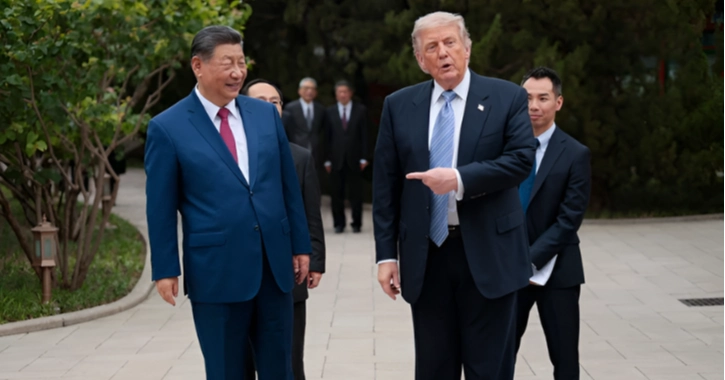
US President Donald Trump’s three-day visit to China featured limited public interaction but wide-ranging discussions on Taiwan, trade, Iran and a possible new framework for managing US-China relations.
Trump remained largely silent before reporters and mostly stayed off social media during the trip, but he spoke extensively after boarding Air Force One on his return journey.
Chinese President Xi Jinping warned at the start of the visit that mishandling Taiwan, the self-governed island claimed by Beijing, could trigger confrontation or even open conflict between the United States and China. Trump did not comment publicly on Taiwan while in Beijing but later said Xi’s objections could influence his view on a previously approved US arms sale to Taipei. He said he had not yet made a decision and stressed the importance of avoiding a distant war, while also referring to Washington’s policy of strategic ambiguity on military intervention.
Explainer: What is the Thucydides trap, and how does it apply to the US-China relationship?
On trade, Trump said discussions included potential major deals, including Boeing aircraft purchases, but no concrete agreements were announced. He suggested China could buy up to 200 planes initially, with larger future orders possible.
The leaders also discussed the conflict in Iran. Trump said Xi agreed that a nuclear-armed Iran is unacceptable and supported reopening the Strait of Hormuz, though Beijing has not confirmed this. China said both sides agreed on a new “constructive China-US relationship of strategic stability” to guide ties for the remainder of Trump’s term.
Despite limited outcomes, Trump repeatedly praised Xi as a “great leader.”