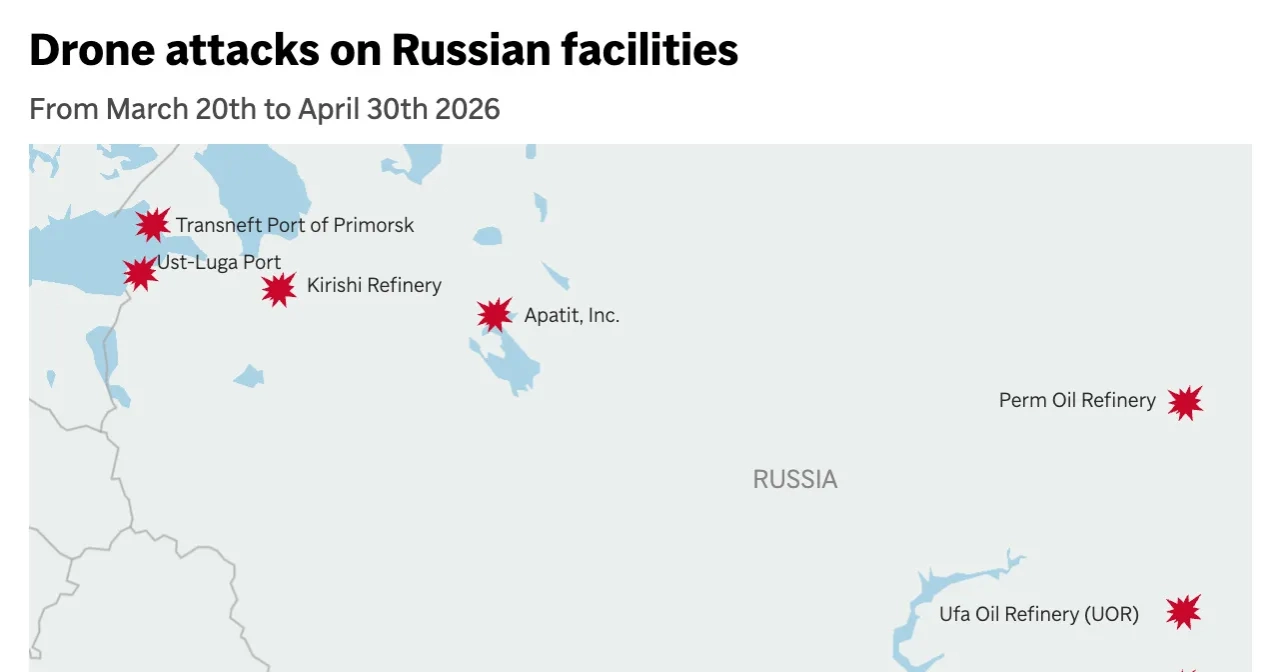
Ukrainian drones are targeting oil facilities deep inside Russia, causing large fires, smoke visible from space and pollution affecting areas along the Black Sea coast.
The attacks are aimed at cutting Russia’s oil exports, a major source of funding for its ongoing war in Ukraine. However, the overall economic impact remains uncertain, as higher global oil prices linked to the Iran conflict and relaxed US sanctions have helped boost Moscow’s revenues.
Even so, the strikes are bringing the effects of the war closer to ordinary Russians living far from the battlefield.
In the Black Sea town of Tuapse, Ukrainian drones struck an oil refinery and export terminal four times within just over two weeks. The attacks triggered fires, forced evacuations and sent thick smoke into the sky. Tuapse lies about 450 kilometers from the front lines.
After one of the strikes on April 18, local officials reported that burning oil spilled onto nearby streets, damaging vehicles.
Ukraine also said it hit an oil pumping station in Russia’s Perm region, more than 1,500 kilometers from Ukraine, on consecutive days. Russian authorities confirmed drone strikes on industrial sites but gave limited details.
Another major facility at Ust-Luga on the Baltic Sea, one of Russia’s largest oil and gas export hubs, was targeted three times within a week in late March. The site is over 800 kilometers from Ukraine.
Following the attacks, officials near St. Petersburg described the region as a “front-line area” due to increasing aerial threats.
Ukrainian President Volodymyr Zelenskyy said the strikes have caused Russia at least $7 billion in losses since the start of the year. He also cited intelligence reports indicating a drop in exports from key ports such as Ust-Luga and Primorsk.
Experts say the attacks have disrupted refining operations, while sanctions continue to limit Russia’s ability to replace damaged equipment.
However, Russia has also benefited from the global energy crisis. The International Energy Agency said Russian oil exports rose to 7.1 million barrels per day in March, while revenues nearly doubled to $19 billion due to higher prices.
Analysts say the dramatic explosions seen in attacks may not reflect the full level of damage. Strikes on storage tanks often create large fires but cause only temporary disruption, while critical infrastructure such as pumping systems appears to be better protected.
Ukraine’s ability to hit targets deep inside Russia highlights its expanding drone capabilities. Since the start of the full-scale war in 2022, Kyiv says it has significantly increased the range of its strike systems, allowing attacks from multiple directions and putting pressure on Russia’s air defenses.
These operations are also exposing more Russians to the realities of the war, which the Kremlin has often portrayed as distant.
The attacks have raised environmental concerns as well. Russian officials reported high levels of benzene in the air following fires and advised residents to stay indoors.
Locals have reported “black rain,” with oily droplets falling from the sky. Images shared in Russian media showed animals stained with oil and marine life affected along the coastline, including birds, fish and dolphins.
Environmental experts warn the damage could have lasting effects on public health and ecosystems, with oil pollution likely to return to shorelines during storms in the coming years.
So far, there has been little public protest inside Russia, partly due to strict controls on dissent. But analysts say public concern could grow if the environmental and economic impact worsens.