On Friday, the United Nations General Assembly overwhelmingly voted in favor of a two-state solution to the Israel-Palestinian conflict, urging Israel to recognize a future Palestinian state — a move staunchly opposed by Israeli Prime Minister Benjamin Netanyahu.
The 193-member body passed a nonbinding resolution backing the “New York Declaration,” which outlines a gradual plan to resolve the decades-long conflict. The vote was 142 in favor, 10 against, and 12 abstentions.
Just hours before the vote, Netanyahu declared that a Palestinian state would never be established, speaking during the signing of an agreement to expand Israeli settlements in the West Bank — territory Palestinians claim for their future state. “This place belongs to us,” Netanyahu said.
The resolution was introduced by France and Saudi Arabia, who led a high-level conference in July to promote the two-state solution, where the declaration was originally endorsed.
The ongoing war in Gaza and the broader Israeli-Palestinian conflict are expected to be key issues at the upcoming U.N. General Assembly session, beginning September 22. The Palestinian delegation hopes more countries — at least 10 — will formally recognize Palestine, adding to over 145 that already have.
Palestinian U.N. envoy Riyad Mansour described the vote as a sign of global support for peace. Without directly naming Israel, he criticized those “still pushing for war and destruction,” urging them to listen to reason and the international call for a peaceful solution.
Israel’s U.N. Ambassador Danny Danon rejected the resolution, calling it “theater” that benefits Hamas and undermines the Assembly’s credibility.
The United States, a close ally of Israel, also criticized the resolution. U.S. representative Morgan Ortagus labeled it “misguided” and “ill-timed,” calling it a propaganda gift for Hamas that undercuts genuine diplomatic efforts.
The New York Declaration notably condemns Hamas for its October 7, 2023, attacks in southern Israel — a rare instance of Arab states publicly denouncing the militant group. The assault killed around 1,200 people and resulted in about 250 hostages, with roughly 20 still believed alive.
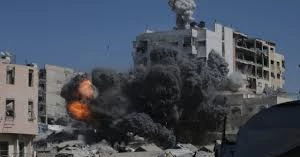
The declaration also denounces Israeli military actions in Gaza, citing the severe humanitarian crisis caused by airstrikes, blockades, and shortages of food and supplies. According to Gaza’s Health Ministry, over 64,000 Palestinians have been killed, though the numbers do not separate civilians from militants.
The document calls for the Palestinian Authority to take control of all Palestinian territories, including Gaza, through a transitional committee once a ceasefire is in place. It also demands that Hamas relinquish control of Gaza and disarm.
Additionally, the declaration supports a temporary U.N.-backed international mission to help protect civilians, oversee the ceasefire, assist the Palestinian Authority with security, and monitor future peace agreements.
Finally, the declaration urges global recognition of the Palestinian state, describing it as vital for realizing the two-state solution. Without directly naming Israel, it warns that “illegal unilateral actions” are threatening the viability of a Palestinian state.