
The Trump administration carried out military attacks in Syria on Friday, aiming to destroy Islamic State fighters and weapons facilities after an ambush last week killed two U.S. soldiers and an American civilian interpreter.
U.S. officials said the operation was extensive, striking about 70 Islamic State targets across central Syria, including weapons depots and infrastructure. One official noted that additional strikes are likely in the coming days.
Defense Secretary Pete Hegseth said the action was not the start of a broader conflict but a forceful response meant to protect Americans, emphasizing that the U.S. would act decisively against threats to its personnel.
The strikes come as the administration has emphasized shifting U.S. military attention closer to the Western Hemisphere, including expanded operations in the Caribbean and pressure on Venezuela. In line with that shift, significant military assets have been moved out of the Middle East, including the redeployment of an advanced aircraft carrier to South America.
Trump promises strong response
President Donald Trump vowed a “very serious retaliation” after the attack in the Syrian desert, which U.S. officials attributed to Islamic State. The victims were part of the U.S. military presence in eastern Syria supporting an international coalition against the militant group.
Trump said the strikes targeted Islamic State strongholds and reiterated his support for Syrian President Ahmad al-Sharaa, stating that the Syrian leader backed the U.S. operation. He also issued a stark warning to Islamic State, threatening even harsher consequences for any future attacks on Americans.
The operation involved F-15 and F-16 fighter jets, A-10 attack aircraft, AH-64 Apache helicopters, and HIMARS rocket artillery. U.S. Central Command said more than 100 precision-guided munitions were used.
Syria’s reaction
The strikes tested improving relations between Washington and Damascus following the removal of former president Bashar Assad a year ago. Trump said Syrian forces were cooperating closely with the U.S. and that President al-Sharaa was deeply angered by the attack on American troops.
Syria’s foreign ministry said the incident highlighted the need for stronger international cooperation against terrorism and reaffirmed the country’s commitment to eliminating Islamic State and denying it safe havens. Syrian state media reported that the strikes hit locations in Deir ez-Zor, Raqqa, and areas near Palmyra, targeting weapons caches and command centers.
Islamic State has not claimed responsibility for the attack on U.S. personnel but has acknowledged carrying out recent assaults on Syrian security forces. The group has condemned al-Sharaa’s government, despite his past ties to al-Qaida and long-standing hostility toward IS.
Victims of the attack
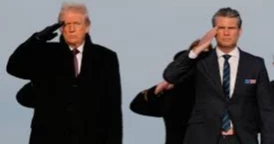
Trump met privately this week with the families of those killed at Dover Air Force Base, attending the dignified transfer ceremony honoring the fallen.
The U.S. service members killed were Sgt. Edgar Brian Torres-Tovar, 25, of Des Moines, and Sgt. William Nathaniel Howard, 29, of Marshalltown. Ayad Mansoor Sakat, a civilian interpreter from Macomb, Michigan, also lost his life.
The shooting near Palmyra injured three additional U.S. troops and members of Syrian security forces. The attacker, who was killed during the incident, had recently joined Syria’s internal security forces and was under suspicion of Islamic State ties. He opened fire during a joint meeting between U.S. and Syrian officials after a confrontation with Syrian guards.