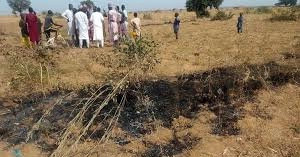
Former President Donald Trump said the United States carried out what he described as a “strong and lethal” military strike against Islamic State-linked militants in Nigeria, following weeks of criticism that Nigerian authorities were not doing enough to stop attacks on Christians.
In a post shared on his social media platform on Christmas night, Trump offered few details and did not specify the level of destruction caused by the strikes, which reportedly took place in Nigeria’s northwestern Sokoto state.
A U.S. Defense Department official, speaking anonymously because the information had not been formally released, said the operation was conducted in coordination with Nigeria and had the approval of the government in Abuja.
Nigeria’s Foreign Ministry confirmed the joint effort, saying it involved intelligence sharing and strategic cooperation carried out in line with international law, respect for national sovereignty, and shared security goals. The Associated Press was unable to independently verify the results of the strikes.
Multiple militant threats in Nigeria
Nigeria continues to face violence from several armed groups, including two with links to the Islamic State. These include the Islamic State West Africa Province, which split from Boko Haram and operates mainly in the northeast, and the lesser-known Lakurawa group, which is active in the northwest and uses forested areas as bases.
Security experts believe the U.S. operation may have targeted Lakurawa, a group that has grown increasingly dangerous over the past year by attacking isolated communities and security personnel.
Malik Samuel, a Nigerian security analyst with Good Governance Africa, said Lakurawa has taken control of territory in Sokoto and neighboring states such as Kebbi. He added that extremist groups have expanded in the northwest partly due to the weak presence of government authorities and security forces.
Impact of violence
Trump said the strikes were aimed at IS militants responsible for killing “primarily innocent Christians.” However, residents and analysts note that Nigeria’s insecurity affects people of all faiths, with Christians concentrated mainly in the south and Muslims forming the majority in the north.
Nigeria’s Foreign Ministry emphasized that terrorism, regardless of whether it targets Christians, Muslims, or others, contradicts the country’s values and threatens global peace. Nigerian officials have repeatedly stated that extremist violence has harmed citizens across religious lines.
US pressure on Nigeria
Last month, Trump directed the Pentagon to prepare for possible military action in Nigeria, citing concerns over the persecution of Christians. The U.S. State Department has also announced visa restrictions on Nigerians implicated in attacks on Christians and recently classified Nigeria as a “country of particular concern” under the International Religious Freedom Act.
Trump claimed that U.S. forces carried out “flawless strikes” and vowed that the United States would not allow extremist groups to thrive.
Nigeria, home to about 220 million people, is nearly evenly divided between Christians and Muslims. The country has long struggled with insecurity driven by extremist insurgencies, communal disputes, farmer-herder clashes, ethnic tensions, and separatist movements. Boko Haram, which seeks to impose a strict form of Islamic law, has also targeted Muslims it considers insufficiently devout.
While the U.S. military presence in Africa has declined in recent years, Trump has continued to press Nigerian authorities amid ongoing attacks on schools and churches that observers say affect both Christian and Muslim communities.
U.S. Defense Secretary Pete Hegseth wrote on X late Thursday that the president had made it clear the killing of innocent Christians must stop, adding that U.S. forces were prepared to act. He praised cooperation from the Nigerian government and ended his message with a Christmas greeting.