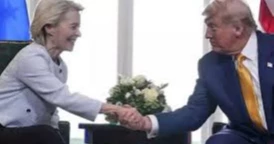
A major trade agreement between U.S. President Donald Trump and European Commission President Ursula von der Leyen has helped avoid a deeper conflict by setting a 15% tariff on most European imports, instead of the 30% Trump had threatened if no agreement was reached by August 1.
While the deal prevents a trade war, it will still increase costs for U.S. consumers and reduce profits for European exporters due to higher import taxes.
Key Takeaways From the Agreement:
Major Uncertainties Remain
The announcement, made during Trump’s visit to Scotland, lacks specifics. A 15% tariff will apply to most EU imports into the U.S., including vehicles, semiconductors, and pharmaceuticals. This is lower than the previously proposed rates of 20%, 30%, or even 50%.
Both sides agreed to remove tariffs entirely on certain "strategic" items — like aircraft parts, specific chemicals, semiconductor machinery, select farm goods, and raw materials — though exact items weren’t named. Von der Leyen said more products may be added in future talks.
US and EU reach an ‘across the board’ agreement on tariffs
Additionally, the EU will buy $750 billion worth of U.S. energy, including gas, oil, and nuclear fuel, to reduce dependence on Russia. European investments in the U.S. are also expected to increase by $600 billion, although details on funding sources were unclear.
Some Tariffs Stay, and New Ones May Follow
Trump confirmed the 50% tariff on imported steel remains, though talks will continue on reducing tariffs, combating steel oversupply, and setting import limits.
Pharmaceuticals were excluded from the current deal, with discussions on that topic set aside. Von der Leyen noted that not all agricultural tariffs could be reduced but didn’t specify which products were protected.
Tariffs Still Higher Than Normal
Although the deal lowers the threat of a 30% tariff, the new 15% rate is well above pre-Trump trade levels, which averaged around 1%. Businesses now face the challenge of either passing on those extra costs to consumers or absorbing them through lower profit margins.
The higher tariffs are expected to hurt European export earnings and slow economic growth. In fact, the EU had already cut its 2024 growth forecast from 1.3% to 0.9% due to earlier 10% tariffs during negotiations.
Von der Leyen called the agreement the best outcome possible, providing much-needed stability and continued access to the U.S. market.
Mixed Reactions in Europe
German Chancellor Friedrich Merz welcomed the agreement for avoiding further conflict but said he had hoped for more tariff relief. The Federation of German Industries was more critical, warning that even a 15% tariff would have severe consequences for Germany’s export-heavy economy.
ING Bank economist Carsten Brzeski pointed out that the lack of a formal written deal remains a major caveat. Still, he noted the agreement eased a significant risk to the global economy.
Automakers Brace for Impact
Asked whether European car manufacturers could manage under the new 15% rate, von der Leyen said it's a relief compared to the current 27.5% rate, which combines a 25% Trump-era tariff with a 2.5% existing duty.
Despite that, carmakers are expected to take a hit. Volkswagen, for example, reported a €1.3 billion ($1.5 billion) drop in profits in the first half of the year due to higher tariffs. Mercedes-Benz dealers in the U.S. are holding 2025 model prices steady for now but expect significant price hikes in the future. The brand assembles 35% of its U.S. vehicles in Alabama, offering limited tariff protection.
A Longstanding Trade Imbalance
Before Trump’s presidency, the U.S. and EU had one of the world’s most stable trade relationships, with tariffs averaging under 1.5%. However, Trump has long criticized the EU’s €198 billion trade surplus with the U.S., claiming European markets are unfairly closed to American vehicles.
Despite the goods trade gap, U.S. firms outperform in services — like tech, legal, and financial sectors — and many European imports come from American-owned subsidiaries, helping to balance the broader trade relationship.