
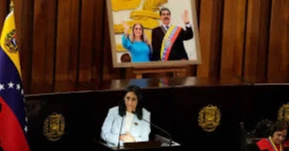
Venezuela’s interim leader Delcy Rodríguez announced Friday that her government is introducing an amnesty law that could result in the release of hundreds of people imprisoned for political reasons, including opposition figures, journalists, and human rights defenders.
The proposal, long demanded by the U.S.-supported opposition, marks Rodríguez’s most recent compromise since she assumed power on Jan. 3 following the dramatic U.S. military operation in Caracas that removed former President Nicolás Maduro.
Speaking at a recorded ceremony attended by senior judges, cabinet members, military officials, and other top authorities, Rodríguez said the National Assembly—controlled by the ruling party—would move quickly to debate the bill.
She said the law is intended to mend the harm caused by years of political conflict marked by violence and extremism, restore justice, and promote peaceful coexistence among Venezuelans.
Rodríguez also revealed plans to close Helicoide, a notorious Caracas detention center where independent groups have repeatedly documented torture and serious rights violations. According to her, the facility will be converted into a recreational and cultural complex serving police officers and nearby communities.
The announcement was made in the presence of several officials whom former detainees and rights organizations have accused of authorizing abuses at Helicoide and other prisons.
Outside the prison, relatives of inmates watched Rodríguez’s address on a mobile phone. Emotions ran high—some wept while others shouted, “Freedom! Freedom!”
“God is good. God listened to us,” said Johana Chirinos, the aunt of a detainee, through tears.
Opposition leader and Nobel Peace Prize winner María Corina Machado said in a statement that the measures were not voluntary but instead driven by pressure from the U.S. government. She emphasized that Venezuelans have been jailed for political reasons for periods ranging from one month to as long as 23 years.
She described the government’s repression as severe, adding that once fear and repression end, authoritarian rule will collapse.
According to Foro Penal, a Venezuelan prisoners’ rights organization, 711 people are currently held nationwide for political reasons, with 183 already convicted.
The government has not yet made public the full text of the amnesty bill, leaving uncertainty over eligibility requirements.
Rodríguez said the proposed “general amnesty law” would apply to acts linked to political violence from 1999 to the present, but would exclude those convicted of crimes such as murder, drug trafficking, corruption, or human rights abuses.
Earlier this month, her administration pledged to free a significant number of detainees as a goodwill measure, though families have criticized the process for moving too slowly.
“A general amnesty is positive only if it applies to all of civil society without discrimination, avoids granting impunity, and helps dismantle the machinery of political persecution,” said Foro Penal president Alfredo Romero in a social media post.
The group reports that 302 prisoners have been released since Jan. 8, when National Assembly leader Jorge Rodríguez first announced plans for large-scale releases.
Human rights organization Provea also criticized the lack of clarity and the gradual pace of releases, stressing that freeing political prisoners is urgent. It warned that an amnesty should not be portrayed as an act of mercy by the state.
“These individuals were unlawfully detained for exercising rights guaranteed by international human rights standards, the constitution, and Venezuelan law,” Provea said.