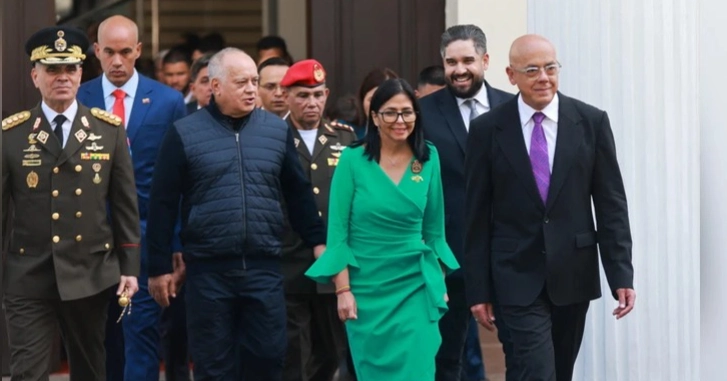
The Venezuelan government on Tuesday sought to demonstrate that the country remains governed from Caracas, not Washington, following the dramatic U.S. military operation that captured President Nicolás Maduro over the weekend.
Ruling-party lawmakers, including Maduro’s son, convened in the capital to carry out the previously scheduled swearing-in of the National Assembly, which will serve until 2031. The session was intended to project institutional continuity and national sovereignty.
Former Vice President Delcy Rodríguez, who has pledged cooperation with the Trump administration, was sworn in as interim president by her brother, National Assembly Speaker Jorge Rodríguez. In her remarks, she expressed grief over what she described as an “illegitimate military aggression” that caused suffering among Venezuelans.
Lawmakers used the session to denounce Maduro’s seizure by U.S. forces. Maduro’s son, Nicolás Maduro Guerra, warned that accepting the abduction of a sitting head of state would endanger all nations. “Today it’s Venezuela. Tomorrow, it could be any nation that refuses to submit,” he said, calling the episode a threat to global political stability. He also demanded the return of his father and stepmother, Cilia Flores, and rejected allegations that he was part of the alleged conspiracy.
As lawmakers met in Caracas, Maduro appeared in a U.S. courtroom in New York, pleading not guilty to federal narco-terrorism and drug trafficking charges. He described himself as innocent and denied wrongdoing.
President Donald Trump said the U.S. would temporarily “run” Venezuela, though Secretary of State Marco Rubio later clarified that Washington would not manage day-to-day governance, aside from enforcing an oil embargo aimed at forcing political and economic changes.
Rodríguez struck a more conciliatory tone on Sunday, calling for “respectful relations” and cooperation with the U.S. within international law, a shift that followed Trump’s warning that she could face consequences if she resisted U.S. demands.
Venezuela’s Supreme Court appointed Rodríguez interim president, declaring Maduro’s absence “temporary,” despite constitutional provisions that would normally require elections within 30 days. The court did not specify a time limit, prompting speculation she could remain in office beyond the usual interim period.
U.S. officials said preliminary steps are also underway to potentially reopen the American embassy in Caracas.