Wall Street remained steady following the postponement of the U.S.-China tariff deadline, with investors shifting focus to July’s inflation data due Tuesday, which could heavily influence the Federal Reserve’s decision on whether to cut interest rates as demanded by President Donald Trump or maintain the current stance.
Futures for the S&P 500, Dow Jones Industrial Average, and Nasdaq showed little change before the market opened.
President Trump signed an executive order late Monday granting a 90-day extension for trade talks between the U.S. and China, delaying a possible tariff increase on Chinese imports from the existing 30% rate. Beijing responded with a similar extension.
This delay provides an opportunity for a potential trade deal but also prolongs uncertainty affecting businesses and consumers since the trade war escalation began.
“The extension isn’t about goodwill; it’s about keeping oxygen in the room for deals that matter,” said Stephen Innes of SPI Asset Management.
The U.S. government is set to release inflation figures for July later Tuesday, with economists forecasting a 2.8% year-on-year increase in consumer prices, up from 2.7% in June. Despite improvements from a peak above 9% three years ago, inflation remains above the Federal Reserve’s 2% target, raising concerns that tariffs could further push prices upward.
Experts warn of the risk of stagflation — stagnant economic growth combined with high inflation — a scenario difficult to manage as measures to curb inflation could harm the job market and vice versa.
Wall Street stocks rise slightly, maintaining weekly gains
In premarket trading, Intel shares rose 3% after Trump met with CEO Lip-Bu Tan and retracted his earlier demand for Tan’s resignation. The stock had declined last week after Trump accused Tan of conflicts of interest linked to investments in firms associated with the Chinese Communist Party and People’s Liberation Army, following concerns raised by Senator Tom Cotton.
In Europe, France’s CAC 40 and Britain’s FTSE 100 each gained 0.1% by midday, while Germany’s DAX fell 0.5%.
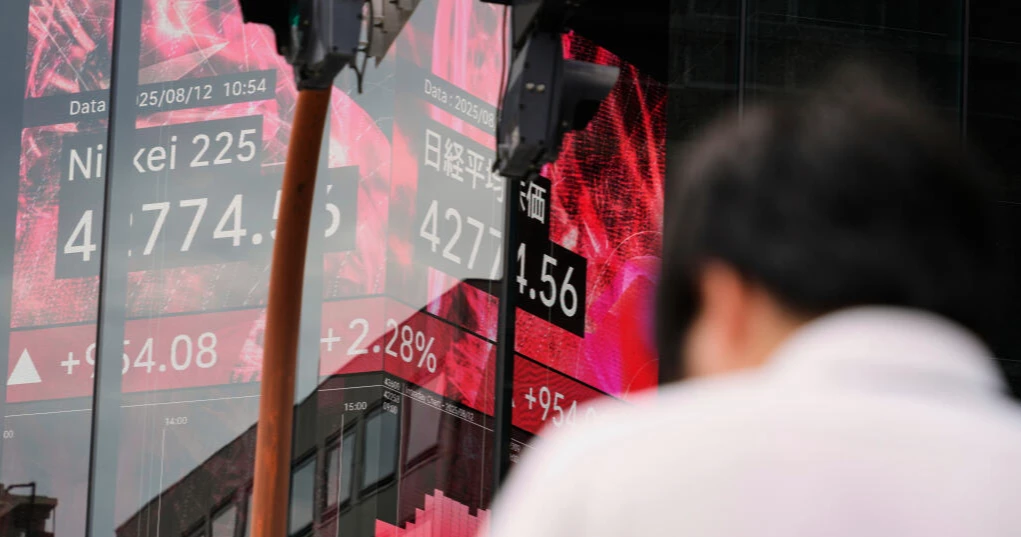
Asian markets saw Tokyo’s Nikkei 225 jump 2.2% to a record high of 42,718.17, boosted by Toyota’s nearly 3% gain. Other Japanese stocks such as Honda, Tokyo Electron, Sharp, Sanrio, and Seiko also saw significant increases following confirmation that tariffs on Japanese imports would be set at 15% without “stacking” additional duties.
Hong Kong’s Hang Seng rose 0.3% to 24,969.68, and Shanghai Composite climbed 0.5% to 3,665.92.
Australia’s S&P/ASX 200 gained 0.4% to 8,880.80, while South Korea’s Kospi declined 0.5% to 3,189.91.
In energy markets, U.S. crude oil fell 25 cents to $63.71 per barrel, and Brent crude dropped 16 cents to $66.47 per barrel.
In currency trading, the U.S. dollar strengthened slightly to 148.46 Japanese yen from 148.15 yen. The euro weakened to $1.1605 from $1.1618.
Source: Agency