
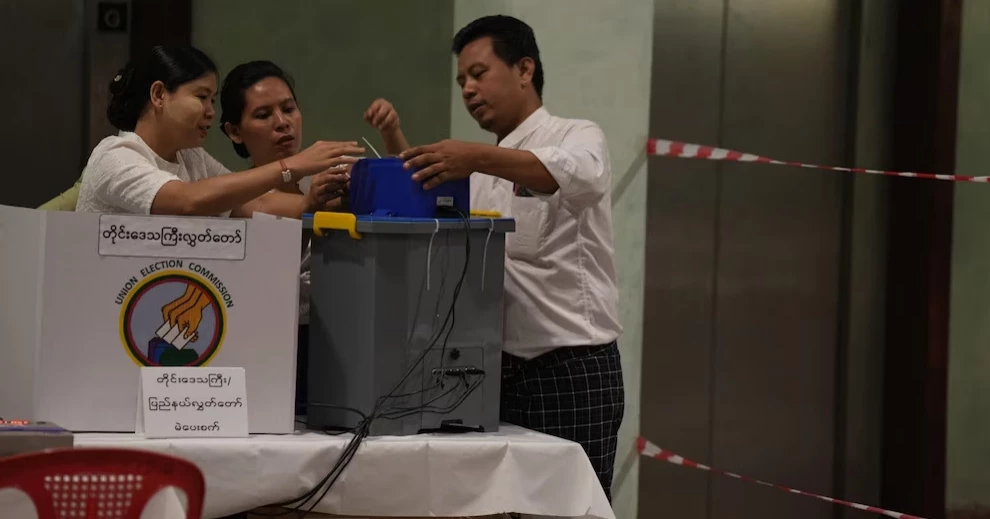
Myanmar has begun voting in an election that has been broadly rejected as illegitimate, with most major political parties dissolved, many senior politicians imprisoned and up to half of the country unlikely to take part because of the ongoing civil war.
The military authorities are conducting the vote in stages, almost five years after seizing power in a coup that triggered mass protests and later escalated into nationwide armed conflict.
Analysts say the junta, backed by China, is trying to secure domestic and international legitimacy and cement its grip on power as it looks for an exit from a prolonged and destructive stalemate, reports BBC.
More than 200 people have been charged under a new law for disrupting or opposing the election. The legislation carries harsh penalties, including the death sentence.
Voting started on Sunday amid reports of explosions and airstrikes in several parts of the country. In the Mandalay region, three people were hospitalised after a rocket struck an uninhabited house early Sunday, the regional chief minister told the BBC, adding that one victim was seriously injured.
In a separate incident, over ten houses were damaged in Myawaddy township near the Thai border following multiple explosions late on Saturday. A local resident told the BBC that a child was killed and three others were taken to hospital in critical condition. Additional reports of casualties have since emerged from other blasts.
Some voters told the BBC the process felt more “disciplined and systematic” than previous elections.
“The experience of voting has changed a lot,” said Ma Su ZarChi from the Mandalay region.
“Before I voted, I was afraid. Now that I have voted, I feel relieved. I cast my ballot as someone who has tried their best for the country.”
Ei Pyay Phyo Maung, 22, voting for the first time, said she participated because she believed voting is “the responsibility of every citizen”.
“My hope is for the lower classes - right now, the prices of goods are skyrocketing, and I want to support someone who can bring them down for those struggling the most,” she said.
“I want a president who provides equally for all people.”
The junta has brushed aside criticism, insisting the vote is meant to “return [the country] to a multi-party democratic system”. After voting at a heavily guarded polling station in the capital, junta leader Min Aung Hlaing told the BBC the election would be free and fair.
“I am the Commander-in-Chief of the Armed Forces, a civil servant. I can't just say that I want to be president,” he said, noting that the election is being held in three phases.
Earlier, he warned that refusing to vote amounted to rejecting “progress toward democracy”.
Several well-known figures, including film director Mike Tee, actor Kyaw Win Htut and comedian Ohn Daing, have been convicted under the election disruption law introduced in July. State media reported they were each sentenced to seven years in prison for criticising a film that promoted the vote.
UN Special Rapporteur Tom Andrews urged the international community on Sunday to reject the election, saying “nothing legitimate” can result from it.
“An election organised by a junta that continues to bomb civilians, jail political leaders, and criminalise all forms of dissent is not an election - it is a theatre of the absurd performed at gunpoint,” he said.
The military continues to fight on multiple fronts against armed groups opposing the coup as well as ethnic armies with their own militias. While it suffered major territorial losses earlier, it has regained ground this year through sustained airstrikes, aided by support from China and Russia.
The conflict has killed thousands, displaced millions, devastated the economy and created a severe humanitarian crisis. A powerful earthquake in March and cuts to international aid have further worsened conditions.
These factors, along with the fact that large areas remain under opposition control, pose serious logistical obstacles to holding the election. Voting is scheduled in three phases over the next month in 265 of Myanmar’s 330 townships, with the remainder deemed too unstable. Results are expected by late January.
Up to half of the country is not expected to vote. Even in areas where polling is taking place, not all constituencies will participate, making turnout difficult to predict.
Six parties, including the military-backed Union Solidarity and Development Party, are contesting nationwide, while 51 other parties and independent candidates are running only at regional or state level. About 40 parties have been banned, among them Aung San Suu Kyi’s National League of Democracy, which won landslides in 2015 and 2020.
Suu Kyi and many senior party figures remain in prison on charges widely viewed as politically motivated, while others have fled abroad.
“By splitting the vote into phases, the authorities can adjust tactics if the results in the first phase do not go their way,” said Htin Kyaw Aye of the election monitoring group Spring Sprouts, speaking to Myanmar Now.
Ral Uk Thang, a resident of western Chin state, said civilians “don't want the election”.
“The military does not know how to govern our country. They only work for the benefit of their high-ranking leaders.
“When Daw Aung San Suu Kyi's party was in power, we experienced a bit of democracy. But now all we do is cry and shed tears,” the 80-year-old told the BBC.
Western governments, including the UK and the European Parliament, have rejected the vote as a sham, while the regional bloc Asean has said political dialogue should come before any election.