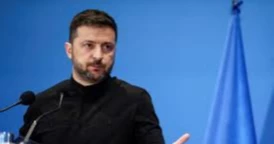
Ukrainian President Volodymyr Zelenskyy said early versions of U.S.-backed peace proposals with Russia align closely with Ukraine’s key demands, describing the talks as “quite solid” so far. Speaking in Kyiv, he noted that while progress has been made, neither side is likely to achieve all of its objectives in a settlement after nearly four years of war.
Zelenskyy said discussions with U.S. officials suggest significant movement toward compromise, though difficult issues remain for both Ukraine and Russia. He added that about 90% of Ukraine’s priorities have been reflected in the draft agreements.
The proposed deal is based on a 20-point plan, alongside a broader framework on security guarantees involving Ukraine, European partners, and the United States, plus a separate U.S.-Ukraine bilateral security document. Key elements include maintaining Ukraine’s army at roughly 800,000 troops in peacetime, advancing toward EU membership, and deploying European forces—led by France and the UK with U.S. support—to help secure Ukraine’s air, land, and sea defenses.
Some countries would provide military presence, while others would contribute in areas such as energy security, financing, and civil protection, Zelenskyy said. Kyiv wants the bilateral security agreement with Washington reviewed by the U.S. Congress, with certain details kept confidential.
Meanwhile, U.S. negotiators are holding talks with Russian representatives, and Washington has asked that details remain undisclosed. Former President Donald Trump, who has pushed for a peace deal for months, said the discussions are ongoing and reiterated his desire to see the fighting end.
On the battlefield, Zelenskyy said Ukraine’s defensive positions are holding despite intensified Russian attacks, which he said have also led to higher Russian losses. Ukrainian forces reportedly carried out strikes deep inside Russia, targeting oil facilities, military assets, and infrastructure as part of efforts to disrupt Russia’s war operations and challenge Moscow’s claim of negotiating from a position of strength.
Ukraine’s military also reported attacks on ammunition depots, drone launch sites, and Russian naval assets, while Ukrainian partisans allegedly sabotaged Russian fighter jets at an air base in western Russia. Russia, for its part, said it intercepted dozens of Ukrainian drones overnight.
At the same time, Russian forces continued strikes on Ukraine’s energy infrastructure across several regions, part of an ongoing campaign to weaken civilian life during winter. Ukrainian officials said most incoming drones were intercepted, but damage to the power grid was reported in multiple areas.