Possible
Is a rickshaw-free Dhaka really possible?
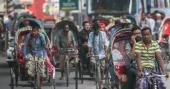
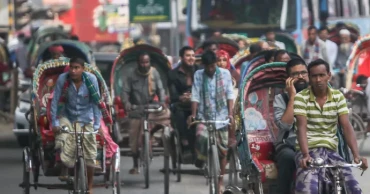
The soft jingle of rickshaw bells weaving through the bustling alleys and traffic-choked arteries of Dhaka has long been a signature sound of the city’s heartbeat.
From dawn to the deep hours of night, these humble three-wheelers — both pedal-powered and battery-run — remain an inseparable thread in the capital’s urban fabric.
Yet, as the megacity steadily advances towards modernity, the continued presence of these iconic vehicles has sparked fervent debate.
At the heart of the discourse lies a pressing question: Can Dhaka ever become truly rickshaw-free?
A Choking Gridlock
Although precise figures remain elusive due to the absence of a comprehensive survey, urban experts estimate that nearly one million rickshaws ply the streets of Dhaka daily.
Of these, alarmingly, only around 80,000 are formally registered with Dhaka North and Dhaka South City Corporations.
The remainder operate informally, contributing to a chaotic and often unregulated streetscape.
Rickshaws in Dhaka: The untold mystery of their numbers
Their overwhelming numbers significantly impede the city’s traffic flow. Average vehicle speeds on main roads often dwindle to a sluggish 6–7 kilometres per hour. This inefficiency transcends mere inconvenience.
A 2018 World Bank report starkly quantified the cost of congestion, estimating annual economic losses of $3–5 billion for the city.
Human Cost and Social Ties
Yet, while rickshaws may bear the brunt of blame for traffic snarls and lost productivity, they also represent a crucial lifeline for millions.
An estimated 2.5 to 3 million people directly rely on rickshaws for their livelihood — a sprawling ecosystem comprising drivers, garage owners, mechanics and manufacturers.
For countless residents, particularly those from lower- and middle-income brackets, rickshaws remain the most affordable and accessible means of daily transport — especially in underserved areas where buses and mass transit fail to reach.
Governmental Hesitation and Public Pushback
In 2019, the Dhaka South City Corporation sought to impose a ban on rickshaws along several key corridors — including Gabtoli-Azimpur, Science Lab-Shahbagh and Kuril-Banani.
Battery-run rickshaws won’t be allowed on Dhaka's main roads: DNCC Administrator
But the plan, introduced without viable alternatives, was swiftly met with public uproar and soon abandoned.
“Completely banning rickshaws is detached from reality,” an urban planner told UNB. “What we need is a planned, zone-based regulation system. Rickshaws should be allowed where they are suitable, such as narrow streets and lanes.”
Rise of Battery Rickshaws and Call for Policy Reform
Ashis Kumar Dey, General Secretary of the National Committee to Protect Shipping, Roads and Railways, voiced concerns over the proliferation of battery-operated rickshaws, which he described as chaotic and dangerously prone to accidents.
He, however, acknowledged the irreplaceable role these vehicles play.
“The movement of these small three-wheeled vehicles across Dhaka has created employment for 2.5 to 3 million people. About 6 million more depend on their income. So, there is no scope for stopping these vehicles,” he said.
He called for a dedicated policy under local government control, encompassing everything from infrastructure development to the licensing, registration and training of drivers. Notably, Bangladesh University of Engineering and Technology (Buet ) has already developed a pilot model of battery-rickshaw infrastructure, which it has submitted to Dhaka North City Corporation for review.
“If the government approves it, positive results will come,” he added.
Unchecked Growth and Need for Control
Saidur Rahman, Executive Director of the Road Safety Foundation, acknowledged rickshaws’ enduring importance but cautioned against their unchecked proliferation.
“There is no doubt that rickshaws are an essential mode of transport for residents of the capital. However, the number must be determined based on road capacity,” he said.
Rickshaw puller, passenger jailed for obstructing traffic police in Dhaka
According to him, the rampant rise of battery-operated rickshaws has paralysed the city with congestion. "Alongside this, accidents are rising. People from across the country are flocking to Dhaka to operate auto-rickshaws. Controlling or stopping this influx has become a major challenge for the government.”
He advocated for sustainable, phased interventions, “To keep the capital at least somewhat functional, we must regulate auto-rickshaws through short-, medium-, and long-term plans. These include banning the import of components, improving vehicle safety, and enforcing strict registration.”
Rahman’s broader recommendations extended to economic decentralisation and youth development: mandatory licensing for drivers, establishment of industrial zones outside the capital, structured market systems for agriculture, and overseas employment opportunities for the educated youth.
“Such steps will not only curb the unchecked dominance of auto-rickshaws but also bolster the national economy,” he asserted.
A City of Megaprojects, But Few Alternatives
While ambitious projects like the metro rail and Bus Rapid Transit (BRT) promise transformative change, their full-scale functionality remains a distant dream. In their absence, the lack of last-mile connectivity continues to tether residents to the modest rickshaw — a vehicle as nimble as it is essential.
Even efforts like bus route rationalisation have stalled, mired in delays and resistance. As a result, rickshaws persist as a vital, if imperfect, link in Dhaka’s transport chain.
A senior officer from the Dhaka Metropolitan Police's Traffic Division, speaking to UNB on condition of anonymity, offered a pragmatic view, “If every rickshaw is brought under digital registration, drivers are trained, and a route-based regulation is enforced — they can remain an essential part of Dhaka’s transit system.”
1 year ago
5 dead after New Zealand boat flips in possible whale strike
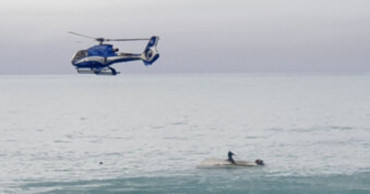
Five people died Saturday in New Zealand after the small charter boat they were aboard capsized, authorities say, in what may have been a collision with a whale. Another six people aboard the boat were rescued.
Police said the 8.5-meter (28-foot) boat overturned near the South Island town of Kaikōura. Police said they were continuing to investigate the cause of the accident.
Kaikōura Police Sergeant Matt Boyce described it as a devastating and unprecedented event.
“Our thoughts are with everyone involved, including the victims and their families, their local communities, and emergency services personnel,” Boyce said.
He said police divers had recovered the bodies of all those who had died. He said all six survivors were assessed to be in stable condition at a local health center, with one transferred to a hospital in the city of Christchurch as a precaution.
Kaikōura Mayor Craig Mackle told The Associated Press that the water was dead calm at the time of the accident and the assumption was that a whale had surfaced from beneath the boat.
He said there were some sperm whales in the area and also some humpback whales traveling through.
He said locals had helped with the rescue efforts throughout the day but the mood in the town was “somber” because the water was so cold and they feared for the outcome of anybody who had fallen overboard.
Read: Whale carcass washes ashore on Cox’s Bazar beach
Mackle said he’d thought in the past about the possibility of a boat and whale colliding, given the number of whales that frequent the region.
“It always plays on your mind that it could happen,” he said, adding that he hadn’t heard about any previous such accidents.
Mackle said the boat was a charter vessel typically used for fishing excursions. News agency Stuff reported the passengers belonged to a bird enthusiasts' group.
Police said they were still notifying the relatives of those who died, and couldn't yet publicly name the victims.
Vanessa Chapman told Stuff she and a group of friends had watched the rescue efforts unfold from Goose Bay, near Kaikōura. She said that when she arrived at a lookout spot, she could see a person sitting atop an overturned boat waving their arms.
She said two rescue helicopters and a third local helicopter were circling before two divers jumped out. She told Stuff that the person atop the boat was rescued and a second person appeared to have been pulled from the water.
Kaikōura is a popular whale-watching destination. The seafloor drops away precipitously from the coast, making for deep waters close to the shore. A number of businesses offer boat trips or helicopter rides so tourists can see whales, dolphins and other sea creatures up close.
Compliance agency Maritime New Zealand said it sent two investigators to the scene and would be conducting a thorough investigation once recovery operations had concluded.
Principal Investigator Tracy Phillips said the agency “offers its heartfelt condolences to the family and loved ones of the people who have died.”
4 years ago

Possible security threats likely to complicate Rohingya crisis: Experts
The future of the Rohingya crisis, with the bleak possibility of Rohingya resettlement and the likely emergence of several security threats, might further complicate the situation, experts have said.
They said the Rohingya crisis, one of the greatest human catastrophes of the 21st century, is getting more complicated since the takeover by the Myanmar military junta.
The Bangladesh Institute of Peace and Security Studies (BIPSS)-Dhaka Tribune Roundtable "Revisiting the Rohingya Crisis: What Lies Ahead?" was held Sunday evening at a city hotel.
Several diplomats, scholars, security experts, and youth representatives from various disciplines joined the discussion.
Shafqat Munir, research fellow at BIPSS, highlighted the contemporary situation and noted that Bangladesh has to ramp up its approaches on all frontiers to resolve the issue, which is becoming more entrenched and prolonged.
READ: PM seeks more international support to ensure Rohingya repatriation
Asif Munier, a national expert on migration and displacement, emphasised the major dimension of the crisis.
He dissected the regional and global political dynamics and the underlying pragmatism and interest-driven approach behind it.
Asif highlighted the three categories of the Rohingya influx throughout the years.
He talked about the vulnerabilities that the Rohingya youths face in terms of being exposed to radicalisation and different violent militant outfits.
Air Vice Marshal Mahmud Hussain (retired), vice-chancellor of the Bangabandhu Sheikh Mujibur Rahman Aviation and Aerospace University, illustrated the key thematic concepts, including the wider geopolitical ramifications of the issue and the reaction it will induce from various actors across the region and abroad.
He also highlighted how Bangladesh might want to consider reinventing its foreign policy approaches.
Mahmud then said: "Military powers are lenient if you speak in their language – military language. In Myanmar, the military is the state. We have to get the right states onboard."
He talked about the necessity to draw the attention of major players like the US and underline the importance of solving this issue to preserve and promote the Indo-Pacific strategy in the upcoming days.
Shafqat emphasised the necessity of a pragmatic yet humanitarian approach.
He also highlighted the necessity to develop Bangladesh's capability and ensure the strengthening of its institutions.
Bangladesh should develop an early warning mechanism to better understand situations like these, and take preemptive actions to either prevent or alleviate the consequences, Shafqat added.
4 years ago

Possible mass graves near Mariupol shown in satellite images
New satellite images show apparent mass graves near Mariupol, where local officials accused Russia of burying up to 9,000 Ukrainian civilians to conceal the slaughter taking place in the ruined port city that’s almost entirely under Russian control.
The images emerged just hours after Russian President Vladimir Putin on Thursday claimed victory in the battle for Mariupol, despite the presence of an estimated 2,000 Ukrainian fighters who were still holed up at a giant steel mill. Putin ordered his troops to seal off the stronghold “so that not even a fly comes through” instead of storming it.
Putin’s decision to blockade the Azovstal steel plant likely indicates a desire to contain Ukrainian resistance in Mariupol and free up Russian forces to be deployed elsewhere in eastern Ukraine, Britain's Defense Ministry said in an assessment Friday.
Satellite image provider Maxar Technologies released the photos, which it said showed more than 200 mass graves in a town where Ukrainian officials say the Russians have been burying Mariupol residents killed in the fighting. The imagery showed long rows of graves stretching away from an existing cemetery in the town of Manhush, outside Mariupol.
Mariupol Mayor Vadym Boychenko accused the Russians of “hiding their military crimes” by taking the bodies of civilians from the city and burying them in Manhush.
The graves could hold as many as 9,000 dead, the Mariupol City Council said Thursday in a post on the Telegram messaging app.
Boychenko labeled Russian actions in the city as “the new Babi Yar,” a reference to the site of multiple Nazi massacres in which nearly 34,000 Ukrainian Jews were killed in 1941.
“The bodies of the dead were being brought by the truckload and actually simply being dumped in mounds,” an aide to Boychenko, Piotr Andryushchenko, said on Telegram.
There was no immediate reaction from the Kremlin. When mass graves and hundreds of dead civilians were discovered in Bucha and other towns around Kyiv after Russian troops retreated three weeks ago, Russian officials denied that their soldiers killed any civilians there and accused Ukraine of staging the atrocities.
READ: From Ukraine to Russia: Boy safer, but not closer to US dad
In a statement, Maxar said a review of previous images indicates that the graves in Manhush were dug in late March and expanded in recent weeks.
After nearly two lethal months of bombardment that largely reduced Mariupol to a smoking ruin, Russian forces appear to control the rest of the strategic southern city, including its vital but now badly damaged port.
But a few thousand Ukrainian troops, by Moscow's estimate, have stubbornly held out for weeks at the steel plant, despite a pummeling from Russian forces and repeated demands for their surrender. About 1,000 civilians were also trapped there, according to Ukrainian officials.
Ukrainian officials have repeatedly accused Russia of launching attacks to block civilian evacuations from Mariupol.
At least two Russian attacks on Thursday hit the city of Zaporizhzhia, a way station for people fleeing Mariupol. No one was wounded, the regional governor said.
Among those who arrived in Zaporizhzhia after fleeing the city were Yuriy and Polina Lulac, who spent nearly two months living in a basement with at least a dozen other people. There was no running water and little food, Yuriy Lulac said.
“What was happening there was so horrible that you can’t describe it,” said the native Russian speaker who used a derogatory word for the Russian troops, saying they were “killing people for nothing.”
“Mariupol is gone. In the courtyards there are just graves and crosses,” Lulac said.
The Red Cross said it had expected to evacuate 1,500 people by bus, but that the Russians allowed only a few dozen to leave and pulled some people off of the buses.
Dmitriy Antipenko said he lived mostly in a basement with his wife and father-in-law amid death and destruction.
“In the courtyard, there was a little cemetery, and we buried seven people there,” Antipenko said, wiping away tears.
Instead of sending troops to finish off the Mariupol defenders inside the steel factory in a potentially bloody frontal assault, Russia apparently intends to maintain the siege and wait for the fighters to surrender when they run out of food or ammunition.
All told, more than 100,000 people were believed trapped with little or no food, water, heat or medicine in Mariupol, which had a prewar population of about 430,000. Over 20,000 people have been killed in the siege, according to Ukrainian authorities.
The city has seized worldwide attention as the scene of some of the worst suffering of the war, including deadly airstrikes on a maternity hospital and a theater.
Boychenko rejected any notion that Mariupol had fallen into Russian hands.
“The city was, is and remains Ukrainian,” he declared. “Today our brave warriors, our heroes, are defending our city.”
The capture of Mariupol would represent the Kremlin’s biggest victory yet of the war in Ukraine. It would help Moscow secure more of the coastline, complete a land bridge between Russia and the Crimean Peninsula, which Russia seized in 2014, and free up more forces to join the larger and potentially more consequential battle now underway for Ukraine’s eastern industrial heartland, the Donbas.
At a joint appearance with Russian Defense Minister Sergei Shoigu, Putin declared, “The completion of combat work to liberate Mariupol is a success,” and he offered congratulations to Shoigu.
Shoigu predicted the Azovstal steel mill could be taken in three to four days. But Putin said that would be “pointless" and expressed concern for the lives of Russian troops in deciding against sending them in to clear out the sprawling plant, where the die-hard defenders were hiding in a maze of underground passageways.
Instead, the Russian leader said, the military should “block off this industrial area so that not even a fly comes through.”
The plant covers 11 square kilometers (4 square miles) and is threaded with some 24 kilometers (15 miles) of tunnels and bunkers.
“The Russian agenda now is not to capture these really difficult places where the Ukrainians can hold out in the urban centers, but to try and capture territory and also to encircle the Ukrainian forces and declare a huge victory,” retired British Rear Adm. Chris Parry said.
Russian officials for weeks have said capturing the mostly Russian-speaking Donbas is the war’s main objective. Moscow’s forces opened the new phase of the fighting this week along a 300-mile (480-kilometer) front from the northeastern city of Kharkiv to the Azov Sea.
While Russia continued heavy air and artillery attacks in those areas, it did not appear to gain any significant ground over the past few days, according to military analysts, who said Moscow's forces were still ramping up the offensive.
Despite Russia’s renewed focus, its troops are still suffering from losses sustained earlier in the conflict, according to the British assessment. In order to try and reconstitute their depleted forces, the Russians have resorted to sending inoperable equipment back to Russia for repair, it said.
A senior U.S. defense official, speaking on condition of anonymity to discuss the Pentagon’s assessment, said the Ukrainians were hindering the Russian effort to push south from Izyum.
In the U.S., President Joe Biden pledged an additional $1.3 billion for new weapons and economic assistance to help Ukraine, and he promised to seek much more from Congress to keep the guns, ammunition and cash flowing.
4 years ago