bumper harvest
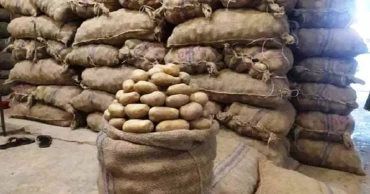
Bumper harvest, plunging prices; Chandpur’s potato market in crisis
Rows of unsold potato sacks in Chandpur’s cold storages reflect a season of deepening losses, turning what was once a lucrative crop into a source of financial despair for thousands of farmers.
In local markets, old potatoes are fetching as little as Tk 7–8 per kilogram, well below production and storage costs, leaving farmers with little incentive to withdraw their stored produce, locals said.
Outstanding dues for seed potatoes purchased on credit last season remain unpaid, while storage fees continue to accumulate, they said.
Agriculture officials said the district’s 56,860 potato farmers are concentrated mainly in Chandpur Sadar, Matlab South, and Kachua upazilas, where some 5,000 hectares are under potato cultivation.
Read more: Delays push up cost of seed potato project to Tk 1,138.74 crore
Despite the market downturn, they said, planting continues, though many farmers have scaled back their operations in response to last season’s losses.
“The absence of syndicates this season has kept potato prices low,” said Mobarak Hossain, officer at the Department of Agricultural Extension (DAE).
“Last season, syndicates pushed prices up to Tk 80 per kilogram. That situation does not exist this year,” he said.
The ripple effect is felt throughout the supply chain. Cold storage operators in Kachua upazila are struggling as farmers hesitate to withdraw their produce.
Mangal Khan and Yasin Mia, managers of local facilities, said that with market prices so low, even selling the stored potatoes fails to cover storage costs.
A bumper harvest last season exacerbated the problem. Good-quality old potatoes now sell for Tk 8–10 per kg, while new potatoes are priced around Tk 20 per kg. Farmers who invested heavily are counting losses.
“I produced 100 maunds of potatoes and made no profit at all—everything turned into a loss,” said Bachchu Miji, a grower and trader at Bakila Bazar in Hajiganj upazila. Others, including farmers from Shah Mahmudpur in Chandpur Sadar, echoed his frustration.
Hanif Patwary, whose 33 sacks of potatoes stored at Baborhat BSCIC cold storage sold for just Tk 3,000 per 50 kg sack, said, “After suffering such losses, I will not cultivate potatoes again.”
Bangladesh hosts its first-ever Potato Festival
The situation is mirrored in Kachua upazila, where more than half of stored potatoes remain in cold storage past the usual withdrawal period of November–December, frustrating both farmers and storage operators.
Meanwhile, the prices of other vegetables have also softened. Beans, snake beans, bitter gourd, and carrots now sell at Tk 60 per kg, and tomatoes at Tk 40 per kg, down from Tk 90–120 per kg just two weeks ago.
Despite the downturn, potato planting continues in Chandpur Sadar, Haimchar, Kachua, and Matlab upazilas, with some farmers reducing cultivation areas due to past losses.
Shamsul Islam of Bagadi and Ismail Hossain and Suruj Mia of Dhanpardi said they planted on smaller plots, wary of another season of poor returns.
New potatoes arriving from Munshiganj have further driven prices down, falling sharply from Tk 70 to Tk 20 per kg, boosting consumer demand. Currently, 5 kg of new potatoes sell for Tk 100, while 10 kg of old potatoes go for Tk 50–60.
Chandpur’s 10 operational cold storages are holding 80,169 tonnes of potatoes against a maximum capacity of 80,250 tonnes, according to Mobarak Hossain.
Abu Taher, Deputy Director of DAE Chandpur, said the cultivation target for the current season has been set at 7,200 hectares, down 1,000 hectares from last year, citing farmers’ discouragement and mounting debts.
“Farmers are naturally drawn to crops that guarantee fair prices. While about 4,000 hectares are already under potatoes, the focus is shifting to crops that ensure financial returns,” he said.
Read more: Sirajganj’s mustard fields bloom into golden seas, promise bumper harvest
For Chandpur’s potato farmers and storage operators, the coming months will be critical, as the market continues to weigh on livelihoods and investment decisions, according to the officials.
9 months ago

Sirajganj’s mustard fields bloom into golden seas, promise bumper harvest
Vast stretches of mustard fields across Sirajganj have burst into radiant shades of yellow, turning the district into a rolling sea of gold and offering a visual feast that is delighting visitors and farmers alike.
From late afternoon until dusk, the flowering fields have become a magnet for people of all ages. Youths, women and men are seen wandering through the blossoms, pausing to admire the view, capturing selfies against the glowing backdrop of nature’s seasonal spectacle.
The golden transformation is most striking in Tarash, Raiganj, Ullapara and the char areas—long known as the district’s ‘granary’—where mustard flowers sway gently in the winter breeze, painting the countryside with warmth and colour.
Read more: Golden Harvest: Sirajganj farmers reap bumper mustard crop
According to the Department of Agricultural Extension (DAE), a cultivation target of 87,125 hectares was set for mustard farming across Sirajganj’s nine upazilas this season.
Farmers, however, have gone beyond expectations, bringing even more land under cultivation and raising hopes of a bumper harvest.
Mustard farming has expanded notably in the Chalan Beel areas, particularly in Tarash, Raiganj, Ullapara and Shahjadpur upazilas. Significant cultivation has also been recorded in Kamarkhanda, Kazipur, Belkuchi and Sirajganj Sadar upazilas, reflecting a district-wide surge in production.
Among the commonly cultivated varieties are Tori-7, BARI-14, Beena-9 and Beena-14. In the char areas, farmers have opted for the uric acid-free Kalania variety, well-suited to the region’s soil and conditions.
Read more: Chapainawabganj farmer sparks local excitement with amazing Chinese orange harvest
Local farmers said government incentives have played a crucial role in encouraging cultivation. Seeds and fertilisers were distributed at fixed rates, while agricultural officers provided regular guidance and technical advice to ensure better yields.
With favourable weather prevailing, farmers remain optimistic about achieving a bumper output this season.
Adding to the vibrancy of the fields, honey collectors from different areas have already installed bee boxes among the mustard crops. Harvesting of mustard flower honey has begun, and collectors expect production to surpass last year’s levels due to the increased acreage under cultivation.
Deputy Director of the DAE, AKM Manjur-e-Maula, said farmers had brought more land under mustard cultivation this year compared to the previous season.
“We distributed free seeds and fertilisers among small and marginal farmers and provided necessary advice. If the weather remains favourable, there is a strong possibility of a bumper mustard harvest this season,” he said.
As Sirajganj’s fields glow under winter skies, the mustard bloom stands not only as a scenic delight but also as a symbol of agricultural promise and rural resilience.
Read more: Khulna farmers reap rewards from mustard cultivation, honey production
10 months ago

Low price dims the joy of watermelon growers in Khulna despite bumper harvest
Watermelon growers in south-western Khulna district are staring at losses due to abnormally low price despite a bumper production of the summer fruit.
Rather than looking for profit the growers are now worried about a recovery of their production cost. They are partly blaming a nexus of middle traders for their price woes.
The syndicate, they complain, buys the fruit at a very low price to sell in the city markers with high profit margin.
The shunning of middlemen is not as easy as it may look. In interviews with some growers it was found that they are to pay Tk 15,000-25,000 each to hire a truck for transporting watermelons besides paying the loaders. Most growers can’t afford the cost.
The price of watermelons dropped significantly after the month of Ramadan and the selling of mouth-watering thirst-quenching fruit is low in the local markets.
To recoup losses, a few were seen taking their produce to Dhaka and Khulna cities but failed to get desired prices.
According to the Department of Agriculture Extension, Khulna, farmers this year cultivated watermelons on 13,990 hectares of land.
Of these, 7,625 hectares are in Dakope upazila, 3,600 hectares in Batiaghata, 1,510 hectares in Paikgachcha, 895 hectares in Koyra, 350 hectares in Dumuria, five hectares in Rupsha, three hectares in Terokhada, one hectare each in Phultala and Metropolitan areas of the district.
Also read: Corona shutdown: Khulna farmers in distress with bumper yield of watermelon
In 2021, a total of 7,512 hectares of land were brought under watermelon cultivation and as the watermelon cultivation proved to be profitable, the farmers expanded their cultivation.
An estimated 4.15 lakh tonnes of watermelon have been produced in the district this year.
Abu Syed, a watermelon grower, said “I have brought 10 bighas of land under cultivation and most of the watermelon lying on my lands. One piece of watermelon, weighing 5-10 kg is being sold at Tk 10-20 but in the local market the same watermelon is being sold at Tk 30-40 per kg.”
Quamrul Islam, another farmer, said “I have cultivated watermelons on my ten bighas of land and now I have no idea what to do with these. If I want to take these to Dhaka with my own cost, I have to pay Tk 25000-30,000 more as transport cost. I am I won’t get back one-fourth of the production cost.”
Babul Sheikh, another farmer of Choto Chalna, said “I have brought five bighas of land under watermelon cultivation and still I cannot sell my products due to the poor price. No traders have shown interest to purchase my crop from the field. Now all my watermelon is rotting.”
Utpal Sana, a farmer of Banishanta, said Tk 30,000 to 35,000 is needed to cultivate one bigha of the land but the traders refuse to pay us more than Tk 20,000.
The farmers of Choto Chalna, Pankholi, Moukhali and Tildanga areas are facing the same problems.
The farmers are now searching for markets in Dhaka, Bogura, Chattogram and Rajshahi to sell their products.
4 years ago