Australian prime minister
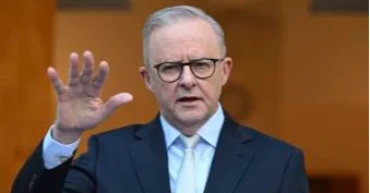
Australian prime minister names new Cabinet that drops Israel critic
Australian Prime Minister Anthony Albanese unveiled his new Cabinet on Monday following his Labor Party’s landslide victory in the May 3 elections, a move that coincided with the exclusion of a minister who had criticized Israel’s actions in Gaza.
The updated Cabinet line-up comes after former Industry and Science Minister Ed Husic said his removal was partly linked to his vocal criticism of Israel’s military campaign.
Albanese revealed the names of 30 lawmakers who will serve in ministerial and outer-ministry roles. With Labor securing 92 seats in the 150-member House of Representatives and possibly reaching 95 as counting continues, Albanese said his government now holds more seats than any Labor government since Australia’s first Parliament in 1901.
“I’m deeply humbled by the trust that was put into my government with the election and we certainly won’t take it for granted,” he said during a press conference at Parliament House.
Although prime ministers distribute ministerial portfolios, the Labor Party’s internal factions determine who fills them based on their proportion of seats. In this reshuffle, faction leaders dropped both Husic, who is of Bosnian Muslim heritage, and former Attorney-General Mark Dreyfus, who is Jewish.
Australians rescue a 10-foot great white shark stranded in shallow water
Husic, the first Muslim federal minister sworn in on the Quran after the 2022 election, told the Australian Broadcasting Corp. on Sunday that Albanese should have acted to retain both him and Dreyfus.
“I think it’s been a factor in there. Would I do things differently? I don’t think so,” Husic said, referring to his stance on the Gaza conflict.
“You can’t celebrate diversity and then expect it to sit in a corner and be silent. You need to speak up … for the communities that you care about,” he added.
When questioned about whether he had attempted to keep Husic and Dreyfus in Cabinet, Albanese avoided a direct answer.
“We have a process in the Labor Party caucus. You’ve been watching it for some time,” he said.
He added that he spoke with Husic on Monday morning in a “constructive discussion.”
“What I’ve done is to allocate portfolios. That’s the system that’s there. It’s one that Ed and others have supported for a long period of time,” Albanese said.
Bilal Rauf, an adviser to the Australian National Imams Council, urged Albanese to clarify if Husic’s demotion was related to his views on the war in Gaza.
“I think at a minimum, some explanation is warranted. We can’t just leave it at explanations about factionalism,” Rauf said.
“If Ed says that’s a factor, I have no reason to discount that,” he added. “It’s hard to deny that it likely is a factor.”
Alex Ryvchin, co-CEO of the Executive Council of Australian Jewry, said his organization had good working relationships with both Husic and Dreyfus, although Husic's comments following Hamas’ October 7, 2023, attacks on Israel had caused concern.
“He levelled accusations at Israel which we fundamentally disagree with but again reasonable people will differ on these things and we wish Ed Husic all the best,” Ryvchin said.
Two weeks after the October attack, Husic had said: “I feel very strongly that Palestinians are being collectively punished … for Hamas’ barbarism.” On Sunday, he reiterated that the Israeli government had “atrociously managed this.”
Meanwhile, Anne Aly, born in Egypt, has been elevated to the Cabinet, becoming the highest-ranking Muslim in the government. She will oversee the small business, international development, and multicultural affairs portfolios.
With Dreyfus no longer in the Cabinet, this marks the first time since 2010 that an Australian government has had no Jewish Cabinet minister.
Most senior ministers have retained their previous roles or experienced minor adjustments. Deputy Prime Minister Richard Marles remains Defense Minister, while Tony Burke’s Home Affairs portfolio now also includes oversight of the Australian Federal Police and the domestic spy agency, ASIO.
Tim Ayres, previously assistant trade minister, has replaced Husic in Cabinet, while Michelle Rowland, formerly communications minister, takes over from Dreyfus.
1 year ago

Australian prime minister concedes election defeat
Australia’s prime minister conceded defeat after an election Saturday that could deliver a minority government.
Scott Morrison acted quickly despite millions of votes yet to be counted because an Australian prime minister must attended a Tokyo summit on Tuesday with U.S., Japanese and Indian leaders.
“I believe it’s very important that this country has certainty. I think it’s very important this country can move forward,” Morrison said.
“And particularly over the course of this week with the important meetings that are being held, I think it’s vitally important there’s a very clear understanding about the government of this country,” he added.
Opposition leader Anthony Albanese will be sworn in as prime minister after his Labor party clenched its first electoral win since 2007.
Labor has promised more financial assistance and a robust social safety net as Australia grapples with the highest inflation since 2001 and soaring housing prices.
Also read: Int'l visitors reach two year high as tourists pour back into Australia
The party also plans to increase minimal wages, and on the foreign policy front, it proposed to establish a Pacific defense school to train neighboring armies in response to China’s potential military presence on the Solomon Islands on Australia’s doorstep.
It also wants to tackle climate change with a more ambitious 43% reduction in greenhouse gas emissions by 2050.
Morrison's Liberal party-led coalition was seeking a fourth three-year term. It holds the narrowest of majorities — 76 seats in the 151-member House of Representatives, where parties need a majority to form a government.
In early counting on Saturday, the coalition was on track to win 38 seats, Labor 71, seven were unaligned lawmakers and 23 were too close to call.
Minor parties and independents appeared to be taking votes from the major parties, which increases the likelihood of a hung parliament and a minority government.
Australia most recent hung parliaments were from 2010-13, and during World War II.
A record proportion of postal votes because of the pandemic, which won’t be added to the count until Sunday, adds to the uncertainty in early counting.
As well as campaigning against Labor, Morrison’s conservative Liberals fought off a new challenge from so-called teal independent candidates to key government lawmakers’ reelection in party strongholds.
At least four Liberal lawmakers appeared to have lost their seats to teal independents including Liberal Party deputy leader Josh Frydenberg, who had been considered Morrison’s most likely successor.
“What we have achieved here is extraordinary,” teal candidate and former foreign correspondent Zoe Daniels said in her victory speech. “Safe Liberal seat. Two-term incumbent. Independent,” she added.
The teal independents are marketed as a greener shade than the Liberal Party’s traditional blue color and want stronger government action on reducing Australia’s greenhouse gas emissions than either the government or Labor are proposing.
Also read: Australia to send armored vehicles to Ukraine after request
The government’s Senate leader Simon Birmingham was concerned by big swings toward several teal candidates.
“It is a clear problem that we are losing seats that are heartland seats, that have defined the Liberal Party for generations,” Birmingham said.
“If we lose those seats — it is not certain that we will — but there is clearly a big movement against us and there is clearly a big message in it,” Birmingham added.
Due to the pandemic, around half of Australia’s 17 million electors have voted early or applied for postal votes, which will likely slow the count.
Voting is compulsory for adult citizens and 92% of registered voters cast ballots at the last election.
Early polling for reasons of travel or work began two weeks ago and the Australian Electoral Commission will continue collecting postal votes for another two weeks.
The government changed regulations on Friday to enable people recently infected with COVID-19 to vote over the phone.
Electoral Commissioner Tom Rogers said more than 7,000 polling stations opened as planned and on time across Australia despite 15% of polling staff falling sick this week with COVID-19 and flu.
Albanese said he had thought Morrison would have called the election last weekend because Australia’s prime minister is expected at a Tokyo summit on Tuesday with U.S. President Joe Biden, Japanese Prime Minister Fumio Kishida and Indian Prime Minister Narendra Modi.
“If we get a clear outcome today then whoever is prime minister will be on a plane to Tokyo on Monday, which isn’t ideal, I’ve got to say, immediately after a campaign,” Albanese said.
Analysts have said that Morrison left the election until the latest date available to him to give himself more time to reduce Labor’s lead in opinion polls.
4 years ago