food crises
Bangladesh among 10 countries bearing two-thirds of global acute hunger burden
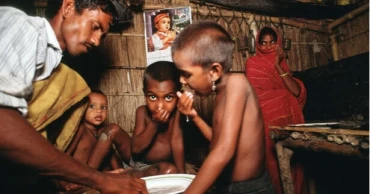
Ten countries, including Bangladesh, accounted for two-thirds of all people facing high levels of acute hunger, says a global report released on Friday.
The nine other countries are Afghanistan, the Democratic Republic of the Congo, Myanmar, Nigeria, Pakistan, South Sudan, Sudan, Syrian Arab Republic, and Yemen.
Afghanistan, South Sudan, Sudan, and Yemen experienced the largest food crises both in terms of the share and absolute number of people facing high levels of acute food insecurity.
Acute food insecurity and malnutrition levels remain alarmingly high and deeply entrenched, with crises increasingly concentrated in a core group of countries, according to the Global Report on Food Crises (GRFC) 2026, released by an international alliance.
In its tenth edition, the GRFC shows that acute hunger has doubled over the past decade, with two famines declared last year for the first time in the report’s history.
The report from the Global Network Against Food Crises reveals that acute food insecurity remains highly concentrated.
In total, 266 million people across 47 countries and territories experienced high levels of acute food insecurity in 2025, representing about 23 percent of the analysed population. The severity level was the second highest on record, while catastrophic hunger (IPC Phase 5) is now nine times higher than in 2016.
The report also highlighted a worsening nutrition crisis, saying 35.5 million children were acutely malnourished in 2025, including nearly 10 million with severe acute malnutrition. Forced displacement of more than 85 million people further deepened food insecurity worldwide.
Famine conditions were identified in Gaza Governorate and parts of Sudan in 2025, marking the first time two separate famine cases were confirmed in a single year since the GRFC began reporting.
Looking ahead, the report warned that ongoing conflicts, climate shocks and global economic uncertainty are likely to worsen food insecurity in 2026. It also flagged declining humanitarian funding and major data gaps as serious challenges to global response efforts.
The GRFC called for urgent international action, including increased investment in resilient food systems, climate adaptation, rural livelihoods and early warning systems, alongside stronger efforts to address conflict-driven hunger and prevent famine.
5 months ago

UN: Climate shocks, war fuel multiple looming food crises
Two U.N. food agencies issued stark warnings Monday about multiple, looming food crises on the planet, driven by climate “shocks” like drought and worsened by the impacts of the COVID-19 pandemic and the war in Ukraine that have sent fuel and food prices soaring.
The glum assessment came in a report by two Rome-based food agencies: the World Food Program (WFP) and the Food and Agriculture Organization (FAO).
WFP Executive Director David Beasley said besides hurting “the poorest of the poor” the global food crises threaten to overwhelm millions of families who are just getting by.
Also read: War in Ukraine adds to food price hikes, hunger in Africa
“Conditions now are much worse than during the Arab Spring in 2011 and 2007-2008 food price crisis, when 48 countries were rocked by political unrest, riots and protests,” Beasley said in a statement. He cited as “just the tip of the iceberg” food crises now in Indonesia, Pakistan, Peru and Sri Lanka.
The report calls for urgent humanitarian action to help “hunger hotspots” where acute hunger is expected to worsen over the next few months.
The U.N. agencies are also warning that war in Ukraine, which was invaded by Russia in February, has exacerbated already steadily rising food and energy prices worldwide.
“The effects are expected to be particularly acute where economic instability and spiraling prices combine with drops in food production due to climate shocks such as recurrent droughts or flooding,” the joint statement from the U.N. agencies said.
Among critical areas cited is East Africa, where the United Nations said an “unprecedented” drought is afflicting Somalia, Ethiopia and Kenya. South Sudan, meanwhile, faces a fourth straight year of large-scale flooding.
The report cited other sobering climate impacts: above-average rain and a risk of localized flooding in the Sahel, a vast swath of Africa stretching south of the Sahara Desert.
It also cited a more intense hurricane season in the Caribbean and below-average rainfall in Afghanistan. That Asian country is already suffering through multiple seasons of drought, violence and political upheaval, including after the return of Taliban rule last summer.
Also read: Russia slams sanctions, seeks to blame West for food crisis
The report tagged six nations as “highest alert” hot spots facing catastrophic conditions: Ethiopia, Nigeria, South Sudan, Yemen, Afghanistan and Somalia. It said as many as 750,000 people are facing starvation and death in those countries. Of those, 400,000 are in Ethiopia's embattled Tigray region — the highest number on record in any one country since the 2011 famine in Somalia, the U.N. agencies said.
In April, according to a study by regional health officials that was seen by The Associated Press, at least 1,900 children under 5 died from malnutrition in the Tigray region. Western Tigray, which is under the control of forces from the neighboring Amhara region, was not included in that survey.
The U.N. food agencies report Monday said Congo, Haiti, the Sahel region, Sudan and Syria remain “of very high concern" and noted that Kenya was a new entry to that list.
Joining the list of hot spot countries were Sri Lanka, Benin, Cape Verde, Guinea, Ukraine and Zimbabwe, while areas that faced continuing food scarcities included Angola, Lebanon, Madagascar and Mozambique.
4 years ago