Israeli strikes on Gaza
Over 60 killed in Israeli strikes on Gaza as aid remains scarce
At least 60 people were killed in Israeli airstrikes across the Gaza Strip over the past 24 hours, according to Gaza’s Health Ministry, as Israel continued its military campaign and allowed only limited humanitarian aid into the area.
The fatalities included 10 in Khan Younis in the south, four in Deir al-Balah in central Gaza, and nine in the Jabaliya refugee camp in the north, according to reports from Nasser, Al-Aqsa, and Al-Ahli hospitals.
Israel is facing increasing global condemnation over its continued offensive and the worsening humanitarian conditions in Gaza, which has been under near-total blockade for almost three months. Experts warn that many of the two million residents face imminent famine. Even the United States, Israel’s key ally, has voiced alarm about the hunger crisis.
Microsoft fires employee who interrupted CEO's speech to protest AI tech for Israeli military
The latest airstrikes extended into Friday, just a day after Israeli forces targeted a hospital in northern Gaza with tanks and drones, causing fires and widespread destruction, according to Palestinian health officials. Video from Al-Awda Hospital showed destroyed walls and thick black smoke.
Israel has pledged to continue its operations until Hamas surrenders and releases the remaining 58 Israeli hostages. Fewer than half of those hostages are believed to still be alive.
Washington Attack Linked to Gaza Conflict
The Gaza violence coincides with a deadly incident in Washington, D.C., where two Israeli Embassy staffers were fatally shot after attending an event. The suspect, who claimed the act was "for Palestine," has been charged with murder.
Prime Minister Benjamin Netanyahu condemned the attack and criticized France, the UK, and Canada for backing the idea of a Palestinian state, arguing their stance implicitly supports Hamas.
Minimal Aid Flows In, U.N. Says It's Not Enough
In response to growing pressure, Israel allowed over 100 aid trucks into Gaza through the Kerem Shalom crossing on Friday, carrying essentials like flour, food, and medical supplies. However, the U.N. called the volume inadequate compared to the 600 daily trucks needed during previous ceasefires.
U.N. Secretary-General António Guterres criticized Israel for offering only “a teaspoon of aid when a flood is needed,” noting that no aid has yet reached northern Gaza. Distribution is hampered by Israeli military restrictions and security issues within Gaza.
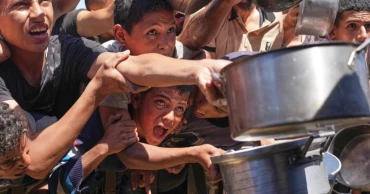
At a charity kitchen in Khan Younis, desperate residents lined up with empty containers, hoping for a portion of lentil soup. Displaced mother Halima Abu Amra said her injured daughter survives on discarded, soaked bread, while her younger children eat only soup.
The World Food Program reported that 15 of its aid trucks were looted in southern Gaza on Thursday night, citing growing desperation and lawlessness.
Israel says the current aid is temporary until a new U.S.-backed initiative begins. The Gaza Humanitarian Foundation (GHF), a private organization, is expected to manage future aid efforts, using armed contractors for security. Israel claims the move is necessary to prevent Hamas from diverting aid.
The U.N. has rejected this plan, arguing that it undermines international law and humanitarian standards. Guterres stated that the U.N. already has the capacity to deliver aid via 9,000 trucks.
Meanwhile, a Geneva-based advocacy group has initiated legal proceedings to push Swiss authorities to oversee the GHF, which is registered in Switzerland. The foundation insists it operates independently and within humanitarian guidelines.
Ceasefire Talks Stalled
Ceasefire negotiations in Doha have hit a deadlock. Prime Minister Netanyahu withdrew his top negotiating team, citing lack of progress. A smaller team remains in place.
Qatari Prime Minister Mohammed bin Abdulrahman Al Thani said the two sides remain far apart. Hamas accused Netanyahu of pretending to negotiate in bad faith.
The war began with a Hamas-led assault on southern Israel that killed about 1,200 people and led to the abduction of 251. In response, Israel launched a devastating campaign in Gaza, which has since claimed over 53,000 Palestinian lives, primarily women and children, according to Gaza’s Health Ministry.
Rising West Bank Violence
The conflict has also escalated violence in the occupied West Bank. In Bruqin, Israeli settlers reportedly attacked Palestinian residents on Thursday, torching vehicles and damaging homes. The U.N. confirmed that eight people were injured, mostly while trying to put out fires.
Israeli strikes kill 51 in Gaza as limited aid begins to arrive
Mustafa Khater, a local resident, said settler violence had been ongoing for days. He evacuated his family out of fear but stayed behind to protect their home.
The West Bank has seen an upsurge in both settler and military violence since the Gaza war began, with large Israeli operations targeting militants, killing hundreds and displacing many, while also triggering Palestinian attacks on Israelis.
1 year ago
.jpg)
Israeli strikes on Gaza kill 10, including senior militant
Israel unleashed a wave of airstrikes Friday on Gaza, killing at least 10 people, including a senior militant, according to Palestinian officials. Israel said it targeted the Islamic Jihad militant group in response to an “imminent threat” following the recent arrest of another senior militant.
Hours later, Palestinian militants launched a barrage of rockets as air-raid sirens wailed in Israel and the two sides drew closer to another all-out war. Islamic Jihad claimed to have fired 100 rockets.
Israel and Gaza’s militant Hamas rulers have fought four wars and several smaller battles over the last 15 years at a staggering cost to the territory’s 2 million Palestinian residents.
A blast was heard in Gaza City, where smoke poured out of the seventh floor of a tall building. Video released by Israel’s military showed the strikes blowing up three guard towers with suspected militants in them.
Also read: Israeli strikes on Gaza kill 8, including senior militant
In a nationally televised speech, Israeli Prime Minister Yair Lapid said his country launched the attacks based on “concrete threats.”
“This government has a zero-tolerance policy for any attempted attacks — of any kind — from Gaza towards Israeli territory,” Lapid said. “Israel will not sit idly by when there are those who are trying to harm its civilians.”
He added that “Israel isn’t interested in a broader conflict in Gaza but will not shy away from one either.”
The violence poses an early test for Lapid, who assumed the role of caretaker prime minister ahead of elections in November, when he hopes to keep the position. He has experience in diplomacy, having served as foreign minister in the outgoing government, but his security credentials are thin.
Hamas also faces a dilemma in deciding whether to join a new battle barely a year after the last war caused widespread devastation. There has been almost no reconstruction since then, and the isolated coastal territory is mired in poverty, with unemployment hovering around 50%.
The Palestinian Health Ministry said a 5-year-old girl and a 23-year-old woman were among those killed in Gaza, without differentiating between civilian and militant casualties. The Israeli military said early estimates were that around 15 fighters were killed. Dozens of people were wounded.
Islamic Jihad said Taiseer al-Jabari, its commander for northern Gaza, was among the dead. He had succeeded another militant killed in an airstrike in 2019.
An Israeli military spokesman said the strikes were in response to an “imminent threat” from two militant squads armed with anti-tank missiles. The spokesman, who briefed reporters on condition of anonymity, said al-Jabari was deliberately targeted and had been responsible for “multiple attacks” on Israel.
Hundreds marched in a funeral procession for him and others who were killed, with many mourners waving Palestinian and Islamic Jihad flags and calling for revenge.
Israeli media showed the skies above southern and central Israel lighting up with rockets and interceptors from Israel’s Iron Dome missile-defense system. An explosion was heard in Tel Aviv.
It wasn’t immediately clear how many rockets were launched, and there was no immediate word on any casualties on the Israeli side.
Israel continued to strike other targets Friday, including weapon-production facilities and Islamic Jihad positions.
The U.N. special envoy to the region, Tor Wennesland, said he was “deeply concerned.”
“The launching of rockets must cease immediately, and I call on all sides to avoid further escalation,” he said.
Following the initial Israeli strikes, a few hundred people gathered outside the morgue at Gaza City’s main Shifa hospital. Some went in to identify loved ones and emerged later in tears.
“May God take revenge against spies,” shouted one, referring to Palestinian informants who cooperate with Israel.
Defense Minister Benny Gantz approved an order to call up 25,000 reserve soldiers if needed while the military announced a “special situation” on the home front, with schools closed and limits placed on activities in communities within 80 kilometers (50 miles) of the border.
Israel closed roads around Gaza earlier this week and sent reinforcements to the border as it braced for a revenge attack after Monday’s arrest of Bassam al-Saadi, an Islamic Jihad leader, in a military raid in the occupied West Bank. A teenage member of the group was killed in a gunbattle between the Israeli troops and Palestinian militants.
Hamas seized power in the coastal strip from rival Palestinian forces in 2007. Its most recent war with Israel was in May 2021, and tensions soared again earlier this year following a wave of attacks inside Israel, near-daily military operations in the West Bank and tensions at a flashpoint Jerusalem holy site.
Islamic Jihad leader Ziad al-Nakhalah, speaking to Al-Mayadeen TV network from Iran, said “fighters of the Palestinian resistance have to stand together to confront this aggression.” He said there would be “no red lines” and blamed the violence on Israel.
Hamas spokesman Fawzi Barhoum said “the Israeli enemy, which started the escalation against Gaza and committed a new crime, must pay the price and bear full responsibility for it.”
Islamic Jihad is smaller than Hamas but largely shares its ideology. Both groups are opposed to Israel’s existence and have carried out scores of deadly attacks over the years, including the firing of rockets into Israel. It’s unclear how much control Hamas has over Islamic Jihad, and Israel holds Hamas responsible for all attacks emanating from Gaza.
Israel and Egypt have maintained a tight blockade over the territory since the Hamas takeover. Israel says the closure is needed to prevent Hamas from building up its military capabilities, while critics say the policy amounts to collective punishment.
Mohammed Abu Selmia, director of the Shifa hospital, said hospitals faced shortages after Israel imposed a full closure on Gaza earlier this week. He said there were enough supplies and essential drugs to sustain hospitals for five days in normal times, but that with a new round of fighting underway, “they may run out at any moment.”
Israel called off an expected fuel delivery for Gaza’s sole power plant, which was expected to shut down early Saturday if the fuel did not enter the territory. Even when the plant is running at full capacity, Gazans still endure daily power outages that last several hours.
Earlier Friday, a couple of hundred Israelis protested near the Gaza Strip to demand the return of the remains of two Israeli soldiers held by Hamas.
The protesters were led by the family of Hadar Goldin, who along with Oron Shaul was killed in the 2014 Gaza war. Hamas is still holding their remains, as well as two Israeli civilians who strayed into Gaza and are believed to be mentally ill, hoping to exchange them for some of the thousands of Palestinian prisoners held by Israel.
Israel says there can be no major moves toward lifting the blockade until the soldiers’ remains and captive civilians are released. Israel and Hamas have held numerous rounds of Egyptian-mediated talks on a possible swap.
4 years ago