Economist Dr Debapriya Bhattacharya
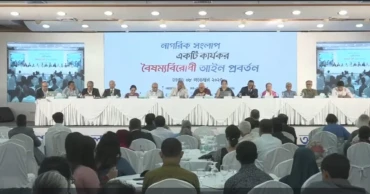
Parties must pledge in election manifestos to eliminate discrimination: Debapriya
Economist Dr Debapriya Bhattacharya on Saturday (8th November 2025) urged political parties to make a firm commitment in their election manifestos to eradicate all forms of discrimination from the country’s legal and social frameworks.
“Political parties have to pledge to eradicate discrimination from the legal context in their election manifestos,” said Dr Debapriya, Convener of the Citizen’s Platform for SDGs, Bangladesh.
He emphasised that the Citizen’s Platform is dedicated to eliminating discrimination in every form within legal and societal structures, and that the inclusion of such commitments in election manifestos would represent a strong step towards implementation in the future.
Interim govt pursuing reforms without engaging stakeholders: Debapriya
Dr Debapriya made the remarks while addressing the opening session of a dialogue titled “Elimination of Discrimination in Bangladesh: Legal Context, Current Reality, and Way Forward.”
He highlighted the gap between constitutional promises and the lived realities of marginalised and vulnerable communities across the country.
Citizen’s Platform for SDGs, Bangladesh organised the event in collaboration with the Bangladesh Legal Aid and Services Trust (BLAST), Manusher Jonno Foundation, and Nagorik Uddyog (Citizen’s Initiative), with support from Switzerland and UNDP.
Read more: Bangladesh Election: EC to begin political dialogues this week
11 months ago

Proposed budget ‘disappointing in many ways’: Debapriya
Eminent economist Dr Debapriya Bhattacharya on Wednesday described the proposed budget for the 2025–26 fiscal year as “in many ways, a budget of disappointment.”
“This (budget) has turned out to be a budget of disappointment in many cases, this disappointment has come from expectations because our desire was something different, but we are seeing that in many cases it is traditional,” he said.
The distinguished fellow of Centre for Policy Dialogue (CPD) made the remarks while delivering his introductory speech at a discussion meeting titled ‘National Budget 2025-26: What is there for the left-behinds’.
Citizen’s Platform for SDGs, Bangladesh organised the programme at a city hotel where Senior Research Fellow of the CPD Towfiqul Islam Khan presented the keynote speech at the event.
Dr Debapriya said this budget was the budget of big expectation as the government has come through a big political uprising.
“This government has been formed through an anti-discrimination spirit. So, this budget was supposed to be something different, we have that huge expectation from this budget,” he said.
The CPD distinguished fellow also alleged that this budget was presented to the public before getting a nod from the cabinet. “Usually, the budget passed in the cabinet first, this has come in front of people without administrative and state approval,” he said.
Senior Research Fellow of the CPD Towfiqul Islam Khan, in his keynote speech, mentioned that Macroeconomic realities are not fully reflected in the setting benchmark and economic policy.
“Fiscal framework remains unrealistic and expected to go through a significant change as the tradition of the past regime continues, Fiscal measures lack transparency and are often not backed by evidence with the legalising black money provision remaining in place without justification,” he said.
He mentioned that Revenue mobilisation will continue to rely on indirect taxes, disproportionately putting a burden on low-income people; the budget signals no meaningful structural shift in revenue mobilisation. “Limited fiscal space will continue to haunt Bangladesh.
TIB comes down hard on govt for retaining black money whitening provision
Towfiqul Islam Khan said there is no significant positive change in allocating resources for priority sectors for the LNOB groups although social protection has brought some positive changes.
“ADP allocation mirrors past trends, with no major shift in priorities or project quality improvements,” he said.
He said the budget remains disconnected from the government's broader reform agenda, Budget process lacks inclusivity and rigour, and political actors were completely ignored, and data transparency remains poor,” he observed.
In the winding up speech, Dr Drbapriya Bhattacharya called the 2025-26 as the budget of mistakes and errors, anti-reform budget and anti-equality budget.
He attributed this outcome partly to citizens, citing a "demand-side failure"—a lack of sufficient public pressure on the interim government.
“Taking lessons from this we have to continue our pressure on the government in the coming days. Election will be held today or tomorrow, we have to put this pressure on the future leaders,” he said.
He said the financial security of the already solvent section of society could be at risk if 80 percent of the population continues to be neglected.
Social security programmes get bigger allocations in national budget for FY26
1 year ago
.jpg)
Economy needs transitional policy to overcome the crisis: Debapriya
Noted Economist Dr Debapriya Bhattacharya on Thursday called for a ‘transitional policy understanding’ to overcome the ongoing financial turmoil in the country’s economy.
"The main villain of the economy is the weakness of the financial sector. The reason for this is the lack of reforms that have been accumulating for a long time. Its effects are now visible. We are unable to move forward without a transitional policy,” he said.
Debapriya, a distinguished fellow of think tank Centre for Policy Dialogue (CPD), made the remarks at a media conversation with economic reporters on “Overcoming the Current Economic Challenges – Towards a Transitional Policy Understanding.”
Also read: A roadmap needed for debt repayment of 20 mega projects: Debapriya
“The current crisis is only a symptom of the disease, because of the lack of reform. He said that the government has to reduce the subsidy to deal with the crisis in the financial sector. But now it was more necessary to give subsidies to protect poor people to control inflation,” he said.
He said Bangladesh’s economy is yet to go back to the pre-COVID benchmark and experiencing fragmented recovery and macroeconomic stability is under high stress, particularly due to inflationary pressure and unstable foreign exchange rate with the local currencies.
Besides, the global economy’s prospects for FY23 --commodity price rise, supply chain disruption, and logistic, increase in transportation cost – are bad for Bangladesh, he argued.
In such a situation the economy needs a transitional policy understanding for a period of 2-3 years to overcome the uncertainties (national and global) for stabilization and consolidation of the economy with a short-term outlook.
Export-Import deficit of USD $33.25 billion, the current account deficit of $18.70 billion, and the overall external deficit of $5.38 million, these are the symptoms of the disease, not the disease itself, he mentioned.
The revenue share in GDP did not go up more than 10 per cent of GDP, the share of income and asset tax in total revenue stagnated at around 30 per cent, and the budget deficit was increasingly being funded by borrowing from banks, all are the elements of fiscal mismanagement, he said.
Also read: Food production, price control should get prioritised in budget: Dr. Debapriya
In reply to a query, he said the recent fuel oil price hike is disagreeable and imprudent, the economy will not be benefited from this move in the current context domestic economic situation, he said.
Debapriya pointed out that the government has cut subsidies in the oil sector, which are now diverted to pay the capacity charge of rental power plants.
He urged to increase the interest of bank lending to 12 per cent for a moderate credit growth, and protect depositors increasing its rate to 8-9 per cent.
He also called for ending the direct central bank’s interference in fixing the exchange rate, rather it should be fixed by the competitive market rate.
In reply to another query, he said people will pay revenue eagerly when they can see transparency and adaptation in government expenditure including procurement.
4 years ago