E-cigarette
E-cigarettes, emerging tobacco products fully banned in Bangladesh
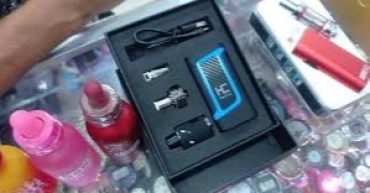
E-cigarettes, vapes and other emerging tobacco products have been completely banned in Bangladesh as the Smoking and Tobacco Products Use Control (Amendment) Ordinance, 2025 has come into effect with provisions for jail terms and hefty fines for violations.
The ordinance, proposed by the Health Services Division under the Ministry of Health and Family Welfare to strengthen the existing Smoking and Tobacco Products Use Control Act, 2005, came into effect on December 30 following approval by the President, said the Chief Adviser’s press wing on Thursday.
Under the new law, the production, import, export, storage, sale and use of e-cigarettes and emerging tobacco products have been declared punishable offences.
Violators may face up to six months in jail and a fine of up to Tk 5 lakh.
Foreign cigarettes imported under false declaration seized at Ctg Port
The other objectives of the ordinance are to protect people from the harmful effects of tobacco and nicotine products and repeal separate laws related to bidi production by introducing a unified legal framework.
Penalties have been significantly increased under the amended ordinance with provisions for cancellation of licences and seizure of goods in the case of companies.
The ordinance also includes provisions for filing and conducting cases under the Code of Criminal Procedure
One of the key changes is the expansion of the definition of ‘tobacco products’ to include e-cigarettes, Electronic Nicotine Delivery Systems, Heated Tobacco Products and nicotine pouches.
The government has also been empowered to declare any similar product as a tobacco product through gazette notification.
Separate definitions for ‘nicotine’ and ‘nicotine products’ have been added, while the scope of ‘public place’ has been significantly broadened.
The government also banned the use of tobacco products in all public places and public transport.
The fine for violating this provision has been increased from Tk 300 to Tk 2,000.
All forms of tobacco advertising and promotion have been prohibited in print, electronic and online media, including social media and OTT platforms.
The sale of tobacco products has also been banned within 100 metres of educational institutions, hospitals, clinics, playgrounds and children’s parks.
Display and promotion of tobacco packs at points of sale have been banned,along with the use of tobacco company names or logos in corporate social responsibility activities and financial sponsorship of events or programmes by tobacco companies.
The ordinance has imposed a complete ban on the production, marketing and use of bidis made from kumbi leaves and tendu leaves.
Tk 5,000 fine for selling cigarettes near schools, hospitals
Mixing any harmful or addictive substances with tobacco or tobacco products has been declared a punishable offence.
The law has further strengthened provisions on health warnings and standard packaging, making it mandatory for tobacco packs to carry graphic health warnings covering 75 percent of the package.
The sale of tobacco products without standard packaging has been prohibited.
9 months ago

Tobacco control interventions: Banning e-cigarettes to make things worse, say experts
Bangladesh's goal of becoming a tobacco-free country by 2040 will be hindered if e-cigarettes are banned, experts said Thursday.
They were speaking at the webinar "Save Vaping, Save Bangladesh" organised by the Bangladesh-based Voices of Vapers.
The experts addressed the recent proposal to ban vape and other alternative and heat-not-burn tobacco products in a new amendment to the country's tobacco control legislation.
Dr Delon Human, president of Health Diplomats and an expert on harm reduction, said there is no evidence for the statement that nicotine in vapes are more harmful than cigarettes, as claimed by the National Tobacco Control Cell.
"There needs to be a credible harm reduction strategy as practised by many developed countries," he added.
"The authorities must consider regulating a safer alternative such as vape and make it accessible to smokers wanting to quit."
Read: BENDSTA for scrapping vape ban from draft Tobacco Control Amendment bill
Schumann Zaman, president of Bangladesh Electronic Nicotine Delivery System Traders Association (BENDSTA), said not recognising vape traders and vape users as stakeholders will have major consequences as many of these vapers are using e-cigarettes as a smoking cessation tool.
John Dunne, director general of the UK Vaping Industry Association, said vapes should be regulated separately because vapes and cigarettes are different products.
"In fact, vapes are far safer and a proven method of nicotine replacement therapy (NRT). Regulating vapes will help smokers who are trying to quit have access to vapes," he added.
"Countries such as the UK, France, New Zealand and Canada have successfully lowered smoking rates by using vaping as NRT. Banning vapes will lower the number of smokers trying to quit."
4 years ago