political gains
Stock market manipulated for political gains: Amir Khosru
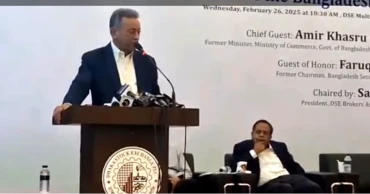
BNP standing committee member Amir Khosru Mahmud Chowdhury on Wednesday said the government didn’t own the stock market rather it was abused for political gains for the last 15-16 years.
“The stock market was used for political exploitation for the last 15-16 years instead of owning it,” he said.
The BNP leader made this remark while addressing a roundtable discussion on ‘the current state of the Bangladesh Capital Market and Way Forward’ held at DSE Multipurpose Hall in the city’s Nikunja area.
Those discovering 'Ziaism' have bad intentions: Amir Khosru
He said it must be admitted that none of past governments of Bangladesh could ever own the stock market. The stock market had been considered as a third matter or separate thing outside the economy. “But it is a driving force for the economy,” he said.
Amir Khosru, also the founding chairman of Chittagong Stock Exchange, said the stock market was neglected despite its significant role in the economy.
He said the first and foremost thing is that the government must own the stock market for the sake of the economy.
The former commerce minister stressed the need for integrating the stock market and other related forces of the economy.
BNP’s Khosru seeks impartial interim govt for national election
“We can surely tell you if there is a change in the government and we’ll get scope (to run the government) being elected with the votes of the country’s people, we’ll own the stock market,” he said.
He put emphasis on ensuring transparency and self-regulation as well as making those who looted the share market accountable.
He said those who looted the stock market need to be identified and bring them under a new legal process. If it could not be done, then the manipulators will continue the same things directly or indirectly in the share market because at the end of the day, money talks after all. The brokers association should be careful about it, he said.
“I would like to request that you please make sure that those who manipulated the stock market and looted the money of million common people must be accountable,” said Khosru
Former chairman of Bangladesh Security and Exchange Commission Faruq Ahmad Siddiqi also spoke at the function chaired by President of DSE Brokers Association of Bangladesh Saiful Islam.
1 year ago

“Please don’t use labour weaknesses as a tool to achieve political gains”
Foreign Minister Dr AK Abdul Momen has urged the International Labour Organization (ILO) to join Bangladesh in its forward-looking efforts without dragging them into the unfortunate past that otherwise only helps serve some “vested” national and international interests and agenda.
“Please don’t use labour weaknesses, if there be any, as a tool to achieve political gains, rather try to help and assist to overcome those weaknesses with generous support and financing,” he said.
The Foreign Minister was speaking at a national seminar on “Fundamental Principle and Rights at Work” held at the Foreign Service Academy to discuss the progression in the area of labour rights, decent work and social justice.
It has been 50 years since Bangladesh joined the ILO as a member state. To mark the occasion, the Ministry of Foreign Affairs and ILO jointly organised the seminar.
Momen said he publicly made these observations in the spirit of Bangladesh’s “constructive engagement” with ILO and in their mutual interest.
He reiterated that the government of Bangladesh remains willing to facilitate appropriate course-corrections in the labour and employment sectors in response to its socio-economic context at any given time.
“We would, however, expect our relevant international partners including ILO to acknowledge the value of local level knowledge and insights without taking a one-sided prescriptive approach that one model fits all,” Momen said.
He said the government remains determined to navigate the current cost-of-living crisis in the wake of the war in Ukraine by continuing its efforts to create decent jobs for the young workforce and by expanding the reach of social safety nets to help poor households offset the inflationary pressures.
“It is critical that the international financial institutions provide the required fiscal space to developing countries like ours by taking certain proven policy measures in the face of a likely global recession,” he said.
Read: Momen seeks Kuwaiti, Iranian support on Rohingya issue
Momen recalled ILO’s resurgence and relevance in the international policy discourse during the global financial crisis of 2008-09. “We would wish to see ILO living up to its expected role as we countenance yet another multiple crisis period.”
Speaking at the seminar, ILO’s Assistant Director-General and Regional Director for Asia and the Pacific Chihoko Asada-Miyakawa said ILO will continue to support the government with the application of ratified conventions.
ILO has supported a systematic approach to skills governance and anticipates further modernization and ILO is committed to continue this partnership, she said, adding that “Together with the government and social partners we will continue to strive to reach common goals.”
The ILO senior official said the overarching goal is to see Bangladesh achieve an economic and social recovery from the crisis that is fully inclusive, systematic and resilient.
She laid emphasis on strengthening policies that prioritise the creation of decent works for all and address the inequalities.
Reaching this goal will mean making progress through a comprehensive agenda and promote quality employment, economic development, workers protection, universal protection and social dialogue, Asada-Miyakawa said.
She highly appreciated Bangladesh’s commitment in advancing the decent work for all.
Flagging five specific issues of interest for reinforcing and recalibrating future cooperation with ILO, Momen hoped that ILO would give enhanced focus on supporting the government and social partners for the rapid transformations to be taking place in the world of work due to climate change, digitization, artificial intelligence and other factors.
“We would like to see ILO taking a future-leaning approach in supporting our long-term development aspirations in lieu of resorting to short-term project-driven engagements carried out through hired expertise,” he said.
Secondly, he said, Bangladesh wants to see ILO take a more vocal stand in favour of upholding the fundamental rights at work for migrant workers around the world.
It is unfortunate that the international trade union bodies often pay nothing more than lip service for protecting the rights and interest of migrant workers, he said.
Read: Democracy in US has weaknesses too: Momen
Momen said Bangladesh wishes to see ILO as a partner in capacity building and not necessarily appropriate what should be matters of local competence.
“ILO is expected to act as a UN agency and appreciate the dynamics of national or local narratives and aspirations,” he said.
Bangladesh, like many other countries, had experienced some gravely tragic incidents in the labour sector, even till recently.
“As a nation with a resilient spirit, it is our continuous effort to learn from those tragedies and overcome the structural and systemic constraints underlying those incidents,” Momen said.
The foreign minister said Bangladesh remains convinced that without a productive workforce employed in a decent work environment, it would be a challenge for them to realize the Vision 2041.
“Our government will sustain the momentum of reforms in the labour sector building on our shared achievements and experiences in the last fifty years,” he said, adding that Bangladesh has proved itself to be a poster child for much of the UN's development activities.
Foreign Secretary Masud Bin Momen and other stakeholders spoke at the seminar.
3 years ago