BD-Japan
Japan invites PM Tarique, eyes cooperation with Bangladesh to realise FOIP
Japan has invited Prime Minister Tarique Rahman to pay an official visit at a mutually convenient time as Tokyo reaffirmed its commitment to further strengthening bilateral relations with Dhaka.
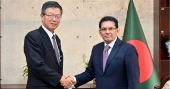
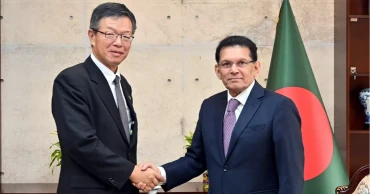
Japanese Ambassador to Bangladesh Shinichi Saida, who met Foreign Minister Dr Khalilur Rahman at the Foreign Ministry on Tuesday, conveyed the invitation for the Prime Minister to visit Japan, said the Ministry of Foreign Affairs.
Shama Obaed Islam, State Minister for Foreign Affairs; Humayun Kabir, Adviser to the Ministries of Foreign Affairs, Disaster Management and Relief, and Civil Aviation and Tourism; Mahdi Amin, Adviser to the Ministries of Education, Primary and Mass Education, Expatriates’ Welfare and Overseas Employment, and Labour and Employment; Dr Neyamat Ullah Bhuiyan, Senior Secretary, Ministry of Expatriates’ Welfare and Overseas Employment; and Asad Alam Siam, Foreign Secretary were, among others, present.
During the meeting, Ambassador Saida congratulated Foreign Minister Dr Khalilur Rahman on his assumption of office.
The Ambassador said Japan will work with Bangladesh under the Strategic Partnership to further steadily deepen bilateral relations and collaborate to realise a Free and Open Indo-Pacific (FOIP).
They also exchanged views on a wide range of issues, including Japan’s development assistance, trade and investment, defence cooperation and other bilateral items.
The two sides discussed cooperation under the Employment Skill Development Programme (ESDP), with particular focus on skills enhancement and Japanese language training for Bangladeshi workers aspiring to work in Japan.
The Foreign Minister underscored the importance of improved access to information and proposed the development of a digital matchmaking platform to facilitate recruitment of skilled Bangladeshi workers by Japanese employers.
Discussions were also held on defence procurement, metro rail cooperation and mutual support in international forums.
Earlier in the day, the Japanese Ambassador paid a courtesy call on State Minister for Foreign Affairs Shama Obaed Islam.
Recalling Japan’s early recognition of Bangladesh, the State Minister reaffirmed her commitment to advancing Bangladesh-Japan relations and appreciated Japan’s continued support, including on the Rohingya issue.
7 months ago
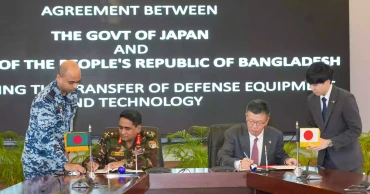
Dhaka, Tokyo sign deal over transfer of defence equipment, technology
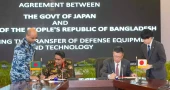
Bangladesh and Japan have signed an agreement over ‘transfer of defence equipment and technology’ which is expected to ensure ‘appropriate control’ over the defence equipment and technology transferred between the two countries.
Lieutenant General SM Kamrul Hassan, Principal Staff Officer, Armed Forces Division, Chief Adviser’s Office of Bangladesh and Saida Shinichi, Ambassador Extraordinary and Plenipotentiary of Japan to Bangladesh, signed the deal on behalf of their respective sides on Tuesday.
The agreement entered into force on February 3, officials said.
The strategic partnership and long-standing friendship between the two countries have been elevated to new heights through this agreement, the ISPR said in a media release.
Bangladesh approves proposal to sign EPA with Japan
It mentioned that the strategic partnership between Bangladesh and Japan in South Asia will be further deepened, making an important contribution to regional stability and global security.
The ISPR said the agreement is expected to further accelerate Bangladesh’s defense modernisation process.
The deal establishes a legal framework for the governments of Japan and Bangladesh regarding the handling of defence equipment and technology to be transferred between the two governments in order to implement projects to be jointly determined, including those contributing to international peace and security, said the Japanese Ministry of Foreign Affairs.
Specifically, it stipulates procedures to determine and confirm each specific transfer as well as basic rules on the proper use of the transferred defence equipment and technology.
The agreement, Japan said, will ensure appropriate control over the defence equipment and technology transferred between Japan and Bangladesh, especially regarding any subsequent transfer to a third party or any extra-purpose use.
It is expected that this agreement will contribute to closer cooperation between Bangladesh and Japan for defence equipment and technology, and maintaining and improving the production and technological bases for Japan’s defence industry, thereby contributing to the security of Japan, said the Japanese side.
Quoting sources at the Armed Forces Division, the ISPR said the signing of the agreement was made possible through intensive and continuous efforts by both sides since 2023.
It said the defense agreement reflects the deep mutual trust, shared vision and cooperation between the two countries, achieved through the visionary and effective diplomacy of the interim government of Bangladesh.
The agreement has been executed in full compliance with the principles of the United Nations Charter and will create an institutional framework for the acquisition of advanced technology and defense equipment, as well as for joint research and development, to help establish international peace and security and protect the independence and sovereignty of Bangladesh.
Japan, South Korea leaders drum to K-pop after summit
The ISPR said the signing of this historic agreement will increase the exchange of military experts between the two countries, which is expected to play an important role in strengthening Bangladesh’s defense capabilities and implementing future action plans.
According to the ISPR, the agreement is also expected to play a significant role in enhancing strategic relations and military cooperation between the two countries.
8 months ago
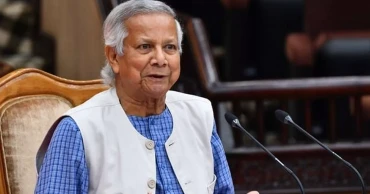
Prof Yunus seeks accelerated development of MIDI infrastructures
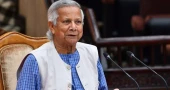
Chief Adviser Professor Muhammad Yunus has called for the expedited development of key infrastructure in the Matarbari region, aiming to transform the coastal area into Bangladesh's premier manufacturing and export-orientated free trade zone.
Prof Yunus announced that the development of the MIDI region would be a focal point during his upcoming two and a half days of official visit to Japan, beginning on May 28, said Chief Adviser's Deputy Press Secretary Abul Kalam Azad Majumder.
Ways needed to overcome hurdles for stronger ties with Pakistan: Chief Adviser
He is scheduled to attend the 30th Nikkei Future of Asia conference in Tokyo and hold bilateral talks with Japanese Prime Minister Shigeru Ishiba on May 30, aiming to secure funding for key projects.
During a high-level meeting on Monday at the State Guest House Jamuna in Dhaka, Prof Yunus reviewed the progress of the Moheshkhali-Matarbari Integrated Infrastructure Development Initiative (MIDI).
The session was chaired by Principal Secretary Md Siraj Uddin Miah and attended by SDG Coordinator Lamiya Morshed, along with secretaries from the Road Transport, Shipping, Energy, Power and Local Government ministries. Sarwar Alam, Director General of the MIDI Cell, presented a comprehensive review of ongoing MIDI projects.
Emphasising the strategic importance of the region, Professor Yunus said, "We envision Matarbari as the nation's largest hub for ports, logistics, manufacturing and energy. To realise this vision, we must attract substantial foreign investment."
He highlighted the interest of international investors in these sectors and underscored the necessity of a master plan to facilitate such investments.
The Chief Adviser directed the Road Transport and Shipping Secretaries to accelerate the construction of roads connecting the MIDI region to the rest of the country and to develop terminals capable of accommodating large ocean-going container vessels.
He also stressed the importance of urban development in the area, including building a planned city to support the anticipated influx of workers in the free trade zone and associated industries.
The meeting also revealed Japan's intention to establish its second exclusive Japanese economic zone within the MIDI region. Araihazar, Narayanganj, is the site of the first Japanese Economic Zone. It has already attracted sizeable foreign investments.
Besides, several international companies, including Saudi Arabian petrochemical giant Aramco, Abu Dhabi Ports, Saudi Arabian port operator Red Sea Gateway, Japanese power producer JERA and Malaysian petrochemical company Petronas, have expressed interest in investing in the area.
Dhaka has recently signed an agreement with Japanese firms Penta-Ocean Construction Co., Ltd. and TOA Corporation to construct the country's first deep-sea port at Matarbari.
This project, supported by the Japan International Cooperation Agency (JICA), is a cornerstone of the MIDI initiative and is expected to enhance the region's connectivity and economic potential.
BNP delegation to meet Chief Adviser on April 16
The MIDI initiative represents a collaborative effort between Bangladesh and Japan to transform the Moheshkhali-Matarbari region into a strategic economic corridor, integrating logistics, energy, and industrial development.
1 year ago
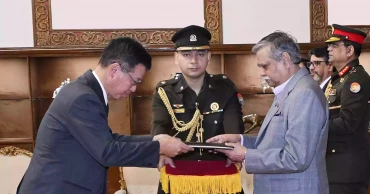
President seeks increased Japanese investment in emerging sectors
President Mohammed Shahabuddin on Wednesday urged Japan to enhance its investment in Bangladesh, particularly in emerging sectors such as automobiles, ICT, medical equipment, light engineering, consumer electronics and tourism.
The President made the request during a meeting with newly appointed Japanese Ambassador to Bangladesh Shinichi SAIDA at Bangabhaban.
Ambassador SAIDA presented his credentials to the President at Bangabhaban, where a smart contingent of the Presidential Guard Regiment accorded him a guard of honour.
After the meeting, President’s Press Secretary Md. Sarwar Alam briefed reporters, highlighting the key points of their discussion.
President Shahabuddin said that Japan is Bangladesh’s largest bilateral development partner, with the relationship between the two nations recently elevated to a strategic partnership.
He emphasised Japan’s commitment under the BIG-B Initiative (Bay of Bengal Industrial Growth Belt), which has been pivotal for Bangladesh’s development. To date, the country has received over USD 23 billion in Japanese grants and loans.
President urges Kuwait to recruit more manpower from Bangladesh
The President expressed satisfaction with the growing volume of bilateral trade, currently standing at around USD 4 billion annually, and acknowledged Japan as one of Bangladesh’s top five export destinations.
He highlighted the presence of over 350 Japanese companies operating in Bangladesh and encouraged further investment in diverse sectors.
The President also urged the ambassador to consider increasing the recruitment of Bangladeshi workers, particularly caregivers and nurses, while seeking Japanese support for technical and language skill development for prospective Bangladeshi employees.
Acknowledging Japan’s continued humanitarian assistance for the Rohingya population in Bangladesh, President Shahabuddin requested the Japanese government to persist in its efforts to ensure the safe, sustainable, and dignified repatriation of the Rohingyas to Myanmar’s Rakhine State.
The President also extended an invitation to the Emperor, Empress, and members of the Japanese Imperial Family to visit Bangladesh at a mutually convenient time.
In response, Ambassador SAIDA expressed Japan’s keen interest in diversifying its investments in Bangladesh and assured the President of his full cooperation in strengthening bilateral ties during his tenure.
President’s Military Secretary Major General Mohammad Adil Chowdhury, Press Secretary Sarwar Alam, and Foreign Secretary Jasim Uddin were present during the meeting.
1 year ago

Dhaka, Tokyo to elevate bilateral ties to ‘strategic partnership’
Bangladesh and Japan want to elevate the bilateral relations to ‘strategic partnership’ level during Prime Minister Sheikh Hasina’s upcoming visit to Japan.
The Prime Minister is scheduled to visit Japan from November 29 to December 1, at the invitation of Japanese Prime Minister Fumio Kishida.
The planned visit was discussed when the Director General of Southeast and Southwest Asian Affairs of Japan’s Ministry of Foreign Affairs Arima Yutaka met Foreign Secretary Masud Bin Momen in Dhaka on Thursday.
At the meeting, both sides expressed satisfaction at the growing bilateral relations between the two countries.
They particularly highlighted the visit of Prime Minister Sheikh Hasina to Japan in May 2014, when she and the then Prime Minister of Japan Shinzo Abe elevated the bilateral relations between the countries to ‘Comprehensive Partnership’ level, and also the visit of Shinzo Abe to Bangladesh in September 2014, when the two countries forged deeper economic partnership under BIG-B.
Read: PM’s Japan Visit: Dhaka to seek more investment, financing for big projects
Both sides expected that during PM Hasina’s upcoming visit, Bangladesh and Japan would foster deeper economic partnership in terms of development cooperation, trade and investment, human resources development, agriculture, ICT, education, defence dialogue and exchanges, people-to-people connectivity, repatriation of Rohingyas, etc.
The two sides also expressed the desire to enhance cooperation in international fora, including on climate change, UN reforms, disarmament and non-proliferation, etc.
Ambassador of Japan to Bangladesh Ito Naoki and Director General (East Asia and Pacific) of the Ministry of Foreign Affairs also joined the meeting.
The Director General of the Ministry of Foreign Affairs of Japan is on a two-day visit to Dhaka to discuss the preparations of Prime Minister Sheikh Hasina’s upcoming visit to Japan.
3 years ago