Peru Congress
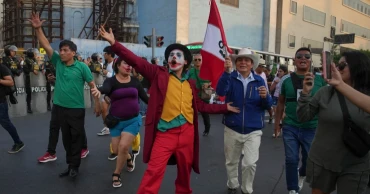
Peru's Congress votes to oust the interior minister for failing to halt killings
Peru's Congress voted Friday to remove the interior minister from office after deciding that he had failed to adequately handle rising violent crime in the Andean country.
Interior Minister Juan José Santiváñez by law has 72 hours to leave his position after the no-confidence vote, which succeeded with 78 votes in favor, 11 against and 20 abstentions. Santiváñez insisted that he had worked hard alongside police during his 10 months in office, but that he would respect the lawmakers' decision.
Santiváñez must step down and take responsibility for his “inability to address the wave of citizen insecurity the country is facing,” the Peruvian Congress said on its X account.
Public outrage has surged over an increase in killings and other violence, especially the killing Sunday of Paul Flores, the 39-year-old lead singer of the cumbia band Armonia 10. He was fatally shot when assailants attacked his band's tour bus after a concert in Lima.
Fire at London's Heathrow Airport leaves thousands of travelers in trouble
In reaction to the Flores killing, President Dina Boluarte on Monday declared a state of emergency in the capital and ordered the deployment of soldiers to help police address the surge of violence. That same day, opposition lawmakers requested a vote of no confidence against the interior minister.
Boluarte’s government previously had decreed a state of emergency from September to December in an attempt to stem the violence.
Authorities reported 2,057 killings in 2024, up from 1,506 in 2023.
1 year ago

Peru Congress to reconsider early election, unrest continues
Peru's Congress is set Tuesday to consider holding early elections, beset by protesters who have blocked highways and clashed with security forces amid deadly nationwide unrest ever since the lawmakers ousted President Pedro Castillo.
It's the second time in days that the lawmakers — easily the most reviled of a widely discredited political elite — are taking up the proposal to push forward to next year the elections for president and Congress originally planned for 2026.
The measure has the backing of caretaker President Dina Boluarte, who took over from Castillo after the former rural school teacher tried to dissolve Congress on Dec. 7 — a move widely condemned by even his leftist supporters as a self-coup and act of political suicide. After the failed move, he was swiftly arrested.
Read more: Peru judge orders 18-month detention for ousted president
The early elections proposal failed to muster enough votes last week after leftist lawmakers abstained, conditioning their support on the promise of a constitutional assembly to overhaul Peru's political charter — something that conservatives denounce as putting Peru's free market economic model at risk.
“Don’t be blind,” Boluarte said in comments over the weekend, slamming lawmakers for not moving more decisively to defuse mounting political tensions. “Look at the people and take action in line with what they are asking.”
Castillo, a political novice who lived in a two-story adobe home in the Andean highlands before moving to the presidential palace, eked out a narrow victory in elections last year that rocked Peru's political establishment and laid bare the deep divisions between residents of the vibrant capital, Lima, and the long-neglected countryside.
Castillo's attempts to break a stalemate with hostile lawmakers by closing Congress only deepened those tensions. Within hours of his attempted power grab, he was ousted by Congress and jailed facing a criminal investigation, accused of trying to usurp power in violation of the constitution.
Read more: Anger in rural areas fuel protests against Peru government
Boluarte, who has the backing of U.S. President Joe Biden's administration and speaks fluently the native Quechua language of many protesters, has struggled to restore order in the restive nation.
In several parts of the country, protesters who voted for her and Castillo's ticket last year have defied a 30-day state of emergency and taken to the streets to demand her immediate resignation.
The death toll from the unrest rose to 26 on Monday after security forces firing tear gas dispersed thousands of informal miners who cut off the Pan-American Highway at two vital chokepoints for more than a week, forcing truckers to dump spoiled food and fish bound for market. Hundreds have been injured.
Should lawmakers decide to push up elections, they would in essence be throwing themselves out of work. Under Peru's constitution, the 130 members of Congress are entitled to serve only a single term.
Boluarte is also facing pressure from fellow leftists across Latin America led by Mexican President Andrés Manuel López Obrador.
Ignoring calls by Boluarte and others to butt out of Peru's internal affairs, López Obrador has criticized Peru's conservative media and business establishment for the classist, sometimes bigoted way it portrayed Castillo during his 17-month presidency.
On Monday he said that if lawmakers reject early elections and cling to power, and the president stays, then "everything will have to be achieved by force and repression, leading to a great deal of suffering an instability for the people.”
The Mexican president has reiterated his willingness to grant asylum to Castillo, who was intercepted by protesters and security forces while trying to flee to the Mexican Embassy in Lima after his bid to shutter Congress backfired.
3 years ago