U.S. Geological Survey
Powerful 6.3-magnitude quake strikes northern Afghanistan, at least 20 dead
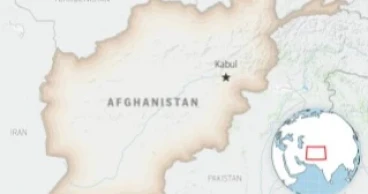
A powerful, 6.3 magnitude earthquake shook northern Afghanistan before dawn Monday, killing at least 20 people and injuring more than 300 others, a health official said.
The U.S. Geological Survey said the quake's epicenter was located 22 kilometers (14 miles) west-southwest of the town of Khulm, and that it struck at 12:59 a.m. at a depth of 28 kilometers (17 miles).
Sharafat Zaman, a spokesperson for the Ministry of Public Health, said the quake killed at least 20 people and injured 320 others.
Yousaf Hammad, a spokesman for Afghanistan’s disaster management agency, said most of the injured suffered minor wounds and were discharged after receiving initial treatment.
In the Afghan capital of Kabul, the Ministry of Defense announced that rescue and emergency aid teams have reached the areas affected by last night’s earthquake in the provinces of Balkh and Samangan, which suffered the most damage, and have begun rescue operations, including transporting the injured and assisting affected families.
Afghanistan earthquake kills over 2,200, Taliban reports
The Taliban government’s chief spokesman, Zabihullah Mujahid, in a post on X platform said the earthquake hit Afghanistan's Balkh, Samangan and Baghlan provinces, causing casualties and financial loss. He expressed his sorrow and grief over the losses and said relevant governmental organizations were busy trying to get needed help to the people affected by the quake.
According to the Afghan officials, the earthquake was also felt in Mazar-e-Sharif, the capital of northern Balkh province.
In Mazar-e-Sharif, footage circulating on social media showed damage to the historic Blue Mosque. Several bricks had fallen from the walls but the mosque remained intact. The centuries-old site is one of Afghanistan’s most revered religious landmarks and a major gathering place during Islamic and cultural festivals.
The quake was felt in Kabul and several other provinces in Afghanistan. The Defense Ministry said in a statement that a rockslide briefly blocked a main mountain highway linking Kabul with Mazar-e-Sharif, but the road was later reopened. It said some people who were injured and trapped along the highway were transported to the hospital.
The United Nations in Afghanistan said on X that Monday's earthquake came just weeks after a deadly earthquake struck eastern Afghanistan. The U.N. said its teams are on the ground assessing needs and delivering urgent aid.
“We stand with the affected communities and will provide the necessary support,” the post said.
Afghanistan has been rattled by a series of earthquakes in recent years and the impoverished country often faces difficulty in responding to such natural disasters, especially in remote regions. Buildings tend to be low-rise constructions, mostly of concrete and brick, with homes in rural and outlying areas made from mud bricks and wood, many poorly built.
A magnitude 6.0 earthquake hit eastern Afghanistan on Aug. 31 near the border with Pakistan, killing more than 2,200 people. On Oct. 7, 2023, a magnitude 6.3 quake followed by strong aftershocks left at least 4,000 people dead, according to the Taliban government.
Read more: Earthquake Safety: Do’s and Don’ts during an Earthquake
Source: AP
11 months ago
Strong quake shakes Taiwan
A strong earthquake shook Taiwan on Wednesday morning, setting off alarms in the capital.
The Central Weather Administration measured the quake at 5.8 magnitude. The shaking in Taipei lasted only a few seconds.
Tsunami warning lifted for Papua New Guinea after earthquake
The U.S. Geological Survey said the magnitude 5.0 quake was about 21 kilometers (12 miles) south-southeast of Yilan on the northeast coast. It was centered 69 kilometers (43 miles) below the Earth's surface. Deeper quakes can be widely felt while generally causing less damage than shallow quakes.
Source: With input from agency
1 year ago
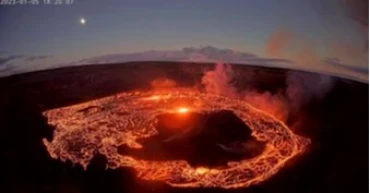
Hawaii's Kilauea volcano erupts again, summit crater glows
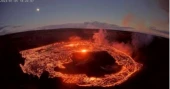
Hawaii's Kilauea began erupting inside its summit crater Thursday, the U.S. Geological Survey said, less than one month after the volcano and its larger neighbor Mauna Loa stopped releasing lava.
The Hawaiian Volcano Observatory detected a glow in webcam images indicating Kilauea had begun erupting inside Halemaumau crater at the volcano's summit caldera, the agency said.
Kilauea’s summit is inside Hawaii Volcanoes National Park and away from residential communities.
Earlier Thursday, the U.S. Geological Survey raised the alert level for Kilauea due to signs that magma was moving below the summit surface, an indication that the volcano might erupt.
Kilauea is one of the world's most active volcanoes. It last erupted for 16 months starting in September 2021. For about two weeks starting Nov. 27, Hawaii had two volcanoes spewing lava side by side when Mauna Loa erupted for the first time in 38 years. Both volcanoes stopped erupting at about the same time.
During the twin eruption, visitors to Hawaii Volcanoes National Park were able to see lava from both eruptions at the same time.
Read more: Hawaii's Kilauea volcano erupts, lava fountains form in park
“It was a beautiful eruption, and lots of people got to see it, and it didn’t take out any major infrastructure and most importantly, it didn’t affect anybody’s life,” said Ken Hon, the Hawaiian Volcano Observatory’s scientist in charge.
Mauna Loa lava didn’t pose a threat to any communities, but got within 1.7 miles (2.7 kilometers) of a major highway connecting the east and west sides of the island. A 2018 Kilauea eruption destroyed more than 700 residences.
The observatory planned to continue monitoring the volcanoes for signs of renewed activity. Hon previously said there is generally a three-month “cooling off” period before scientists consider an eruption to be complete.
It was unclear what connection there could be to the volcanoes stopping their eruptions around the same time. The volcanoes can be seen at the same time from multiple spots in Hawaii Volcanoes National Park near Kilauea’s caldera.
Read more: World’s largest active volcano Mauna Loa erupts in Hawaii
Scientists planned to look at data to study the relationship between the two volcanoes, Hon previously said.
For Native Hawaiians, volcanic eruptions have deep cultural and spiritual significance. During Mauna Loa’s eruption, many Hawaiians took part in cultural traditions, such as singing, chanting and dancing to honor Pele, the deity of volcanoes and fire, and leaving offerings known as “hookupu.”
3 years ago