sand
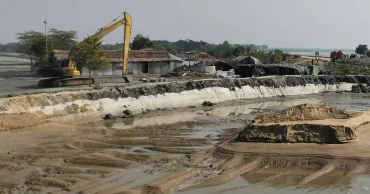
Irregularities deepen doubts over Khulna’s mega embankment project
Riverbank erosion has long haunted the people of Koyra, a coastal upazila in Khulna, but this year their fears have intensified.
Despite a massive government project meant to offer lasting protection, irregularities and sluggish progress are raising serious questions about whether the embankments will withstand the next tide.
Experts say climate change, rising tidal pressure and shifts in river flow continue to intensify threats along the Bay of Bengal coast.
Read more: Sand syndicates tighten grip on Bangladesh's northern region
The government’s long-awaited sustainable embankment project—worth nearly Tk 12,000 crore—initially offered hope to thousands who face erosion every summer and monsoon. But allegations of mismanagement now overshadow the initiative.
Illegal Sand Extraction, Tree Cutting Undermine Safety
Locals and environmental groups report that sand is being illegally extracted from the Kopotakkho and Shakbaria rivers to support embankment construction.
At the same time, riverside trees are being cut indiscriminately, weakening natural buffers meant to stabilise the structures.
On December 4, these fears materialised when nearly 200 metres of embankment collapsed at Matiabhanga in South Bedkashi union—without strong winds or floods.
The sudden breach inundated nearby areas. Two days later, fresh cracks appeared between Doshahalia in Maharajpur union and Hoglar, forcing residents to patch the damage themselves.
Residents say they heard unusual soil-lifting sounds late at night before the embankment gave way. Many believe the incident was linked to unchecked extraction and construction malpractice.
Read more: Teesta Dam ‘renovation’ in Rangpur turns into a 'sand bonanza'
“The embankment just vanished before our eyes. We thought our homes and everything would be washed away,” recalled Masum Billah, a resident of Matiabhanga.
Abdus Salam, another villager, said erosion has been intensifying daily. “Three houses have already been lost. Despite the long-standing vulnerability, no repairs were undertaken,” he said.
Warnings Ignored, Cracks Left Unrepaired
The breached area is part of a Tk 1,200-crore Bangladesh Water Development Board (BWDB) mega project in Koyra and adjoining regions. The work includes raising and widening 32 km of embankments, slope protection, river management and riverside afforestation. But locals say they have seen little evidence of strong, sustained work on the ground.
Didarul Alam, a member of Ward No. 3 of South Bedkashi union, said cracks had been reported a month earlier near the mouths of the Arpangasia and Kopotakkho rivers.
“No effective measures were taken. Only a few sandbags were placed, which allowed the crack to widen and collapse,” he said.
Read more: 130 metres of Teesta bridge embankment collapses threatening 1700 families
BWDB Satkhira-2 Division Deputy Assistant Engineer Alamgir Kabir insisted that repair work is underway and that a temporary ring embankment has helped halt further flooding.
Environmentalists Alarmed by Project Irregularities
Environmental activists say the recent embankment breach in winter—traditionally a calm season—is highly unusual and signals structural weaknesses.
Anwar Hossain, convener of the Coastal and Sundarbans Conservation Movement, expressed deep concern over illegal sand lifting and deforestation along river chars. These destructive practices, he said, directly undermine embankment durability.
“Breaches like this in winter are unprecedented,” he said, pointing to irregularities in project execution despite substantial government funding.
A Coastal Region Running Out of Time
For vulnerable communities already living on the edge, the collapse has renewed fears of a future defined by unchecked erosion, tidal surges and displacement. With the monsoon months only half a year away, residents worry that without transparency, accountability and swift action, the mega project may fail to deliver the protection it promised.
Read more: Illegal sand extraction in Feni continues despite political shift
Locals say they cannot afford another collapse, or another year of neglect.
10 months ago
Teesta Dam ‘renovation’ in Rangpur turns into a 'sand bonanza'
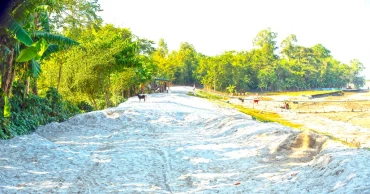
A Tk 1.5-crore project to renovate a vulnerable Teesta River dam in Nohali Union, Rangpur, has turned into a hub of illegal sand extraction, political involvement and profit-making, raising concerns among locals.
Instead of reinforcing the embankment, influential groups and contractors are allegedly using the project to extract sand illegally. Locals describe it as a ‘sand looting festival’.
The Water Development Board (Rangpur Zone) said the UNDP allocated Tk 1,38,94,085 to renovate a 1,206-metre stretch.
Read more: Govt moves to modernise BSTI labs with Tk 851.93cr project
Contractor Hasibul Hasan was officially in charge, but subcontractor Bharat Prasad is actually doing the work. Multiple irregularities have already been reported. No public notice board, required by law, was displayed at the site.
Locals claim the work is proceeding secretly with the knowledge of PAUBO Executive Engineer Rabiul Islam.
The official plan called for profiling the embankment with bamboo, pegs, and coconut-husk ropes, bringing soil from distant areas, and planting grass and tree seedlings. Instead, a 300-metre stretch has been filled only with sand, and a dredger is being prepared to extract sand directly from the river.
Day labourer Serajul Islam said, “Four of us work here extracting sand for Tk 3,000 per day. The Executive Engineer knows about it.”
Residents say local political figures, including UP Chairman Ashraf, former member Wahed, UP member Bakul (BNP), and member Azharul, are involved in the illegal sand removal. Most of the sand is sold outside, not used for the embankment.
A 70-year-old former WDB employee warned that continued sand extraction could destroy homes in future floods. Attempts to protest were reportedly stopped by the Executive Engineer.
Read more: Project launched to boost climate resilience, food security in Cox’s Bazar
Subcontractor Bharat Prasad admitted he is managing the work through local political leaders and had paused site visits due to disputes over bamboo supply. UP member Azharul Islam claimed, “We are all working together; there is no problem.”
Other local political leaders, including Ashraf Ali (Jatiya Party), Chand Sarker (BNP), Rifat Chowdhury (NCP), and Nayebuzzaman (Jamaat-e-Islami), denied involvement.
PAUBO Executive Engineer Rabiul Islam initially defended sand extraction but later admitted irregularities and said he halted the work, ordering sand removal and proper reconstruction.
UNO Mahmud Hasan Mridha said an investigation will be conducted, with action taken as needed, supported by Rangpur Deputy Commissioner Mohammad Enamul Ahsan.
Read more: Teesta cries for survival as northern Bangladesh’s lifeline runs dry
10 months ago
Sand syndicates tighten grip on Bangladesh's northern region
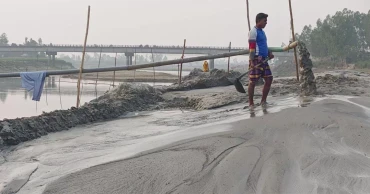
Once vibrant lifelines for northern Bangladesh, the Teesta, Dharla and Jamuneswari rivers are now being ruthlessly stripped of sand by illegal dredging syndicates operating under the shadow of political protection and administrative inaction.
Despite a standing government ban on sand extraction from these ecologically sensitive rivers, dredgers continue to roar day and night, turning riverbeds into pits as deep as 60 to 70 feet in some areas and transforming others into barren, desert-like highlands.
Locals allege that the trade in stolen sand thrives not just because of political shelter, but also due to police complicity and the negligence of local administrations.
“Police and administration officials take commissions at night. Everyone gets their share,” said one sand lifter in Badarganj upazila, requesting anonymity.
During a recent visit to the Rajarampur Kashiganj area in Rangpur’s Badarganj upazila, dredgers were seen extracting sand openly from the Jamuneswari River.
Legal notice served to stop sand extraction from Kalidas Pahalia in Feni
Local residents claimed the operation has continued for nearly six years — first under the influence of local Awami League leaders and now reportedly under a local BNP leader’s patronage, after ‘managing’ the police.
“Even when the UNO raids in the morning, dredgers return by afternoon with police help,” said a villager.
Local administration officials, however, insist that they are actively working to stop illegal dredging.
“Sand extraction is completely prohibited. Mobile courts are being conducted wherever we receive reports,” said Rangpur Divisional Commissioner Shahid Islam.
Gongachara Upazila Nirbahi Officer (UNO) Mahmudul Hasan Mridha said several dredgers were recently seized and destroyed during operations in the Teesta.
26 dredging machines seized for illegal sand extraction from Feni River
11 months ago
1488 kg sand found in govt wheat consignment in Chuadanga; 3 arrested
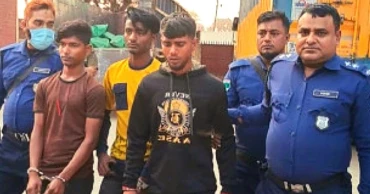
Three people were arrested by Chuadanga Sadar Police over putting sand and stones in the same truck carrying government wheat consignment.
A case has been filed by Sadar Upazila food inspector and officer-in-charge of Chuadanga Sadar Food Warehouse, Nazrul Islam, with Chuadanga Sadar Police Station against 12 people and three organizations. The organizations are: Jonaki Paribahan, Sarkar Enterprise and Sunrise Jute Traders.
All the wheat has been unloaded from 6 trucks but 3 tons and 771 kg of wheat were missing, and we recovered 1488 kg of sand from the trucks, said Nazrul Islam.
Till now, police arrested three helpers of the trucks. The arrestees are helpers Rabiul Islam, Hridoy and Hossain Ali.
Hasanuzzaman, sub-inspector of Chuadanga Sadar Police Station, confirmed the matter and said that a case has been filed by the Sadar Upazila food inspector, claiming that the government wheat consignment arriving on Monday night was short of 3771 kg of wheat.
An operation is underway to catch the rest of those involved, the sub-inspector added.
Additional District Commissioner (General) Nazmul Hamid Reza, also convener of the investigation committee of the district administration, said that they primarily think the truck drivers and helpers are involved with the manipulation.
According to the agreement, 300 metric tons of wheat were to be sent to Chuadanga Food Warehouse through Sarkar Enterprise, Jonaki Paribhan and Sunrise Jute Traders transport contractor. Accordingly, the first consignment of 100 metric tons of wheat arrived last Friday. On Sunday morning, when the second shipment of 100 metric tons of wheat arrived, 7 sacks filled with sand were found on a truck. Later, while unloading the other trucks, 28 sacks filled with sand were found.
3 years ago