climate change
Bangladesh most credible, influential voice in global climate negotiations: Australia
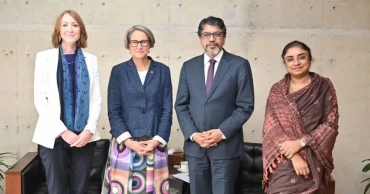
Australia’s Ambassador for Climate Change Kristin Tilley has acknowledged the efforts and investment of Bangladesh for its adaptation and mitigation initiatives which positioned Bangladesh as the most credible and influential voice in global climate negotiations.
She agreed with Foreign Secretary Md Jashim Uddin on the importance of global partnerships in tackling the climate change crisis sharing Australia’s energy transition.
Tilley said that renewable energy which constitutes 43% of its energy mix has a strategic roadmap to enhance this to 83% by 2030, primarily through solar and wind energy.
She had a courtesy meeting with the foreign secretary at the Ministry of Foreign Affairs on Wednesday.
The foreign secretary sought Australia’s cooperation in green technology transfer and renewable energy expansion.
He underlined the role of the global partners to take their responsibility and make quick and pragmatic action on climate financing along with adaptation and mitigation initiatives.
The FS referred to the commitment of Bangladesh to Paris Agreement, its proactive leadership in Climate Vulnerable Forum (CVF) and its adoption of National Adaptation Plan (2022), and most importantly its commitment to transitioning to a NetZero future aligned with the Three Zero Theory of Chief Adviser Prof Muhammad Yunus.
Adviser Rizwana urges unified global action to tackle climate change
He called the top emitters to take their responsibility at multilateral, regional and bilateral process.
Referring to the devastating consequences of climate change in Bangladesh including sea level rise, increased salinity and frequent natural disasters, the Foreign Secretary stressed for urgent global attention and action especially from Australia to support climate financing and technology transfer to Bangladesh.
He also highlighted on the early repatriation of the Forcibly Displaced Myanmar Nationals (FDMNs) to Myanmar since they are making heavy toll on Bangladesh not only on economy and demography but also in deforestation and environmental degradation of Cox’s Bazar and Teknaf areas.
The foreign secretary, welcoming the ambassador, appreciated the strong bilateral relations with Australia, based on shared values and mutual interests.
The discussion broadly focused on critical challenges posed by climate change. Mentioning Bangladesh as the least emitter (0.48% of global emission) of CFC and CO2 but one of the most climate-affected countries in the world.
Tilley heard from Bangladesh, a world leader in climate adaptability. Her visit highlights Australia’s commitment to finding practical solutions to shared challenges, including community resilience and the energy transition.
She joined a panel discussion with Adviser Syeda Rizwana Hasan and IFC Country Head Martin Holtmann. She also met with Adviser Faruk-e-Azam.
Hilly areas neglected in climate change interventions: Rizwana
Ambassador Tilley plays a leading role in Australia’s international climate diplomacy, with a focus on engaging with the Pacific and Southeast Asia.
1 year ago

Bangladesh seeks German support to implement climate change NAP
Bangladesh has sought help from Germany to implement the National Adaptation Plan (NAP) and areas related to climate change including technology transfer, capacity building and renewable energy.
Minister of Environment, Forest and Climate Change Md Shahab Uddin had a meeting with the members of the German Parliament visiting Bangladesh along with Achim Troster, the German Ambassador to Bangladesh, at the Foreign Service Academy on Saturday.
The minister said $230 billion will be required to implement the newly formulated NAP to deal with climate change risks. It will be easier to implement if the developed world, including Germany, supports it.
Also Read: Active civil society an ‘essential element’ in democracies: German Embassy
He said that Bangladesh is implementing various projects across the country including in the Sundarbans to prevent climate change. The government is also implementing programs to implement a circular economy in waste management and set a timeline to introduce block bricks instead of burnt bricks to prevent air pollution, the minister added.
The German ambassador said that Germany's cooperation in all activities related to combating the effects of climate change and ongoing development in Bangladesh will continue at an increasing pace.
Also Read: German parliamentary delegation to visit Bangladesh from February 22-26
This cooperation will be given on the basis of mutual discussion and demand, he added.
Dr. Farhina Ahmed, Secretary, Ministry of Environment, Forest and Climate Change, Additional Secretary (Administration) Iqbal Abdullah Harun, Additional Secretary (Climate Change) Md. Moniruzzaman, Additional Secretary (Environment) Sanjay Kumar Bhowmik and Additional Secretary (Environment, Pollution Control) Md. Mizanur Rahman were present on the occasion.
3 years ago