CIRDAP
Experts stress inclusive foreign policy for regional realignment
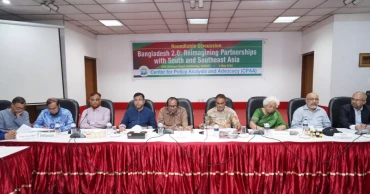
Speakers at a roundtable on Saturday emphasized the importance of inclusive political participation in shaping Bangladesh’s foreign policy and urged a strategic realignment in its regional partnerships, particularly with South and Southeast Asia.
They said at the event, titled Bangladesh 2.0: Reimagining Partnerships with South and Southeast Asia was organized by the Center for Policy Analysis and Advocacy (CPAA) at the CIRDAP auditorium in Dhaka.
President of CPAA and former Secretary to the Government of Bangladesh Dr. Shariful Alam presided over the session while the panel featured eminent academics, diplomats, media professionals, and civil society representatives.
Former Jahangirnagar University professor Dilara Chowdhury remarked that since independence, Bangladesh had heavily relied on an Indo-centric foreign policy, which often led to diplomatic setbacks. She called for a shift in paradigm and the need to free the intellectual space from biases that limit sovereign discourse.
“Academics and civil society actors have often supported submissive foreign policy narratives, stifling critical engagement,” she said, adding that the country’s internal deep state, along with bureaucratic and political forces, have undermined electoral and policy integrity in recent years.
Professor M Shahiduzzaman at International Relations of University of Dhaka stressed the need to consider humanitarian corridors with Myanmar and address confusion within civil society regarding the US Burma Act, which he said could become increasingly relevant for Bangladesh in the Asia-Pacific context.
Foreign Secretary welcomes new CIRDAP director general
Director general of SAARC & BIMSTEC, Ministry of Foreign Affairs ambassador Abdul Motaleb Sarker noted that while South Asia comprises 25% of the world’s population, integration remains limited. He stressed leveraging blue economy potential and preparing for post-LDC economic sustainability through stronger markets in ASEAN and neighboring countries.
He also proposed structural reforms in the foreign employment sector to align with future demands.
Executive Editor of Naya Diganta Masumur Rahman Khalili emphasized the need for a robust and independent foreign policy framework, pointing out the ineffectiveness of SAARC and the strategic necessity of deeper ASEAN integration.
Director at South Asian Institute of Policy and Government of North South University
Professor Toufiq M Haque acknowledged recent signs of policy independence but warned against overreliance on India, noting the ideological influence of the RSS on Indian foreign policy, which often contradicts Bangladesh’s interests.
He urged greater transparency in foreign dealings and highlighted the importance of engaging China and the UN over Myanmar and the Rohingya issue, instead of solely depending on US-led initiatives.
Brigadier General (Retd.) Mohammad Hasan Nasir criticized the BBIN framework as favoring Indian interests and advocated for China's inclusion to revive SAARC.
He also warned of geopolitical risks in corridor decisions, calling for political dialogue and international consensus.
Former VC of Patuakhali Science and Technology University Professor Abdul Latif Masum underscored the permanence of national interest and called for public consensus to guide future governments in shaping an independent foreign policy.
Sharif Osman Hadi, spokesperson of Inqilab Manch, highlighted the need to view Bangladesh’s geopolitical role in the context of a broader South Asian map. He advocated for stronger maritime ties with Sri Lanka, Maldives, and Indonesia and emphasized that corridor decisions must be politically inclusive and negotiated.
1 year ago

“Well-off individuals as well as journalists, police also involved in drug trade”
Home Minister Asaduzzaman Khan Kamal today said that well-off individuals as well as journalists and police are also involved in drug trade, and they too face justice without exception.
The minister made the remark while speaking at a roundtable meeting in Dhaka’s CIRDAP auditorium.
“In prison, you will find police, Rab personnel along with businessmen in narcotic cases. Law is not different for policemen,” he said.
Also read: “Govt, law enforcement alone can’t eradicate drugs, need help from all”
Regarding dope test, the home minister said police are going under dope tests and if results are positive, they are being suspended. “We have taken a strict position in this regard,” he said.
He said dope test during initial selection for jobs will be introduced.
“It is said that doctors are the ones who are mostly into drug abuse but I have no idea about this. Doctors, engineers, journalists – anyone of us can take drugs, as there are misguided people in every profession,” he added.
Also read: 44 arrested in DMP anti-drugs drive
To curb drug abuse, the government is not only running newspaper supplements but also producing short TVCs – generating awareness, increasing manpower and capacity of Narcotics Control Directorate in every district and setting up labs, he said.
Asaduzzaman said the capacity of jails in Bangladesh is more than 41,000 and it will be increased soon. But there are more than 80 lakh inmates and 60 percent of them are drug peddlers, he said.
“There is long backlog of cases, and a separate special tribunal for drugs cases is needed. If the punishment becomes more visible, both supply and demand of drugs will decline,” he said.
Read Bangladesh gets drug, precursor test kits from Japan through UNODC
There are 6 to 7 million drug addicts in Bangladesh, for whom no quality hospital is available, he said.
“Our drug addiction treatment centers do not have experienced doctors or psychiatrists. No one from upper and middle-class goes to the drug treatment center in Tejgaon,” said the home minister.
He assured that government will support the establishment of drug addiction treatment centers in Bangladesh through the private sector.
Read Drug peddler held with yaba pills in Dhaka
4 years ago
Decentralisation of budgetary resources for embankment repair, maintenance demanded
Civil society organisations and climate networks urged the government to decentralise budgetary resources for sustainable embankment construction, repair and management.
6 years ago