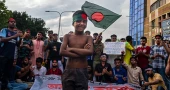
quota reform protest
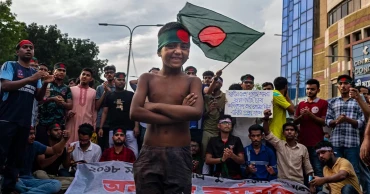
A year on: How the July Uprising redefined Bangladesh’s political landscape
What began as a student movement demanding reforms to the government job quota system on this day last year soon evolved into a broader ‘Anti-Discrimination Student Movement’, ultimately shaking the foundations of the then-ruling, now-deposed Awami League, which had held power for over 16 years.
Few could have imagined that a movement initially focused on quota reform in public sector recruitment would, by July, transform into ‘July Uprising’, with students and ordinary citizens uniting in mass protests demanding their rights for vote, freedom, at the same date of last year.
The discontent was sparked by a High Court verdict that invalidated the government circular issued in 2018, which had abolished quotas in first and second-grade government jobs.
The abolition came in response to intense student protests at the time, but the High Court's decision effectively reinstated a 56-per cent quota.
The reinstated quota system included 30 per cent reserved for descendants of freedom fighters, 10 per cent for women, 10 per cent for underdeveloped districts, five per cent for minorities, and one per cent for persons with disabilities.
Students denounced the quota arrangement as discriminatory against merit-based candidates and took to the streets in protest.
When the government sought to suppress the demonstrations with a heavy hand, the protests escalated into a widespread movement.
Govt declares Aug 5 as 'July Uprising Day' and Aug 8 as 'New Bangladesh Day'
Although the full-scale protests began on July 1, 2024, the initial spark occurred on June 5 when students of Dhaka University (DU) staged an immediate protest on campus, rejecting the High Court verdict.
Despite the ongoing peaceful protests by students in the following weeks, no response came from the government, prompting students from DU, Jagannath University, Jahangirnagar University, Rajshahi University, Chittagong University, Barishal University and Bangladesh Agricultural University to launch a coordinated movement across the country on July 1.
Students from Jahangirnagar University even briefly blocked the Dhaka-Aricha Highway.
At around 7:30pm on July 1, a protest march was held at DU where students categorically rejected the High Court verdict.
Student groups marched through DU chanting slogans rejecting the quota system and demanding its abolition, declaring they would not accept the High Court's ruling.
Meanwhile, under the banner of the ‘Anti-Discrimination Student Movement’, DU students also brought out a procession from the Central Library premises, which concluded at the Raju Sculpture.
Since then, the movement under the ‘Anti-Discrimination Student Movement’ banner has gained momentum, with different universities hosting various programmes on different days.
On July 2, student marches were held on major highways nationwide. On July 3 and 4, rallies took place at Raju Sculpture, Jagannath University, DU's seven affiliated government colleges and other institutions under the National University.
Among the key demands raised by the protesting students were, immediate formation of a commission to review and reform the quota system, ensuring merit-based recruitment if quotas remain unfilled, halting multiple uses of quota benefits by individuals, ensuring transparency and accountability in the recruitment process.
Govt issues ordinance to preserve history of July uprising
The student movement marked a significant challenge to the government, reigniting debates on merit, equality and access to public sector jobs in Bangladesh.
After the historical movements in the history of this nation, this last year’s movement, where people from all walks of life joined without individual interest, left an undeniable mark, reshaping student activism, amplifying calls for equality and reminding the nation of the power of unified youth voices demanding change.
1 year ago
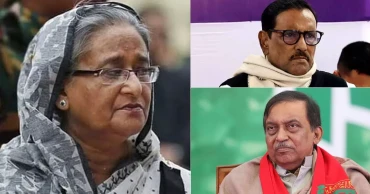
Murder case against Hasina, Quader, Asaduzzaman, others over killing of grocery shop owner on July 19
Former Prime Minister and Awami League President Sheikh Hasina, former ministers Obaidul Quader, Asaduzzaman Khan and several others were sued in a murder case filed over the killing of a grocery store owner Abu Sayeed in police shooting in Dhaka’s Mohammadpur area on July 19.
Amir Hamza, a businessman and resident of Mohammadpur’s Adabor area, voluntarily filed the case in the Court of Dhaka Metropolitan Magistrate Rajesh Chowdhury on Tuesday, confirmed Manun Mia, his lawyer.
The other named accused in the case are: former inspector general of police (IGP) Chowdhury Abdullah Al-Mamun, former additional commissioner of Detective Branch (DB) Harun Or Rashid, former Dhaka Metropolitan Police commissioner Habibur Rahman, and former DMP joint commissioner Biplob Kumar Sarker.
Read more: Almost all police stations resume operations: Police HQ
In his lawsuit, Amir said that Abu Sayeed was killed at around 4:00 pm on July 19, when police were firing indiscriminately at students and civilians during the quota reform protests. Police opened fire on people on the orders of the IGP and the then home minister.
The victim's family members reside in Boda upazila, Panchagarh district. In his complaint, Amir said that the family is unable to pursue a lawsuit over the victim’s death.
In addition, several unnamed high-ranking police and government officials have been charged in the case, according to lawyer Mamun Miah.
Read more: AL can reorganize but if they try to cause disorder, the outcome will not be good: Adviser Sakhawat
2 years ago

US calls for full, undisrupted access to internet and social media in Bangladesh
Acknowledging restoration of telecommunications across Bangladesh, the United States has called for a full and undisrupted public access to internet and social media services.
“We’re aware of some restoration of telecommunications across Bangladesh, but we are calling for a full and undisrupted public access to internet and social media services,” Principal Deputy Spokesperson for the United States Department of State Vedant Patel told reporters at a regular briefing on July 29.
This will enable people in Bangladesh – including US citizens in the country – to be able to access critical information, he said.
Read more: Mobile internet restored after 10 days
Patel said that they, both in public and private, continue to call for a “lasting and peaceful” resolution to the current situation.
“And we reiterate our unwavering support for the freedom of peaceful assembly,” he said.
2 years ago