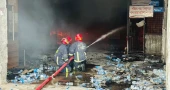
fire hazards
A spark away from disaster; fire hazards haunt Khulna’s markets
From dawn to late night, Khulna’s commercial heartbeats pulse through its crowded markets, where hundreds of shops conduct business worth crores of taka every day. Yet behind the bustle and bargaining lies a silent, growing danger -- fire.
At least 23 large and small markets across Khulna city are facing acute fire risks due to a lack of basic safety measures, according to Fire Service officials.
Narrow access roads, unplanned shop layouts, tangled electrical wiring and the absence of firefighting facilities have turned many of the city’s busiest trading hubs into potential death traps.
Most of these markets have developed over the years without proper planning or approval from the Khulna Development Authority (KDA), the Fire Service or other relevant agencies. As a result, even a minor spark could trigger a devastating blaze, causing massive losses and endangering countless lives.
A Daily Fear for Traders
For traders, fear has become part of their daily routine.
“We open our shops every day with fear,” said Md Kamal Hossain, a cloth trader at Boro Bazar, adding, “A small spark could finish everything. With so many traders packed into narrow lanes, we remain anxious all the time. The roads need to be widened. We have raised the issue with our traders’ association, but there has been little progress.”
Similar concerns echo through Notun Market, Suhrawardy Biponi Bitan, Horoz Market and the markets along Bhairab Stand Road--all among those identified as highly vulnerable.
At Moshla Patti, spice trader Delwar Hossain said repeated appeals have gone unheard. “We keep asking for the market roads to be widened, but no one listens. The Fire Service sometimes visits and gives us basic instructions. We are doing business cautiously,” he said.
St Martin’s-bound cruise ship catches fire in Cox’s Bazar jetty; 1 killed
Inside a Looming Disaster
The danger becomes starkly visible inside places like the Khan Jahan Ali Hawkers Market. Narrow alleys—often no more than four to five feet wide—are lined with shops on both sides. In some sections, goods spill into walkways, while clusters of exposed electrical wires hang overhead.
During peak hours, movement becomes difficult and breathing uncomfortable. In the event of a fire, escape routes would be virtually non-existent.
This scenario is not unique. Fire Service officials say almost all major commercial areas in Khulna share similar conditions.
Firefighters Face Barriers
According to Md Masud Sardar, acting deputy director of the Khulna Fire Service, at least 23 markets in the metropolis have been categorised as high-risk zones.
“If a fire breaks out in these places, our vehicles cannot enter,” he said, adding, “Without training and infrastructural development, accidents cannot be prevented. We face serious challenges.”
Sardar pointed to tangled electrical wiring, narrow lanes, lack of firefighting equipment and inadequate water supply as the primary reasons behind the heightened risk. “We have raised these issues in coordination meetings with various departments, including water administration. With everyone’s effort, we hope the situation will improve,” he added.
Administration Promises Action
The district administration says steps are being taken. Deputy Commissioner of Khulna Toufiqur Rahman said the authorities are working in coordination with the Fire Service and business associations based on the list of risky markets.
“Training programmes and awareness initiatives have already been undertaken,” he said, acknowledging the scale of the challenge.
Planners Warn of Catastrophe
Urban planners, however, warn that awareness alone is not enough.
“These markets developed in the city centre without any prior planning,” said Asif Ahmed, general secretary of the Bangladesh Institute of Planners (BIP), Khulna unit. “Without immediate coordinated action involving the city corporation, KDA, power division, Fire Service and WASA, a major catastrophe could be imminent.”
Woman, granddaughter die as house catches fire in Ctg
He stressed that narrow roads must be widened, electrical cables placed underground, and adequate water supply and firefighting systems ensured in every market.
A Ticking Clock
The warning signs are already clear. According to Fire Service data, 291 small and large fire incidents were reported in Khulna district over the past year.
As the city’s markets continue to expand vertically and horizontally without safety upgrades, the risk grows with every passing day. For thousands of traders and customers, Khulna’s commercial lifelines remain vibrant—but dangerously vulnerable.
9 months ago
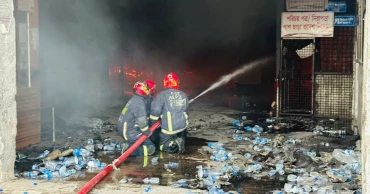
Recent fire incidents highlight safety challenges in Bangladesh: Experts
Three major fire incidents in Dhaka and the port city of Chattogram have raised serious concerns over Bangladesh’s safety standards and emergency preparedness, experts said.
The latest incident occurred at Hazrat Shahjalal International Airport, leading to the suspension of flight operations.
The fire broke out at the airport’s cargo village around 2:30 pm on Saturday near Gate No. 8, said Talha Bin Jashim, an official of the Fire Service and Civil Defence (Media Cell).
Thirty seven firefighting units are currently battling the blaze, with six additional units on their way. Members of the Bangladesh Army, Air Force, and two platoons of the Border Guard Bangladesh (BGB) have also joined the efforts.
Flight operations at the airport have been suspended since the fire erupted, confirmed spokesperson Md Masudul Hasan Masud.
Earlier in the week, a devastating fire in the Shialbari area of the Rupnagar residential zone in Mirpur killed 16 people after a garment factory and an adjacent chemical warehouse caught fire on Tuesday.
CEPZ fire still raging; 23 units battling to bring blaze under control
While the factory blaze was brought under control after three hours, the nearby chemical warehouse continued to burn.
Meanwhile, in Chattogram, a fire at a factory in the Export Processing Zone (CEPZ) on Thursday took 17 hours and 25 firefighting units to bring under control.
Investigations into both the Chattogram and Dhaka incidents are underway, with committees formed by the Fire Service and local authorities.
Large fires are common in Bangladesh, often attributed to poor infrastructure and lax safety standards.
Past tragedies include a 2021 fire at a food and drink factory that killed at least 52 people, a 2019 fire that claimed 78 lives in Old Dhaka, and the 2013 Rana Plaza collapse near Dhaka, which killed more than 1,100 people.
Dhaka, the capital, has a long history of devastating fire incidents — each exposing deep-rooted failures in oversight and enforcement by the authorities.
These incidents point to a worrying pattern: the continued operation of high-risk industrial sites without proper oversight, enforcement, or safety protocols — often at the cost of human lives.
Flights diverted to Ctg, Kolkata after Fire at Shahjalal Airport
Parvez Karim Abbasi, Assistant Professor at East West University, said the responsibility lies with the city corporations and related agencies to carry out regular inspections for fire hazards.
He noted that coordination between the city corporations and other relevant bodies remains limited when it comes to identifying and reducing repeated fire incidents.
Smart city planning, he added, must also address this issue by ensuring that factories are separated from residential areas and that safe work practices are enforced in these factories.
“Hazardous, toxic, or flammable materials must be stored safely and regularly inspected by the responsible organisations. There should also be regular updates on the state of safety,” he said.
Although there are procedures in place on paper, in reality they are often not properly followed.
Arson and fire-related incidents continue to occur regularly, causing major losses of both property and life.
The main issue lies in the lack of proper implementation and coordination among all concerned organisations. It is also about raising public awareness and ensuring that businesses take responsibility by not cutting corners and by investing in proper safety measures.
Fire breaks out at Dhaka airport’s cargo section; 37 units battling blaze
Whether it is the Fire Service, RAJUK, or the city corporations, all relevant bodies must work together more effectively. They need to carry out regular inspections and strictly follow safety protocols.
Regarding the limitations of the Fire Service, Abbasi suggested increasing the number of fire personnel, improving their resources and facilities, and ensuring they are well equipped.
He also blamed traffic congestion, narrow roads, unplanned city layouts, and the lack of water hydrants along streets for delaying fire response times.
“The problem will not be solved overnight. We need to take an integrated approach to deal with it,” he added.
Meanwhile, the country witnessed 26,659 fire incidents last year, in which 140 people — including two firefighters — were killed and 341 others injured.
According to the Fire Service and Civil Defence (FSCD), an average of 73 fire incidents took place per day across the country in 2024.
“Most fires originated from electrical short circuits, burning cigarette or bidi ends, stoves, and gas leaks,” it said.
These fires caused damage to properties worth around Tk 447 crore, while the Fire Service saved properties valued at over Tk 1,974 crore across the country during the same period.
To strengthen fire prevention measures nationwide, the FSCD operated 147 mobile courts in 2024, and 149 organisations were fined a total of Tk 25.832 crore. Cases were filed against three organisations.
To reduce fire accidents, the FSCD conducted 18,983 drills, 3,036 surveys, and 15,683 public awareness events across the country in 2024.
Besides, 1,47,717 people were trained through 7,769 fire safety training courses nationwide. Of them, 1,56,840 garment workers received training through 3,921 courses conducted in garment factories alone.
11 months ago
Nayamati: A commercial hub at risk of fire hazards
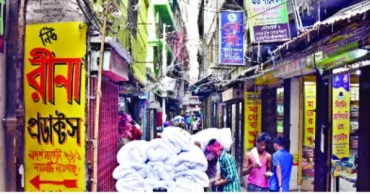
Nayamati, a key commercial hub in Narayanganj city, is marked by its narrow lanes, making it difficult for four-wheeled vehicles to navigate. Despite this, the area sees the annual trade of hosiery products worth hundreds of crores. However, these businesses, collectively valued in the thousands of crores, face significant fire hazards.
A ground visit revealed that the entire area is ensnared in a tangle of electrical wires. In some spots, the clutter is so thick that the sky is barely visible from the streets. Locals report frequent fires caused by short circuits in these wires, which are typically extinguished using water from buildings on either side.
However, in this bustling commercial zone, where every building is packed with fabric, chemicals, and thread, fire service vehicles are unable to reach the scene.
"If a major fire were to occur in this area, no one knows how to handle it," said a hosiery businessman.
On October 7 at 11pm, a severe fire erupted in Narayanganj's Kali Bazar area caused by an electrical short circuit, resulting in the destruction of 40 shops. Since that incident, fear and anxiety have taken hold of hosiery traders and workers in Nayamati.
Read: Workplace Fire Safety: 12 Effective Ways to Prevent Fire Hazards
The Bangladesh Hosiery Association reports that there are approximately 8,000 hosiery businesses in Narayanganj, with the majority situated in Nayamati and its vicinity. Data from the Fire Service highlights that Nayamati is at a high risk for fire incidents, despite its crucial role in meeting Bangladesh's domestic clothing needs.
Hosiery businessman Abdus Selim stated, "Every market and building here involves transactions worth crores of taka, but there is no safety for our lives. If you monitor closely, you won't find any fire extinguishing equipment or water reserves. Since fire service vehicles cannot access this area in the event of a fire, businesses should take that into consideration."
However, no one seems to be concerned about it, Abdus Selim added.
He alleged that the City Corporation, Fire Service, and other government agencies are also responsible for this situation.
Abeda Parveen, a worker at Rahman Hosiery, stated, "The road we enter frequently catches fire due to the wires. We have to extinguish the flames using water and sand from the buildings. What more can I say about our workplace? If a fire breaks out on the ground floor, there’s no way for us to escape."
Read more: Panel formed to prove vessel fire at Ctg port
She noted the stark difference between garment factories and hosiery units, explaining, "Garment factories have two staircases and fire extinguishing equipment, while the hosiery units in Nayamati lack these essentials. Are our owners not making enough money? But, they seem to evade scrutiny."
She called on the government to address this issue, warning that without intervention, they could face deadly fires.
Meanwhile, some local business owners recognized that although the area is highly susceptible to fire hazards, the Fire Service pays little attention here. They pointed out that there have been no substantial efforts from this government agency to establish a safe commercial environment in Nayamati.
When reached for a comment, Fakhruddin Ahmed, Deputy Director of the Narayanganj Fire Service, stated, "Please call me during office hours; I am currently unwell."
Read more: Top Strategies to Enhance Fire Resilience in Dhaka City
1 year ago