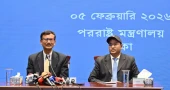
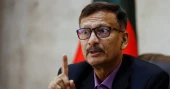
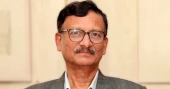
Foreign Affairs Adviser Md Touhid Hossain
US Ambassador meets Adviser Hossain, discusses bilateral relations
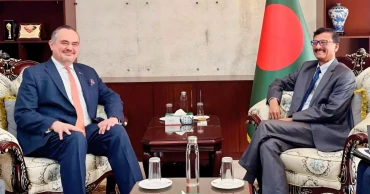
US Ambassador to Bangladesh Brent T Christensen met Foreign Affairs Adviser Md Touhid Hossain on Sunday and discussed issues of bilateral relations.
Ambassador Christensen described the meeting with Adviser Hossain as ‘excellent and productive’.
"Excellent meeting with the Adviser for Foreign Affairs Md. Touhid Hossain...we had a productive discussion on key elements of our bilateral relationship," said Ambassador Christensen after the meeting.
Bangladesh and the United States are likely to sign a trade agreement on Monday.
Dhaka eyes a reducing reciprocal tariff.
Bangladesh has achieved an 'important step forward' towards strengthening its mutually beneficial trade relationship with the United States, opening the door to greater market access and new opportunities for its vital textile and apparel sector, said the Chief Adviser’s press wing last month.
In response to a request from National Security Adviser Dr Khalilur Rahman who recently visited Washington DC, US Trade Representative Ambassador Jamieson Greer has agreed to raise with US President Donald Trump the possibility of reducing Bangladesh’s current 20% reciprocal tariff rate, bringing it more in line with regional competitors.
8 months ago
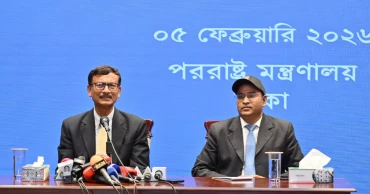
Attacks on media houses not acceptable: Adviser Hossain
Foreign Affairs Adviser Md Touhid Hossain on Thursday said the attacks on the media houses - The Daily Star and Prothom Alo - are in no way acceptable and condemnable.
"Such attacks are not acceptable. We condemn the attacks," he said, acknowledging that they could not prevent it.
The Foreign Affairs Adviser, however, said the Home Ministry would be in a better position to talk about it further.
Hossain made the comments at a farewell interaction with the media at the Ministry of Foreign Affairs.
He said the media was able to speak freely after the formation of the interim government.
When asked about the mob violence and attacks on the The Daily Star and Prothom Alo on the late night of December 18, he, however, said it was right to ask the Home Ministry about the mob violence.
July Museum highlights climax of 36 days, Hasina’s misrule: Foreign Adviser
But, the adviser said, he condemns the attacks on the media houses, and those are in no way acceptable.
Senior officials of the Ministry of Foreign Affairs were present at the media briefing.
8 months ago
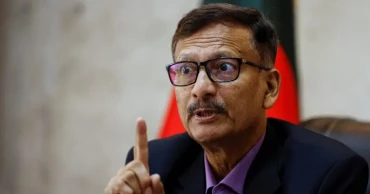
No security situation warrants diplomats’ families to go back home: Touhid Hossain
Foreign Affairs Adviser Md Touhid Hossain on Wednesday said there is no situation in the country that would compel foreign diplomats to send their family members back home, stressing that he sees no justification for the reported non-family posting of Indian diplomats.
“I don’t find any correct message (no valid reason). If they want to take back their families, they are free to do so. We have nothing to do with that,” he told reporters at the Ministry of Foreign Affairs when asked about India’s recent decision.
Adviser Hossain said the government has not been informed of any security concerns regarding the family members of Indian diplomats in Bangladesh.
He said it is also unclear whether any message is being conveyed by the withdrawal of the family members of Indian diplomats from the country.
Asked about the withdrawal, Hossain said there is no security concern, but he does not understand what signal is being sent. “There is no situation in Bangladesh where officials or their family members are in danger.”
“Nothing of this sort has happened so far. They may feel apprehensive, or they may want to send a message, but I do not really see any reason for it. If they want to take their families back, it is not our concern,” said the Adviser.
Referring to security conditions surrounding the 13th National Parliament elections, Hossain said there has been no overall disruption. “I do not think there have been more clashes than during previous election periods. I do not believe there has been a security situation that would warrant such a step.”
When asked whether the Indian High Commission in Dhaka had raised security concerns in advance, the Foreign Affairs Adviser said no such concerns had been communicated.
Earlier, the Indian government advised the dependents of officials posted at its High Commission in Dhaka and other missions outside Dhaka to return home as a precautionary measure, citing the security situation.
However, the High Commission in Dhaka and other Indian missions in Bangladesh continue to remain open and fully operational.
“Given the security situation, as a precautionary measure, we have advised the dependents of officials in the Mission and Posts to return to India,” a source at the Indian Ministry of External Affairs told UNB, responding to recent media reports.
The source added that the Mission and all Posts in Bangladesh remain open and operational at full strength.
Asked about concerns over election-related violence mentioned in a recent statement by the Ministry of Foreign Affairs, Adviser Hossain said those who are not participating in the elections, or are unable to do so, may be involved if any violence occurs.
He said there is normally no reason to anticipate conflict during the elections, as all contesting parties are showing restraint.
On January 25, the Ministry said unabashed incitements by the Awami League leadership once again demonstrated why the interim government had to ban its activities.
The Ministry said Bangladesh would hold the outfit responsible for incidents of violence and terror in the run-up to the elections and on polling day, and would take appropriate measures to foil what it described as ‘evil conspiracies’.
Bangladesh and India have experienced occasional tensions in their relations since the regime change in Bangladesh on August 5, 2024.
In an unprecedented development, cricket, traditionally a symbol of friendly ties, has emerged as a flashpoint after Bangladeshi star Mustafizur Rahman was dropped from the Indian Premier League (IPL).
Bangladesh responded by banning IPL broadcasts, citing player safety concerns, and sought to shift its ICC T20 World Cup 2026 matches from India to Sri Lanka.
Doesn’t matter who thinks what about Bangladesh decision on drone making: Foreign Adviser
The Ministry of Foreign Affairs said the government and people of Bangladesh were ‘surprised and shocked’ that fugitive Sheikh Hasina, who has been convicted by the International Crimes Tribunal for crimes against humanity, was allowed to make a public statement in New Delhi on January 23.
In that statement, she allegedly called for the removal of the Government of Bangladesh and openly incited her party loyalists and the public to carry out acts of terror to derail the upcoming general elections.
Bangladesh is deeply aggrieved that India has yet to act on its obligation to hand Sheikh Hasina over under the bilateral extradition agreement, despite repeated requests from the Bangladesh government.
Instead, she was allowed to make what the Ministry termed inciteful pronouncements from Indian soil. “This clearly endangers Bangladesh’s democratic transition, peace, and security,” the ministry said.
Allowing the event to take place in the Indian capital and permitting Hasina to deliver what it described as hate speech runs contrary to the norms of inter-state relations, including respect for sovereignty, non-interference, and good neighbourliness, the interim government said.
“It sets a dangerous precedent for the future of Bangladesh-India relations and may seriously impair the ability of a future elected government in Bangladesh to engage, shape, and nurture mutually beneficial bilateral relations,” the Ministry said in its statement.
8 months ago
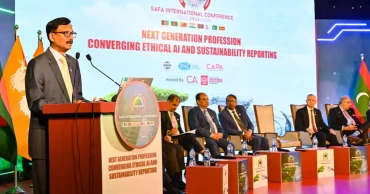
Bangladesh calls for collective action to tackle global economic challenges
Foreign Affairs Adviser Md Touhid Hossain on Saturday said Bangladesh, as a responsible neighbor and an active member of the United Nations and other international bodies, advocates for a rule-based international order and collective action in addressing global economic challenges.
"We support active engagement to promote dialogue, confidence-building, and cooperative solutions to shared concerns," he said while speaking at the Inaugural session of SAFA (South Asian Federation of Accountants) International Conference in Dhaka.
Chairperson of Bangladesh Competition Commission AHM Ahsan and Chairman of the Financial Reporting Council (FRC) Bangladesh Dr Md Sajjad Hossain Bhuiyan attended the conference as special guests.
Organised by the Institute of Chartered Accountants of Bangladesh (ICAB), the conference was themed “Next Generation Profession: Converging Ethical AI and Sustainability Reporting.”
For Bangladesh, the Adviser said, the proposed convergence of technology and sustainability is particularly significant. "Our pursuit of economic growth and deeper global integration requires that our professionals remain not only technically proficient, but also ethically grounded and socially responsible," he said.
US proud to call Bangladesh a friend: US Ambassador
The Adviser said platforms such as this conference play a vital role in facilitating the exchange of knowledge, sharing of best practices, and fostering of meaningful collaborations.
"Such engagements can steer both the region and the global community toward a sustainable, inclusive, and technologically advanced future," he said.
The keynote speech was delivered by Adeeb Hossain Khan FCA, past President of ICAB and Senior Partner at Rahman Rahman Huq, Chartered Accountants.
Khan emphasised that the adoption of AI in sustainability reporting is “no longer a distant concept, but a structural shift already influencing how economic value is created, measured, and disclosed.”
The conference brought together national leadership and international expertise, serving as a platform for thought leadership, knowledge exchange, and strategic dialogue on critical issues set to reshape regional and global professional collaboration.
Delegates from Afghanistan, Bhutan, India, the Maldives, Nepal, Pakistan, and Sri Lanka took part in the event, which featured three technical sessions and a valedictory session.
The global accounting profession is entering a new phase as Ethical Artificial Intelligence (AI) and Sustainability Reporting begin to converge, reshaping business risk, investor expectations, and public trust, experts highlighted at the SAFA international conference.
Organisers noted that their presence demonstrated strong government support for elevating professional excellence, ethical standards, and international collaboration in the accounting and finance sectors.
Adviser Hossain emphasised that the convergence of technology and sustainability is crucial for shaping a ‘new Bangladesh’.
Finnish observers joining EU’s Election Observation Mission
He noted that the country’s aspirations for sustained economic growth and deeper global integration demand professionals who are not only technically competent but also ethically grounded and socially responsible.
AHM Ahsan highlighted that technological advancement presents both opportunities and challenges, and observed that AI-driven systems can boost efficiency, strengthen compliance, and foster innovation. Without strong ethical frameworks, AI also poses risks such as algorithmic collusion, market dominance abuses, opacity, and exclusionary practices.
He urged that AI be adopted with caution to ensure that Bangladesh can fully and responsibly harness its benefits.
8 months ago
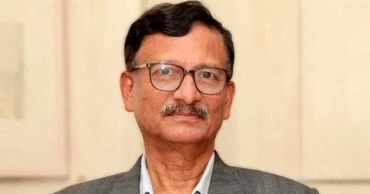
Feb Polls: Foreign Adviser clarifies visa policy, cautions against disruptive entry
The government on Wednesday said it remains hopeful of a smooth transition through the national election but wants to prevent the arrival of any “unexpected individuals” from abroad who may attempt to create an undesirable situation during the election period.
“We are not stopping the issuance of visas. Those who wish to come may apply for visas, and we will issue them as long as their purpose is valid,” Foreign Affairs Adviser Md Touhid Hossain told reporters at the Ministry of Foreign Affairs, responding to a journalist’s query regarding reports of the suspension of visa-on-arrival facilities.
“You know, during the election period, there may be attempts to create unexpected situations. Some unwanted individuals may try to enter the country suddenly,” he said.
The Foreign Adviser said the Ministry of Home Affairs is truly better positioned to comment on the matter but acknowledged that the Ministry of Foreign Affairs has received instructions in this regard.
Read more: Bangladesh issues special visa guidelines ahead of national election
The Ministry of Foreign Affairs and External Trade, Bhutan on Tuesday informed the general public that the Embassy of the People’s Republic of Bangladesh in Thimphu has officially conveyed that the government of Bangladesh has suspended the “Visa on Arrival” facility for all eligible countries, including Bhutan, with effect from January 15 to February 15.
In view of this, Bhutan said, all Bhutanese nationals intending to travel to Bangladesh during the above period are advised to apply for a visa in advance through the Embassy of Bangladesh in Thimphu prior to their travel.
The Bhutanese Ministry advised all travelers to take note of this change and make the necessary arrangements well in advance to avoid any inconvenience.
Foreign Affairs Adviser Hossain on January 8 confirmed that they have asked its three key diplomatic missions in India to keep their visa sections closed for a time being on security grounds.
“What I have done is that I have asked our three missions to keep their visa sections closed for the time being. It’s a security issue,” he said while responding to a question at the Ministry of Foreign Affairs at that time.
Read more: Foreign Adviser communicates with Pakistani counterpart ahead of OIC ministerial meet on Somalia
Asked about the matter, Hossain on Wednesday had taken the decision due to a special situation, noting that they have to look after the security of the missions.
8 months ago
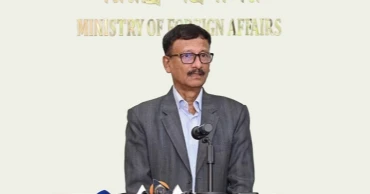
Dhaka yet to decide on sending forces under ISF to Gaza; reiterates conditions
Foreign Affairs Adviser Md Touhid Hossain on Wednesday (January 14, 2026) said Bangladesh has not yet taken any decision regarding sending its forces to Gaza under the International Stabilization Force (ISF), stressing that the country has clearly outlined three conditions.
“No decision has been made. It is still at the discussion level. It has not been determined yet who will be part of this initiative. Most importantly, three conditions have been mentioned clearly,” he told reporters responding to a question at the Ministry of Foreign Affairs.
Under no circumstances Bangladesh would join without the creation of an environment consistent with the three key preconditions, he added.
Read more: BSC should maintain profitable status, expand fleet: Prof Yunus
Asked about discussing such an issue at the fag end of the interim government’s tenure, Adviser Hossain said the tenure is ending with the February 12 election, but the government remains in place.
He said the country’s engagement and interests do not change overnight and the government would not do anything that goes against national interests.
The Foreign Affairs Adviser also said they are very hopeful that the upcoming transition will take place smoothly.
He the ISF is an issue of global concern and does not fully depend on Bangladesh alone.
The interim government said some Muslim countries are interested in participating in the force.
Chief Adviser’s Press Secretary Shafiqul Alam on Monday said they recognise the significance of the UN Security Council decision to establish the International Stabilization Force (ISF) for Gaza and understand that some Muslim countries are interested in participating in the force.
Read more: Election on Feb 12, no matter who says what: Prof Yunus tells former US diplomats
“We are also carefully considering the matter,” he said while responding to a question, noting that as one of the largest contributors to UN peacekeeping forces and an ardent supporter of the Palestinian cause, their interest in participating in the ISF is contingent on the fulfillment of a number of principles.
These include, among others, that the ISF should be temporary and operate under a clear UN Security Council mandate, he said, adding that there must be permanent ceasefire and complete withdrawal of all Israeli forces from Gaza; and the responsibilities for Gaza will be transferred to the Palestinians.
The Press Secretary said they remain steadfast in their support for the right of the Palestinians to self-determination and the establishment of a sovereign Palestinian State based on 1967 borders with Al Quds Al Sharif as its capital.
"As the third largest Muslim nation in the world, Bangladesh has consistently condemned Israeli genocide in Gaza, and called for its immediate end and the complete withdrawal of all Israeli forces from the territory,” Alam said.
Bangladesh noted that the United Nations Security Council, on 17th November 2025, adopted resolution 2803 which provided for, among other things, the establishment of an ISF for Gaza.
Alam said all Muslim countries members of the Security Council voted for the resolution.
He also said a number of other Arab and Muslim countries jointly recommended the adoption of the resolution by the Security Council.
Read more: ISF for Gaza: Dhaka weighs its options carefully
8 months ago

Dhaka asks key missions in India to suspend visa services over security concerns
Foreign Affairs Adviser Md Touhid Hossain on Thursday (January 08, 2026) confirmed that they have asked its three key diplomatic missions in India to keep their visa sections closed for a time being on security grounds.
“What I have done is that I have asked our three missions to keep their visa sections closed for the time being. It’s a security issue,” he said while responding to a question at the Ministry of Foreign Affairs.
Though he did not mention the names of the missions, a diplomatic source said the three missions are Bangladesh High Commission in New Delhi, Deputy High Commission in Kolkata and Bangladesh Assistant High Commission Agartala.
There are Bangladesh Missions stationed in Mumbai and Chennai, too.
Read more: Delhi summons Bangladesh envoy amid growing tensions
Responding to a question on cricketers’ safety issue, the Foreign Adviser said he fully supports what Sports Adviser Asif Nazrul had said.
Sports Adviser Asif Nazrul reaffirmed on Wednesday that Bangladesh will not travel to India for the upcoming T20 World Cup, reiterating the nation’s demand to have their matches relocated to co-host Sri Lanka.
Speaking to the media following a meeting with directors of the Bangladesh Cricket Board (BCB), Asif Nazrul said while the nation is eager to participate it cannot be at the expense of national dignity or player safety.
“We have discussed the situation. The Bangladesh team played hard and fought to qualify for the T20 World Cup, and as a cricket-crazy nation, we certainly want to play in the World Cup,” he said.
“We will certainly play outside India,” said Foreign Adviser Hossain.
Asked about the impact of this in bilateral relations, the Foreign Adviser said this issue came afresh though at various times various issues came and each issue will have negative impacts to some extent.
Read more: Bangladesh voices concern to India over attacks on missions
Talking about keeping business relations unhurt, the Adviser said if they find their interest in purchasing rice at a cheaper price, the business people will go for that.
Asked about Bangladesh’s ‘potential interest’ in procuring the JF-17 Thunder fighter aircraft from Pakistan, the Foreign Adviser said, “I can’t tell about this today. Talks are underway. You will know once things are finalised.”
9 months ago
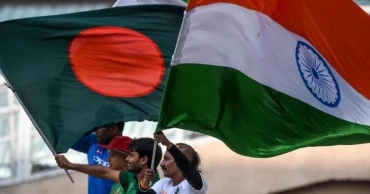
‘Goodwill prevails’ as Bangladesh, India prioritise cooperation over confrontation
Despite occasional tensions, Bangladesh and India continue to value goodwill and good neighbourliness, recognising that cooperation, not confrontation, best serves the interests of the two close neighbours bound by shared history, borders and cultural ties.
The recent visit by India’s External Affairs Minister Dr S Jaishankar to Bangladesh signals a renewed emphasis on advancing this spirit of good neighbourliness and partnership based on mutual respect.
“For any country in diplomacy, relations with neighbors get priority, especially for those who are not global powers - for example, Bangladesh. For them, relations with neighbors are very important,” said Foreign Affairs Adviser Md Touhid Hossain, highlighting the importance of relations with big and small neighbors.
The Adviser, who believes in the country’s permanent interest, said one of their key tasks is to maintain good relations with all small and big neighbors and try to get benefits out of that.
Bangladesh is connected with India through trade, connectivity, water sharing, security and people-to-people exchanges.
“When Bangladesh and India remain sensitive to each other’s concerns and avoid actions that undermine the other’s interests, it helps reduce misunderstandings and build confidence,” said a diplomat.
Prepared to engage with any govt emerges through inclusive polls in Bangladesh: India
Such an approach, the diplomat thinks, strengthens regional stability, supports economic growth, and enables both nations to address common challenges through dialogue.
Adviser Hossain said foreign policy is, to a large extent, influenced by domestic policy. “You can’t forget it.”
During an event at IIT Madras in Chennai, Jaishankar on Friday replied to a question on India’s neighborhood policy and Bangladesh issues, days after attending the funeral of former Prime Minister Begum Khaleda Zia in Dhaka.
Good Neighbours
He highlighted the difference between “good neighbors” and “bad neighbors,” and said India supports and assists countries that maintain cooperative ties. He cited examples such as vaccine diplomacy, economic aid and crisis support.
At the same time, he asserted India’s right to defend itself against neighbors that persist with terrorism, stressing that New Delhi’s approach is guided by common sense and national interest.
“If you have a neighbor who is good to you, or at least who is not harmful to you, your natural instinct is to be kind and to help that neighbor. If the neighbor has a problem, you would like to contribute in some way. If nothing else, you will say hello, you will try to build friendships and bonding, and that is what we do as a country,” Jaishankar said.
He said whenever there is a spirit of good neighborliness, India chooses to invest, help and share. “With good neighbors, India invests, helps and shares, whether it was vaccines during COVID, fuel and food support during the Ukraine conflict, or the $4 billion assistance to Sri Lanka during its financial crisis.”
Wishing Bangladesh well for the upcoming national election, Jaishankar said the sense of neighborliness in the region will grow once things settle down.
"Right now, they (Bangladesh) are heading for elections. We wish them well in that election. We hope that once things settle down, the sense of neighborliness in this region will grow," he said.
Jaishankar wishes Bangladesh well for polls, hopes deepened neighbourly ties
Highlighting the growth of India, Jaishankar said if India grows, all its neighbors will grow with them.
"We will have many more opportunities. I think that in a sense is the message that I also took to Bangladesh," said Jaishankar who visited Bangladesh recently.
Bad Neighbours
Jaishankar also spoke about India’s “bad neighbours” and said if a country decides to “deliberately, persistently, unrepentantly continue with terrorism” India has the right to protect itself from such “neighbours”.
“We will exercise that right. How we exercise that right is up to us. Nobody can tell us what we should do or not. We will do whatever we have to do to defend ourselves. It is a common sense proposition,” he said.
South Asian nations’ gesture highlights Khaleda’s respect, stature: Foreign Adviser
The Indian External Affairs Minister said if there is no good neighbourliness, “you do not get the benefits of that good neighbourliness. You cannot say, "Please share water with me, but I will continue terrorism with you.”
Economic Interests
Finance Adviser Dr Salehuddin Ahmed has recently said Bangladesh manages its ties with India by keeping economic interests distinct from political rhetoric, with trade-related decisions driven by competitiveness and national interest rather than diplomacy.
“Our trade policy is not driven by political considerations. If importing rice from India is cheaper than sourcing it from Vietnam or elsewhere, then it makes economic sense to buy from India,” he said while talking to reporters after a meeting of the Advisers Council Committee on Government Purchase.
Salehuddin said Bangladesh would import essentials such as rice from India if prices remain competitive, regardless of the prevailing political discourse between the two neighbours, mentioning that imports from alternative markets could cost Tk 10 more per kilogram.
Khaleda's passing leaves irreplaceable void, but her vision, legacy will endure: Modi
Salehuddin stressed that Bangladesh has never pursued punitive trade measures against India for political reasons. “We do not believe in using trade as a tool for political retaliation. Our priority is to ensure supplies at the best possible price for our people,” he added.
Deep Relations
“Relations between Bangladesh and India are so deep ... .it will remain good in the future. There is no alternative to maintaining good relations between the two countries,” said Chief Adviser Prof Muhammad Yunus recently.
Referring to huge "interdependencies" on each other, he said the relationship between Bangladesh and India is historically, politically and economically very close and they cannot deviate from this.
Bangladesh will hold a high-stakes national election on February 12 the first polls since mass uprising last year, excluding the Bangladesh Awami League, activities of which remain suspended.
The Chief Adviser said Bangladesh is fully prepared to hold 'free, fair, and peaceful' elections on February 12 next year.
Jaishankar hands over PM Modi’s personal letter to Tarique Rahman
Highlighting the importance of stability and inclusive elections in Bangladesh, India said it wants close and friendly relations with the people of Bangladesh, which is rooted in the liberation struggle and strengthened through various development and people-to-people initiatives.
“We are in favour of peace and stability in Bangladesh and have consistently called for free, fair, inclusive and credible elections conducted in a peaceful atmosphere,” Randhir Jaiswal, official spokesperson at the Ministry of External Affairs (MEA).
9 months ago
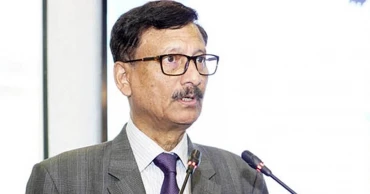
No response on request for Hasina’s extradition: Touhid Hossain
Foreign Affairs Adviser Md Touhid Hossain on Tuesday Bangladesh sought extradition of former Prime Minister Sheikh Hasina following legal aspects and subsequent court’s order but did not get any reply from the Indian side.
“We have followed the legal aspect that we have and we have asked them to return her as per the court's order. Let them look into it. They are yet to reply. Let them look into it from their side,” he said while responding to a question at the Ministry of Foreign Affairs.
Bangladesh sent a diplomatic note (note verbale) to India in December last year, along with a set of supporting documents, formally requesting Hasina's extradition.
Explaining Hasina's presence in India and its impacts on bilateral relations, Indian Foreign Secretary Vikram Misri recently said this is a ‘judicial legal process’ and it requires ‘engagement and consultations’ between the two governments.
ICT-1 sets Nov 13 for verdict in case against Hasina, 2 others
"We are examining these issues. We look forward to working together with Bangladesh authorities on these issues," he said while responding to a question during an interaction with the members of Diplomatic Correspondents Association, Bangladesh (DCAB) at the Indian Ministry of External Affairs.
Beyond that, the Indian Foreign Secretary said, he does not think it would be constructive to say anything further at this point.
Hasina fled Bangladesh to India on August 5 last year in the face of massive student-led protests. Bangladesh is waiting for a response from New Delhi.
The International Crimes Tribunal will set a date for the verdict in the crimes against humanity case against Hasina and other top officials of her government for their alleged role in suppressing the July Uprising on Nov 13.
11 months ago
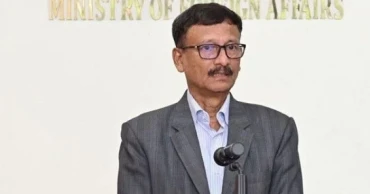
Young generation must be groomed to make basic changes in politics: foreign adviser
Foreign Affairs Adviser Md Touhid Hossain on Friday laid emphasis on building the country and institutions with an improved education system and improving the prospects of the young generation, stressing that the political culture has to change.
He said it is natural that the political parties would like to go to the power but there should be efforts towards building the country and its institutions.
"Politics is still in the hands of our generation of politicians," Hossain said, adding that the young generation will gain experience in the next 10 to 15 years and will be able to make basic changes.
"I am absolutely confident that the young generation will make basic changes in the system," he said while speaking at the inaugural session of the two-day "Bengal Delta Conference 2025" organised by Dacca Institute of Research and Analytics (daira).
"They (youths) may make mistakes along the way, but with time and experience, they will build a stronger and fairer political culture," Hossain said.
Highlighting the importance of gaining knowledge and skills, Hossain said, "We need to learn. If you have proper knowledge, skills and training, sky is the limit (in terms of opportunities) - across the world and within the country."
He said the most important thing for a country like Bangladesh with huge population but limited resources is education.
The adviser said a very small portion of the population receives quality education while the education system in rural areas is in a terrible shape.
"This is one area we need to do a lot. We must do something for the higher education, too," he said as he emphasised the need to redefine political culture.
Adviser Hossain also reflected on the July-August movement and remembered those sacrificed their lives for a change.
Young generation wants to establish a merit-based and professional bureaucracy: Adviser Nahid
Dr. Mushtaq H. Khan, Professor of Economics, SOAS University of London delivered welcome remarks at the session.
Prof. Dr. Maszlee Bin Malik, Chairman, International Institute of Advanced Islamic Studies (IAIS), Prof. Niaz Ahmed Khan, Advisory Board Member, Bengal Delta Conference 2025; Vice Chancellor,University of Dhaka, Dr. Dipak Gyawali, former Minister of Water Resources, Nepal and Mahfuz Anam, Editor and publisher, The Daily Star among others spoke.
The adviser highlighted the significance of the July Uprising in Bangladesh's political history, saying that the youth of Bangladesh will not allow the country to return to the political reality of pre-2024.
He also addressed issues such as the Ukraine war, the genocide in Gaza, the Israel-US-Iran relations, and the global context of US tariffs.
Professor Dr. Maszlee bin Malik, former education minister of Malaysia, said Bangladesh could become a beacon of hope for the Global South.
He praised Chief Adviser Prof Muhammad Yunus for his leadership.
He emphasised the need for Bangladesh to shift from a labor-based economy to a knowledge-based economy and discussed the potential for Bangladesh’s ocean-centered economy.
He also highlighted the positive prospects for Bangladesh's future relationship with the ASEAN regional cooperation organization, saying, “Bangladesh will find ASEAN by its side in resolving the Rohingya crisis.”
Dipak Gyawali, former Minister of Water Resources of Nepal, spoke about the significance of Bangladesh’s people’s uprising, saying, “The people’s uprising in Bangladesh is not only a milestone for the delta but for the entire South Asian region.”
He stressed that alongside democracy, good governance is also crucial for the state.
Professor Niaz Ahmed Khan, vice chancellor of the University of Dhaka, also commented that the delta has not received adequate academic attention, making daira’s initiative highly significant.
Siddharth Varadarajan, founder and editor of the India-based online media The Wire said the path Bangladesh is currently on has global implications.
However, the country’s biggest weakness is economic inequality.”
Mahfuz Anam, reflecting on the political trajectory of the country, said, “Bangladesh’s biggest problem is that politicians use democracy as a ladder to enter parliament.
Prof Mushtaq Khan, reflecting on the hardships faced by students under the previous fascist regime and their subsequent activism post-uprising, welcomed daira’s initiative.
Reinforce tobacco laws to save young generation: Speakers
He discussed Bangladesh’s politics and geopolitics, stating, "Politics must be open. We must rethink the sources of political party funding."
He emphasised that the uprising has made it clear to politicians that returning to the old political settlement is impossible, as the people will no longer accept it.
This year's conference theme was "Bangladesh at Crossroads: Rethinking Politics, Economics, and Geopolitical Strategy."
The opening session of the conference began with the national anthem and a minute of silence to remember the martyrs of the July Uprising.
The session was chaired by Shehrin Amin Bhuiya, assistant professor of Public Administration at the University of Dhaka.
A documentary on the July Uprising and the broader socio-political context of Bangladesh was presented on behalf of daira during this time.
Dacca Institute of Research and Analytics (daira) is a Dhaka-based think tank dedicated to the production and advancement of knowledge about the Bengal Delta.
The institute focuses on understanding the socio-political, economic, and cultural dynamics of Bangladesh in both regional and global contexts.
1 year ago