Hayat Tahrir al-Sham
Israeli airstrike targets area near Syrian presidential palace
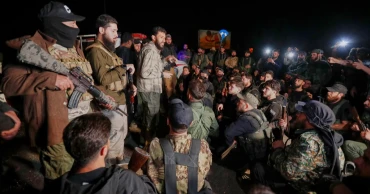
Israel carried out an airstrike early Friday near Syria’s presidential palace, delivering what it called a “clear message” to Damascus after warning authorities not to advance on villages inhabited by members of the Druze minority in the country’s south.
The strike followed several days of fierce clashes between pro-government gunmen and Druze fighters in areas close to the capital, leaving dozens dead or injured, according to Associated Press.
Syria’s presidency condemned the Israeli action, describing it as a “dangerous escalation against state institutions and the sovereignty of the state.” In a statement, it urged the international community to support Syria, stating the attack “target Syria national security and the unity of the Syrian people.”
This marks Israel’s second strike in Syria within a week. The latest strike, near the People’s Palace — a hilltop residence in Damascus — is widely interpreted as a pointed warning to Syria’s new leadership, now reportedly dominated by Islamist groups including Hayat Tahrir al-Sham.
The Israeli military confirmed that fighter jets had struck an area near the Palace of President Ahmad al-Sharaa in Damascus, without providing further details.
Israeli Prime Minister Benjamin Netanyahu and Defence Minister Israel Katz said in a joint statement that the strike was intended as “a clear message” to Syrian authorities.
“We will not allow the deployment of forces south of Damascus or any threat to the Druze community,” they said.
Israel committing ‘Livestreamed Genocide’ in Gaza: Amnesty
Tensions had flared in recent days in southern Syria, particularly in the Sweida province and Druze-majority suburbs of Damascus. On Thursday, the community’s top spiritual leader, Sheikh Hikmat Al-Hijri, delivered a harsh rebuke to the Syrian government, accusing it of carrying out an “unjustified genocidal attack” on the minority group.
Despite the mounting violence, the Druze leadership affirmed their national loyalty, stating early Friday that they remain part of Syria and reject any separatist aspirations.
The statement called on the government to restore its authority in Sweida and secure the vital highway connecting the province with Damascus.
The recent fighting was triggered by the circulation of an audio clip on social media late Monday. The clip, allegedly of a Druze cleric, criticised Islam’s Prophet Muhammad (PBUH), sparking outrage among Sunni Muslims.
However, the cleric in question, Marwan Kiwan, denied any involvement in a video message.
Syria’s Information Ministry reported that 11 members of the security forces were killed in two separate attacks. Meanwhile, the UK-based Syrian Observatory for Human Rights said the death toll from four days of clashes had reached 99, including 51 killed in the Sahnaya area and the Druze-majority suburb of Jaramana. The dead included local gunmen and government forces.
The Druze are a small religious sect that emerged in the 10th century as an offshoot of Ismaili Shiite Islam. Of the estimated 1 million Druze globally, more than half reside in Syria, particularly in Sweida and surrounding regions.
Other significant communities live in Lebanon and Israel, including the Golan Heights, which Israel seized from Syria in the 1967 war and annexed in 1981.
1 year ago
Syrian insurgents advance toward Hama as govt forces counterattack
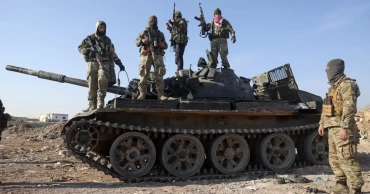
Syrian insurgents, led by Hayat Tahrir al-Sham (HTS) and backed by Turkey, captured four central towns on Tuesday, pushing closer to the strategic city of Hama. Meanwhile, government forces launched counterattacks, regaining some lost ground, opposition activists and state media reported.
The ongoing clashes mark a significant escalation in the 13-year conflict, as insurgents aim to consolidate gains in central Syria, with the ultimate goal of advancing toward Damascus.
Insurgent Gains Near Hama
The insurgents' latest offensive has brought them within 10 kilometers (6 miles) of Hama, Syria’s fourth-largest city. The Britain-based Syrian Observatory for Human Rights confirmed the capture of Halfaya, Taybat al-Imam, Maardis, and Soran.
"We are advancing toward Hama and, God willing, to Homs and Damascus, to liberate Syria," said HTS fighter Abu Abdo al-Hamawi.
The insurgent coalition, comprising HTS and Turkey-backed opposition fighters, has also taken control of several areas in northern Aleppo and southern Idlib provinces over recent days. HTS claims that their forces have inflicted significant casualties on government troops, killing 50 soldiers and capturing 14 towns and villages.
Government Counteroffensive
Syrian government forces, supported by Russian airstrikes, have intensified efforts to reclaim lost territory. On Tuesday, state media reported that government troops recaptured Khanaser, a village on a vital road leading to Aleppo, days after it fell to insurgents.
State-run news agency SANA said government forces are fortifying positions in Hama province as battles with insurgents rage on. Intense airstrikes by Syrian and Russian warplanes continue to target insurgent-held areas.
Read: Syrian insurgents seize four towns amid clashes
Humanitarian Concerns
The escalation has exacerbated Syria’s humanitarian crisis. The Norwegian Refugee Council warned of food shortages and displacement in northern Syria, where thousands of families have fled the violence.
“Civilian casualties are rising due to shelling and airstrikes, and the recent escalation risks plunging Syria back into its darkest days,” said Angelita Caredda, the council’s Middle East director. She urged all parties to adhere to international humanitarian law.
Kurdish-Led Forces Claim Gains in the East
In eastern Syria, the Kurdish-led Syrian Democratic Forces (SDF) announced the capture of seven villages from pro-government forces. However, Syrian state media denied these claims, asserting that the attack was repelled.
The contested villages are near a U.S. military base close to the Iraqi border, adding to the complexity of the conflict.
Turkey’s Role and Erdogan’s Statements
Turkey, a key supporter of Syrian insurgent groups, emphasized the need for a political resolution to the conflict. Turkish President Recep Tayyip Erdogan, in a call with Iraqi Prime Minister Mohammed Shia al-Sudani, reiterated Ankara’s commitment to Syria’s unity and territorial integrity.
Erdogan also warned against Kurdish militant groups exploiting the situation, referring to the U.S.-backed SDF, which Turkey considers a terrorist organization.
Read more: Lebanese officials say an Israeli strike killed 23 Syrian workers and family members in Lebanon
Turkish Foreign Minister Hakan Fidan called on Syrian President Bashar Assad to engage with opposition groups, arguing that reconciliation is essential to stabilize Syria. However, Assad has repeatedly dismissed opposition groups as terrorists and rejected any political dialogue with them.
Regional Implications
Turkey has been seeking to normalize ties with Syria to address security concerns and facilitate the return of over 3 million Syrian refugees. However, Assad demands the withdrawal of Turkish troops from northern Syria as a precondition for reconciliation.
As the conflict intensifies, both sides are bracing for further battles in central Syria. The renewed violence underscores the enduring challenges of achieving peace in a war-torn country.
Source: With inputs from agencies
1 year ago