Law Affairs Adviser Dr Asif Nazrul

Reform of state’s three organs essential to uphold human rights: Asif Nazrul
Law Affairs Adviser Dr Asif Nazrul on Saturday said upholding human rights in Bangladesh is not possible without addressing the longstanding issues within the three key organs of the state -- the executive, the legislature and the judiciary.
“We must fix the state’s three main pillars. Without doing so, there is no way to ensure human rights. We have to touch the core issues. That’s where we are trying to bring change,” he said while speaking at the 11th Human Rights Conference held at Dhaka University’s Muzaffar Ahmed Chowdhury Auditorium.
Human Rights Support Society (HRSS) organised the conference.
Referring to the country’s democratic journey, Dr Nazrul said Bangladesh witnessed relatively fair elections and peaceful transfers of power from 1991 to 2012–13, which allowed for a certain degree of democratic progress. “Even in 2013, during Sheikh Hasina’s tenure, opposition candidates won several mayoral elections …there was still some transparency,” he said.
Govt transparent over aircraft crash, spreading rumors serious offense: Law Adviser
Emphasising a measured approach to reform, he said, “Transformation won’t come overnight. But we must steadily move forward through better elections, administrative and legal reforms, and by building a culture of human rights.”
Presided over by HRSS Chairperson Shahzada Al Amin, the conference was addressed, among others, by human rights activist and HRSS Chief Adviser Md Nur Khan; Senior Human Rights Adviser at the UN Resident Coordinator’s Office in Bangladesh Huma Khan, and Dean of the Faculty of Law at Dhaka University Prof Mohammad Ekramul Haque.
1 year ago
ACC, judiciary worked as subservient to AL: Asif Nazrul
Law Affairs Adviser Dr Asif Nazrul on Monday accused the Anti-Corruption Commission (ACC) and the judiciary of functioning as subordinates to the Awami League during its time in power, alleging they failed to ensure justice and accountability in most cases.
“There was an ACC, there was a High Court, but there were no trials except for Khaleda Zia. Corruption has become entrenched in society due to this lack of accountability,” said Dr Nazrul.
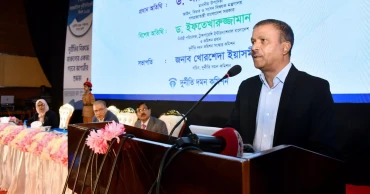
He made the remarks while speaking at a discussion held at the Institution of Diploma Engineers, Bangladesh, to mark International Anti-Corruption Day.
Most cases filed to suppress mass uprising withdrawn: Asif Nazrul
The programme was organised by the ACC, with its Secretary Khorsheda Yasmin in the chair. Executive Director of Transparency International Bangladesh (TIB) and head of the ACC Reform Commission, Dr Iftekharuzzaman, attended the event as a special guest.
Dr Nazrul highlighted the prevalence of corruption during the last 15 years under the Awami League government, stating that institutions like the ACC and judiciary failed to act independently, especially in cases not politically motivated.
Referring to a controversial statement by a former Prime Minister, he said, “How does a Prime Minister's peon claim to own Tk 400 crore and laugh about it during a press conference? The entire family was complicit in corruption. During Sheikh Hasina’s tenure, the ACC and judiciary became her subordinates.”
Interpol red notice planned for Hasina, other fugitives: Asif Nazrul
He emphasised the need for immediate reform and activation of the ACC to address past corruption effectively. “We cannot leave the ACC dormant. The new commission must be empowered to tackle corruption effectively. Time is of the essence,” he added.
Speaking at the event, ACC Director General (Prevention) Md Akhter Hossain underlined the importance of fostering public awareness to combat corruption. “An honest generation can lead to an anti-corruption society. We must awaken the public’s consciousness to the dangers of corruption.”
People will decide Awami League’s election fate: Asif Nazrul
The discussion also underscored the necessity for reform within the ACC and judiciary to ensure their independence and efficiency.
Dr Nazrul urged all stakeholders to stop solely blaming politicians and take individual responsibility for tackling corruption. “We must stop blaming only politicians and take responsibility for our own actions. Learning from the youth and fostering a culture of accountability are essential,” he added.
1 year ago