Bashar Al Assad
Syria's economic struggles persist despite Assad's ousting
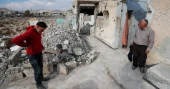
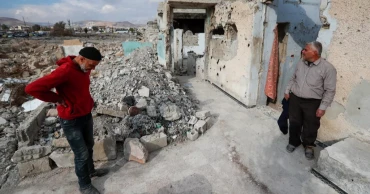
Samir al-Baghdadi, a mechanic, is attempting to rebuild his family home in Qaboun, a district near Damascus, using his own hands.
His house, once a gathering place for family, is now reduced to rubble from years of civil war, reports AP.
Al-Baghdadi cannot afford workers or machinery to clear the debris and repair the house, earning just enough to feed his family. However, with the high cost of rent in a nearby apartment, he is determined to rebuild gradually.
Italy’s foreign minister visits Syria to promote a peaceful transition after Assad’s regime
Though Assad was ousted last month in a swift uprising, the country’s severe economic conditions that sparked protests remain unchanged. Years of civil war, corruption, and mismanagement, compounded by international sanctions, have decimated the economy, with inflation causing about 90% of the population to fall into poverty. The U.N. World Food Program reports that more than 12 million people are uncertain where their next meal will come from.
Even though international sanctions have not been fully lifted and potential investors remain cautious, the hopes for Syria's new rulers may be short-lived. Qaboun and other areas of eastern Damascus became rebel strongholds in 2012, during the protests against Assad. The neighbourhood suffered heavy bombardment, including from the Islamic State group. Although government forces regained control in 2017, al-Baghdadi was banned from returning until Assad's ousting.
Despite the challenges, al-Baghdadi hoped the political change would lead to better times. However, issues such as power outages and fuel shortages persist. Families have relied on humanitarian aid and remittances from abroad, while the country’s infrastructure—electricity, water, and roads—needs extensive rebuilding. Experts estimate that reconstruction could cost up to $400 billion, far more than the $250 billion predicted in 2017.
Although Gulf nations have pledged to work with Syria’s interim rulers, and the U.S. has relaxed some restrictions, many Syrians believe these measures are insufficient to revive the economy. Economic researcher Sinan Hatahet criticises U.S. actions as inadequate, pointing out that restrictions on trade and reconstruction hinder the private sector's ability to recover.
The lack of jobs, investment, and financial aid is putting enormous pressure on Syrian families. The World Food Program’s executive director, Cindy McCain, warned that the ongoing food and economic crises are also a matter of security.
In Damascus, markets may appear lively, but the economy tells a different story. Merchants, like Walid Naoura, note that despite the celebratory atmosphere, high prices have deterred customers. In a nearby workshop, carpenter Abou Samir works by hand, unable to power his equipment due to frequent electricity cuts. His sons send him money from abroad, but he refuses to stop his trade.
First international commercial flight since Assad's ouster lands in Syria's capital
Back in Qaboun, al-Baghdadi reflects on his modest progress—connecting a single lightbulb to electricity but still lacking running water. Despite these challenges, he hopes to move back into his home before summer, even though it's far from complete, believing that living in his own home is preferable to any luxury elsewhere.
1 year ago

Lebanese man freed after 32 years in Syrian prison
Suheil Hamwi, a Lebanese man who spent 32 years imprisoned in Syria, has finally returned to his home in Lebanon following a major offensive by insurgents that ousted the government of Bashar Assad, reports AP.
Hamwi, who worked as a merchant in Chekka, northern Lebanon, was abducted in 1992 on Saint Barbara’s Day, a holiday akin to Halloween. He was taken by force when a group of men dragged him into their car as he fetched whiskey for a customer. His family did not hear from him for years.
US keen to support Syrian leaders on conditions
He was among hundreds of Lebanese citizens detained during Syria’s occupation of Lebanon from 1976 to 2005. On Sunday, in the wake of Syria’s opposition forces advancing, Hamwi and other prisoners discovered their guards had fled. Seizing the moment, they walked free.
“I’m still scared this might not be real,” Hamwi told The Associated Press from his home, the same place he left more than three decades ago. Yet, he added, “I found my freedom.”
Decades of Uncertainty
For years after his disappearance, Hamwi’s family had no idea where he was. Sixteen years later, his wife learned he was detained in Syria, but the reasons for his arrest remained unclear.
It wasn’t until 20 years after his abduction that Hamwi was informed of the charges against him: he was accused of being a member of the Lebanese Forces, a Christian political party and militia opposed to Syria’s military presence in Lebanon during the 15-year Lebanese civil war.
Hamwi endured years of cryptic interrogations and isolation. Held in multiple facilities, including the notorious Saydnaya prison, he faced torture during his early captivity but said it eventually ceased. In 2008, after 16 years, his wife was allowed to visit him, a meeting that became an annual occurrence.
The Path to Freedom
Last week, prisoners heard rumours of rebel advances but didn’t expect the impact to reach them. Early Sunday, chaos erupted as prisoners discovered the guards had abandoned their posts. Rebels broke open gates, and prisoners began escaping.
Hamwi, along with others, walked into uncertainty, guided by strangers back to Lebanon. He crossed into his homeland via the Arida border crossing, where his family awaited him.
A Joyful Homecoming
Back in Chekka, Hamwi was greeted by his two grandchildren, meeting them for the first time. Photos of family milestones, including his son George’s graduation and wedding, filled the home he hadn’t seen in over 30 years.
Amidst laughter and shared memories, neighbours and friends gathered to celebrate. Josephine, his wife, served sweets while friends asked, “Do you remember me?” Hamwi recognised many faces, rekindling old connections.
He has undergone medical tests to assess the physical toll of his decades-long captivity and is adjusting to life outside prison. Still, he eagerly anticipates reuniting with his son George, now an engineer in the Gulf. In their first phone call, George expressed the words Hamwi had longed to hear: “I miss you. I love you. I’m waiting to see you.”
1 year ago