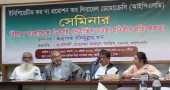
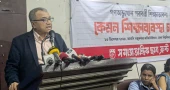
Dr Salimullah Khan
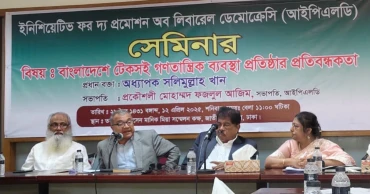
Dr Salimullah slams India over minority oppression propaganda
Dr Salimullah Khan, a writer and teacher, said on Saturday that India is spreading propaganda against us about the oppression of minorities, which you can see by looking at India, whereas Hasina has enslaved this neighboring country to India.
He made the remarks while addressing a seminar titled, "Initiative for the Promotion of Liberal Democracy” organised at the Jatiya Press Club in the capital.
“India is projecting its own diagnosis onto us. The kinds of incidents they are accusing us of are far more prevalent in West Bengal. They claim Muslims constitute 20 to 25 percent of the population there, but you won’t find even five per cent Muslims in the police force or in government jobs. This is structural violence,” Dr Salimullah said.
Criticising the opposition BNP, Salimullah Khan said the party has failed to make any meaningful progress over the last 17 years.
‘March for Gaza’ in Dhaka today in protest against Israeli atrocities
"Even Mirza Abbas himself admitted to fleeing in fear for his life. They claim they couldn’t protest due to fear. But others who sacrificed their lives did so for a cause that isn't even on the BNP's agenda today," he said.
Referring to Bangladesh’s dependency on foreign assistance, he said, “I’ve heard that China plans to build hospitals here. You’ll receive treatment, but to do so, you'll have to detach yourselves from the Commonwealth.”
Salimullah Khan also raised concerns about the state of education in Bangladesh and how it relates to democracy. “How can you have democracy without education?” he questioned.
He also lamented the declining status of Bangla-medium schools in the country, which he claimed are being downgraded to second- or third-tier institutions.
“The best schools are English-medium ones… all cadet colleges teach in English. Meanwhile, madrasas are criticised for teaching in Urdu. Why not promote Bangla in both systems instead?”
1 year ago
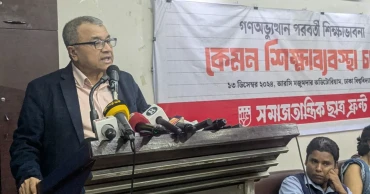
Investment in education must be increased to overhaul the system: Dr Salimullah Khan
The reform of the education system should be gradual, not revolutionary, and requires time. To bring about changes in the education system, investment in education must be increased, and educational opportunities should be provided to all. The state must take responsibility for the cost, curriculum, and language of education.
These points were made during a dialogue titled "Post-People's Uprising Thoughts on Education—What Kind of Education System Do We Want?" held at the RC Majumdar Auditorium of Dhaka University on Friday afternoon, organized by the Samajtantrik Chhatra Front.
Professor and writer Salimullah Khan stated during the discussion that if we want to bring about changes in the education system, investment in education must be increased, and the state must take on that responsibility. He emphasized that the real issue in education is how long we will consider education a right, what the curriculum will be, and in what language education will be delivered.
He added that even if education is universal and everyone’s rights are protected, inequality will still persist. For this reason, the democratic form of education would be nationalization. The state must take responsibility for the cost, curriculum, and language of education. He further said that everyone should have access to education and that the teacher-student ratio must be changed.
Read: AKDN's resident representative discusses education and climate change initiatives with Foreign Adviser
Associate Professor Samina Lutfa of the Department of Sociology at Dhaka University stated that the reform of the education system should not be revolutionary, but should happen gradually. The reform cannot be accomplished quickly, so experienced educators should be involved in the process. She said that teaching is not like a typical 9am to 5pm job; it is a 24-hour responsibility, and teachers should be provided with the necessary environment to perform their duties.
She further emphasized that for real change to take place, students need to be involved in extracurricular activities such as sports and various cultural and literary events, and that diversity is important. The infrastructure of schools and colleges, along with the role of teachers, are crucial in this process.
Professor Kamrul Hasan Mamun of the Department of Physics at Dhaka University commented that political stories have been included in the textbooks of children in the country’s education system. Political messages and images have been added to the back covers of books. The inclusion of politics in children’s books is something not found in any other country.
He also mentioned that various education streams, including Bengali, English, Madrassa, and technical education, exist in the country, but there is no common platform for them. He pointed out that those who study in English-medium schools are expected to pursue "export-quality" education, while those studying in Bengali-medium schools aim to take the BCS exam. This divide has emerged in the education system.
He added that there has been a rush to establish universities in districts under the name of development. Unqualified individuals have been made teachers in these universities. However, he noted that Bangladesh has never had a sufficient number of qualified teachers in its 161 universities.
Navine Murshid, a teacher at a private university, said that the kind of education system they want is one where students can think critically. Critical thinking should be the foundation of any education system.
Read more:Private institution teachers to get transfer opportunity: Education Adviser
Other speakers at the dialogue included writer and editor Rakhal Raha, and senior teacher Shamiem Zaman from Muhammad Shahidullah Adarsha Higher Secondary Institution.
1 year ago