Chief Prosecutor
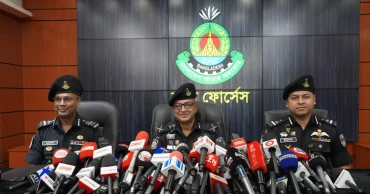
RAB yet to receive tribunal request over enforced disappearance, crossfire cases: DG
Newly appointed Director General of Rapid Action Battalion (RAB) Md Ahsan Habib Palash on Sunday said the force has not yet received any request from the International Crimes Tribunal regarding allegations of enforced disappearances and crossfire incidents but pledged full cooperation if approached.
Any request related to judicial proceedings would be duly honoured, he said a media briefing at the RAB Media Centre in the capital’s Karwan Bazar.
Responding to a question about the Chief Prosecutor’s remarks on summoning and examining RAB’s crossfire records, the DG said, “If any cooperation is sought in relation to the judicial process, RAB will provide it. We will share whatever information we have and if any information is unavailable, we will inform accordingly. However, the tribunal has not yet contacted us.”
On reported domestic and international calls for disbanding RAB, he said such decisions lie with the government. “RAB’s responsibility is to carry out its assigned duties properly and build public trust through its work,” he added.
Addressing allegations that the force was used for political purposes in the past, the DG said recent activities suggest a decline in major irregularities. “If managed properly, RAB can play a constructive role,” he said.
On tackling piracy and separatism, he said intelligence surveillance has been strengthened and operations are being conducted based on gathered information.
Without directly commenting on militancy, he said RAB continues to work against all forms of terrorism and will maintain that effort in the future.
Expressing concern over the rise of juvenile gangs, he said the problem is increasing across the country. “Police and RAB are working jointly, but bringing juveniles under the law often remains challenging,” he noted, urging journalists to support efforts through investigative reporting.
Regarding the possible renaming or restructuring of RAB, he said it is entirely a policy matter for the government. “Our priority is to perform our duties. Internal investigations into allegations of human rights violations are ongoing, and no one will be spared,” he said.
On US sanctions, the DG acknowledged that the situation stemmed from past shortcomings. “If those are addressed, we hope such sanctions will not continue in future,” he added.
5 months ago

Legal costs escalate due to lawyers’ syndicate: ICC Chief Prosecutor
Legal expenses in Bangladesh are escalating at an alarming rate, driven by a syndicate of Supreme Court lawyers, said ICC Chief Prosecutor Md Tajul Islam on Monday.
Tajul Islam said this while speaking at a dialogue titled "Dialogue for Democratic Reconstruction — on Judiciary," organised by the Centre for Governance Studies (CGS) at the CIRDAP Auditorium in the capital.
Raising serious concerns about the state of the judiciary, the chief prosecutor said, “While a regular lawyer’s fee might amount to Tk 20,000, political biases in the courts often compel litigants to hire syndicate lawyers, who charge between Tk 5 lakh and Tk 25 lakh to secure bail or a favourable outcome.”
“Cases handled by general lawyers are unlikely to succeed,” he added, highlighting the difficulties faced by those unable to afford such exorbitant costs.
Tajul Islam alleged that ordinary lawyers, unable to secure clients, are increasingly resorting to corrupt practices.
He also criticised bench officers for accepting bribes ranging from Tk 20,000 to Tk 1 lakh to expedite the listing of bail petitions.
Advocate Tajul Islam returning as Chief Prosecutor at ICT, where once he led defence of Jamaat leaders
“I have seen instances where judgments were delayed by three years due to bribe-related issues. Political appointments of judges have exacerbated corruption within the judiciary. When the judicial system is used for political purposes, judges exploit the situation to engage in corrupt activities,” he mentioned.
Citing the Supreme Court’s decision to halt the corruption investigation into S Alam, he posed a pointed question: “Why did the Supreme Court shield corrupt individuals who support the ruling party? This culture must end.”
Backlog of cases
The ICC Chief Prosecutor expressed alarm over the backlog of cases in the judicial system, and described how files are stored haphazardly in inadequate spaces, including in front of bathrooms in annex buildings.
He called for the urgent digitisation of case management to enhance efficiency. “At present, even if no new cases are filed, it would take at least 30 years to resolve the existing backlog.”
The prosecutor underscored the necessity of structural reform in the judiciary to ensure its impartiality and effectiveness.
He urged authorities to address corruption, improve infrastructure, and embrace digital solutions to overcome the inefficiencies plaguing the judicial system.
1 year ago