President Yoon Suk Yeo
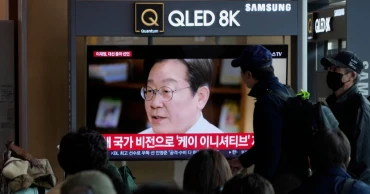
SKorean opposition leader opens presidential bid following Yoon's ouster
South Korean opposition leader Lee Jae-myung, widely seen as the frontrunner in a presidential by-election triggered by the removal of President Yoon Suk Yeol last week, officially announced a presidential bid on Thursday, vowing to heal a starkly divided nation through economic growth.
Lee, who narrowly lost the 2022 election to Yoon, led the liberal Democratic Party’s campaign to oust the former president over his December declaration of martial law, reports AP.
Lee recently stepped down as the party’s chairman to focus on campaigning for the June 3 election. He is considered the clear frontrunner in party's primary. Kim Dong-yeon, the Democratic governor of Gyeonggi province and a longtime financial policymaker, also told reporters Wednesday that he intends to run for president.
Yoon’s downfall has left the conservative People Power Party in disarray, with roughly 10 politicians expected to seek the nomination, reflecting a split between Yoon loyalists, who still control the party’s leadership, and reformists calling for a fresh start.
In a video message, Lee said that Yoon’s martial law saga exposed the country’s deep divisions and social conflicts, and argued that the root cause was a widening rich-poor gap. He promised aggressive government spending to jolt economic growth and ease income polarization.
“We have more than we did in the past, but wealth is too concentrated in certain areas,” Lee said. “With economic growth rates declining worldwide, it has become difficult to maintain and develop an economy solely on the strength of the private sector. However, with government-led talent development and extensive investments in technological research and development, we can revive the economy.”
Pakistan says US companies seek to invest in its minerals sector
Lee said it was crucial to maintain a robust alliance with the United States and to pursue three-way cooperation with Japan, but he stressed that South Korea’s national interest should come first in “every decision.”
Lee, who has served as a lawmaker, provincial governor and city mayor, is adored by supporters for his outspoken style and has long positioned himself as an anti-elitist. His critics view him as a populist who stokes division and demonizes conservative opponents while failing to offer realistic funding plans to achieve his ambitious goals.
Kweon Seong-dong, floor leader of the People Power Party and a staunch Yoon loyalist, said that if Lee becomes president, he will “ruthlessly wield the sword of dogmatism and retribution” and further deepen the country’s divisions.
Lee also has his own set of legal troubles, facing five different trials for corruption and other criminal charges.
1 year ago
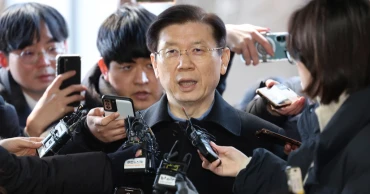
South Korea presidential security chief questioned amid tensions
South Korean police interrogated the head of the presidential security service on Friday amidst escalating tensions between agencies over the detainment of impeached President Yoon Suk Yeol, reports AP.
The Corruption Investigation Office for High-Ranking Officials and the police plan a renewed effort to detain Yoon, investigating whether his brief declaration of martial law on December 3 constituted an attempted rebellion. The security service had previously obstructed an attempt to detain Yoon at his official residence, where he has been confined for weeks.
South Korean anti-corruption agency receives new court warrant to detain impeached President Yoon
Presidential security chief Park Jong-joon, defending his role as the president’s protector, warned of potential "bloodshed" and faced criticism that the security agency is acting as Yoon's private army. After ignoring two summonses, Park appeared for questioning over allegations of justice obstruction, following last week’s clash where security forces repelled investigators attempting to detain Yoon.
Authorities are considering arresting Park and other security leaders to facilitate Yoon’s detainment. Yoon remains at his fortified residence in Seoul, with heightened security measures, including barbed wire and blocked roads.
South Korean anti-graft agency asks police to measures to detain impeached Yoon
On December 3, Yoon briefly declared martial law, deploying troops around the National Assembly. This measure was overturned the same day when lawmakers breached the blockade and voted to lift martial law. Subsequently, Yoon’s presidential powers were suspended after his impeachment on December 14, with the Constitutional Court deliberating on whether to remove him from office or reinstate him.
Park criticized the investigation, urging an approach that respects Yoon’s status as president and the dignity of the nation. He stated that he sought mediation from acting leader Deputy Prime Minister Choi Sang-mok and Yoon’s legal team but received no satisfactory response.
Yoon’s lawyers have accused the police of undermining the presidential security service, arguing that national security is being disregarded. While the Presidential Security Act mandates protecting the president, legal experts argue that the security service’s actions might be unlawful if they obstruct court-ordered detainments.
South Korean fire fighters tackle blaze in commercial building in Seongnam
National Court Administration head Cheon Dae-yeop remarked that unwarranted resistance to such orders could constitute a crime. Although sitting presidents enjoy broad immunity from prosecution, charges of rebellion or treason are exceptions.
Yoon’s legal team questioned the legitimacy of the detention warrant issued by the Seoul Western District Court, asserting that the anti-corruption office lacks authority to investigate rebellion or enforce detainment at a location potentially linked to military secrets without the resident's consent.
The lawyers have called for the anti-corruption agency to either indict Yoon or seek a formal arrest warrant, which requires a court hearing. However, they insist Yoon would only comply with an arrest warrant from the Seoul Central District Court, accusing the agency of judge-shopping by choosing a more favourable jurisdiction.
1 year ago