Dhaka-Air
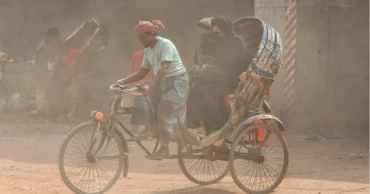
Dhaka’s air world's 6th worst this morning
Dhaka, the overcrowded capital city of Bangladesh, has ranked sixth on the list of cities with the worst air quality with an AQI score of 171 at 8am this morning (February 12, 2025).
Today’s air was classified as 'unhealthy', referring to the fact that air pollution levels are high enough to cause adverse health effects for some people.
When the AQI value for particle pollution is between 50 and 100, air quality is considered ‘moderate’, usually sensitive individuals should consider limiting prolonged outdoor exertion, between 101 and 150, air quality is considered ‘unhealthy for sensitive groups’, between 150 and 200 is ‘unhealthy’, between 201 and 300 is said to be 'very unhealthy', while a reading of 301+ is considered 'hazardous', posing serious health risks to residents.
Vietnam’s Hanoi, Bosnia Herzegovina’s Sarajevo, India’s Mumbai and Delhi and Pakistan’s Lahore cities respectively occupied the first, second, third, fourth and fifth spots on the list.
Dhaka’s air quality world's worst this morning
The AQI, an index for reporting daily air quality, informs people how clean or polluted the air of a certain city is and what associated health effects might be a concern for them.
The AQI in Bangladesh is based on five pollutants: particulate matter (PM10 and PM2.5), NO2, CO, SO2, and ozone.
Dhaka has long been grappling with air pollution issues. Its air quality usually turns unhealthy in winter and improves during the monsoon.
As per World Health Organization (WHO), air pollution kills an estimated seven million people worldwide every year, mainly due to increased mortality from stroke, heart disease, chronic obstructive pulmonary disease, lung cancer, and acute respiratory infections.
1 year ago
Dhaka’s air quality ranks world’s 2nd worst on Thursday
Dhaka, the overcrowded capital city of Bangladesh, has ranked the second on the list of cities with the worst air quality with an AQI score of 267 at 9am this morning (January 30, 2025).
Today's air was classified as “very unhealthy”, referring to a severe health threat, according to the AQI index. Such an unhealthy environment has been prevailing in the densely polluted city over the past few days.
When the AQI value for particle pollution is between 50 and 100, air quality is considered ‘moderate’, usually sensitive individuals should consider limiting prolonged outdoor exertion, between 101 and 150, air quality is considered ‘unhealthy for sensitive groups’, between 150 and 200 is ‘unhealthy’, between 201 and 300 is said to be 'very unhealthy', while a reading of 301+ is considered 'hazardous', posing serious health risks to residents.
Delhi’s India, Uganda’s Kampala and Iran’s Tehran respectively occupied the first, third and fourth positions on the list, with AQI score of 333, 194 and 183.
Reducing air pollution time-consuming process: Rizwana
The AQI, an index for reporting daily air quality, informs people how clean or polluted the air of a certain city is and what associated health effects might be a concern for them.
The AQI in Bangladesh is based on five pollutants: particulate matter (PM10 and PM2.5), NO2, CO, SO2, and ozone.
Dhaka has long been grappling with air pollution issues. Its air quality usually turns unhealthy in winter and improves during the monsoon.
As per World Health Organization (WHO), air pollution kills an estimated seven million people worldwide every year, mainly due to increased mortality from stroke, heart disease, chronic obstructive pulmonary disease, lung cancer, and acute respiratory infections.
1 year ago
Improved air quality could save over 81,000 lives annually in Bangladesh: Report
Bangladesh could prevent over 81,000 premature deaths each year and avert significant economic losses by reducing its air pollution, according to a report by the Center for Research on Energy and Clean Air (CREA).
The report titled "Public Health Impact of Fine Particulate Air Pollution in Bangladesh" was unveiled at a press conference jointly organised by Center for Atmospheric Pollution Studies (CAPS) and CREA at the Jatiya Press Club on Saturday.
Every year, 102,456 people, including 5,258 children, die prematurely in Bangladesh due to the effects of air pollution (annual average PM 2.5) while many people are suffering from fatal diseases such as heart disease, stroke, asthma-respiratory infections and lung cancer due to air pollution, it said.
Besides, data-driven analyses were presented on the health risks posed by air pollution in Dhaka and other major cities across the country.
The press conference and report launching event was moderated by Professor Dr. Ahmad Kamruzzaman Majumder, Chairman of CAPS.
Professor Dr. Adil Mohammed Khan, President of the Bangladesh Institute of Planners, was present as the chief guest.
According to CREA analysis, PM2.5 is responsible for roughly 102,456 deaths annually related to ischemic heart disease, stroke, chronic obstructive pulmonary disease, lower respiratory infections, and lung cancer.
Children under five are especially vulnerable, with 5,258 deaths annually attributed to PM2.5-related lower respiratory infections, it said.
Besides, the air pollution is leading to thousands of premature births, low birth weights, and childhood deaths each year.
These outcomes stressed the need for targeted interventions to protect those who are least able to protect themselves.
Dhaka's air quality 2nd worst in the world this morning
Addressing Bangladesh’s air pollution needs an investment in both public health and the domestic economy, said CREA Air Quality Analyst Dr Jamie Kelly.
By enforcing stricter controls and adopting cleaner energy solutions air pollution levels can be dramatically reduced, said CREA Southeast Asia Analyst and lead author, Daniel Nesan.
1 year ago