Bangladesh Election
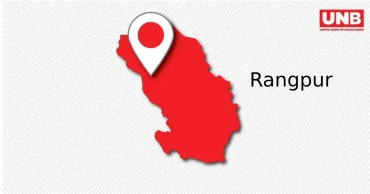
Tension erupts in a polling station in Rangpur-6 after recovery of six ballot papers
Tension flared on Monday morning after six tampered ballot papers and two seals were recovered from a polling station in Pirganj Upazila of the Rangpur-6 constituency.
The incident occurred at Hasarpara Government Primary School polling station in Madankhali Union.
Locals said some students who arrived at the school in the morning found six sealed ballot papers inside a classroom. Two of the ballots were stamped for the paddy sheaf symbol, while four were for the referendum.
When the matter was reported to the school headmaster, he seized the ballots and seals and informed the upazila administration. Upazila Executive Officer (UNO) Poppy Khatun arrived at the scene shortly after, but a crowd of agitated locals had already gathered and began protesting.
At one-point, angry crowd confined the UNO and vandalized her car amid allegations of vote rigging. Following this, additional police personnel arrived and restored order in the area.
The Assistant Returning Officer assured that a thorough investigation would be conducted into the incident.
8 months ago
Commonwealth calls Bangladesh elections acceptable, orderly
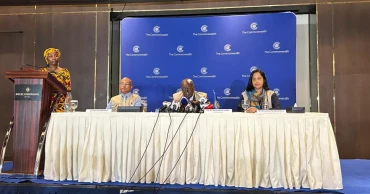
Chairperson of the Commonwealth Observer Group Nana Addo Dankwa Akufo-Addo on Saturday described Bangladesh’s 13th parliamentary election as ‘acceptable, transparent, peaceful and orderly’.
He commended the peaceful conduct of Bangladesh’s parliamentary elections and the July Charter referendum, while highlighting areas where further progress on ‘inclusion and accessibility’ could strengthen the democratic process.
“The people of Bangladesh have exercised their democratic rights to seek the fulfillment of their aspirations. We encourage them to be magnanimous and united in their shared democratic future,” said the former President of Ghana while presenting the Group’s interim statement on Thursday’s national election and referendum at a city hotel.
Looking ahead to the next election cycle, he encouraged the Bangladesh Election Commission to conduct a post-election review, including of all observer recommendations, as is consistent with good practice.
The final report, which will set out the full findings on the process and recommendations in greater detail, will be submitted to the Commonwealth Secretary-General, Shirley Botchwey, and thereafter shared with the government of Bangladesh, the Election Commission, political parties, and Commonwealth governments and then made public.
The Chairperson acknowledged the context in which the elections were conducted, including the significant political developments following the July Uprising of 2024, as well as decisions affecting the participation of some political parties.
While the Group noted isolated reports of post-election tensions, it encouraged all stakeholders to continue to promote calm and peaceful conduct during the post-election period, and to resolve any disputes through the relevant legal channels.
The Observer Group praised the vibrant media coverage, noting its important role in informing citizens and encouraging political debate.
At the same time, it raised concerns about online misinformation, cyber harassment and hate speech, which continue to affect public discourse.
The participation of women and youths emerged as areas requiring greater attention.
Women accounted for only 4 per cent of candidates, with seven elected, while youth activism did not always translate into formal influence within political party structures, he said.
According to the Group’s statement, despite isolated pre- and post-election tensions, polling officials, security personnel and election agents generally carried out their duties with professionalism.
The Group also noted that officials assisted elderly voters and persons with disabilities.
However, many polling stations remained inaccessible, particularly on upper floors, and lacked provisions for other forms of disability.
On the referendum, the Group said it recognises the Charter as a response to multiple and urgent demands for reform. “At the same time, some stakeholders expressed concerns as to whether the referendum process was sufficiently consultative and clearly communicated.”
The Group encouraged all stakeholders to maintain calm during the post-election period and consider the recommendations that will be outlined in its forthcoming final report.
The Commonwealth Observer Group is an independent body that will make recommendations to the Commonwealth Secretary-General.
It was constituted by the Commonwealth Secretary-General. Twelve experts, drawn from the fields of politics, law, media, gender, and election administration from several Commonwealth regions, were part of the group.
UN encourages political stakeholders to strengthen national unity in Bangladesh
The Commonwealth admitted Bangladesh as its 34th member on 18 April 1972, after its independence in December 1971.
This is the fourth time that a Commonwealth Observer Group has been deployed.
8 months ago
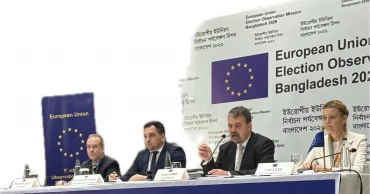
Bangladesh election credible, genuinely competitive: EU Chief Observer
Chief Observer of the European Union Election Observation Mission (EU EOM) to Bangladesh Ivars Ijabs on Saturday described the national election as ‘credible, hugely and genuinely competitive and pluralistic’ but observed that there was lack of proper women's representation.
“Parliamentary elections were credible and competently managed, marking a pivotal step towards restoring democratic governance and rule of law,” he told reporters at a city hotel.
Ijabs noted that for the first time since 2008, elections were genuinely competitive, conducted under a renewed legal framework that largely accords with international standards and with fundamental freedom broadly respected.
He, however, said sporadic, localised political violence and persistent fear of mob attacks, often triggered by manipulated online narratives, harmed the democratic process.
Regarding the voter turnout, Ijabs said this is historically higher and lower and noted that it is shrinking everywhere and it is something concerning for all democracies.
He said the limited political space afforded to women undermined their equal participation but the EC worked independently and transparently, maintaining the confidence of stakeholders and upholding the integrity of the polls.
“Women candidates were, regrettably, almost absent from these elections,” Ijabs said, noting that only four percent of the contestants were women, with BNP fielding 10 and NCP two candidates, while Jamaat and 30 other parties did not have any, evidencing a ‘clear lack of political will’ to advance women in national politics.
He also highlighted the vital role of citizen observers, fact-checkers, as well as youth and women activists in rebuilding public trust in elections, enhancing transparency, and helping voters to make informed choices.
The EU EOM observers noted that the election day was orderly, festive, and calm, while dedicated poll workers managed the opening, voting, and counting efficiently.
EU Chief Observer calls twin polls a big day for Bangladesh democracy
The presence of party agents at all stages of the process enhanced integrity, while regular updates on results tabulation at the local level by returning officers and by legacy media helped to maintain public confidence. Independent participation of persons with disabilities was not always ensured.
The absence of affirmative action measures still leaves indigenous communities and minorities underrepresented in the political arena.
"It is time to abandon the old practices that no longer reflect the growing maturity of Bangladesh's democracy and to chart a new course promoting independent institutions, human rights and accountability," said Ijabs.
Head of the European Parliament Delegation Tomas Zdechovsky said the country is now entering a new crucial phase. “We urge the new parliament and government, backed by all other state institutions, to implement the approved reforms.”
The EU EOM has been present in Bangladesh since the end of 2025 and on election day with 223 international observers, drawn from all EU Member States, as well as Canada, Norway and Switzerland, deployed across all 64 administrative districts.
The mission will continue to observe the post-election environment and will publish a final report, including recommendations for improving future elections, in the coming months.
8 months ago
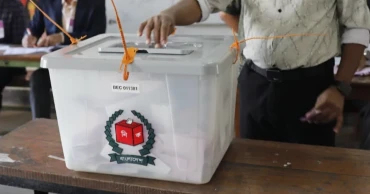
59.44 percent votes cast in national election:EC
The voter turnout in the national election stood at 59.44 percent, the Election Commission (EC) said on Friday.
The information was shared around 11:30am by the Director of Public Relations wing of the Election Commission Md Ruhul Amin Mallik.
On Thursday night, the commission explained that since postal ballots were added in most constituencies, there was a possibility of error in providing immediate statistics.
The commission said it decided to disclose the turnout rate only after completing the counting process to ensure accuracy.
8 months ago
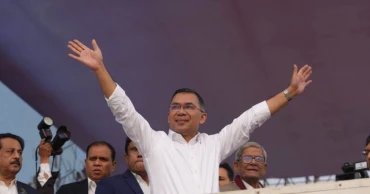
All eyes on Tarique Rahman as BNP set to form government
A new chapter is set to unfold in Bangladesh politics, as BNP is poised to form a government after securing a two-thirds majority in the national election, held largely in a peaceful atmosphere following years of uncontested polls.
The party’s media unit said on X Friday that BNP has secured enough parliamentary seats to govern independently.
Although the Election Commission is yet to release the final tally, unofficial results show that BNP has crossed the 151-seat mark required for a majority in Parliament.
This outcome marks a remarkable comeback for BNP and its leader Tarique Rahman, positioning him to potentially become Bangladesh’s next prime minister.
Just two years ago, Tarique was living in self-imposed exile in London while many BNP members and supporters faced imprisonment under Sheikh Hasina’s regime.
Meanwhile, BNP has extended heartfelt congratulations to the people of the country after the decisive election victory.
The party has announced that Friday prayers will be offered in mosques in the country after Jum'a seeking eternal peace of late Prime Minister Khaleda Zia, and for the well-being of the nation, according to the party’s media cell.
The party said that no rallies or public meetings will be held to celebrate the victory.
BNP has urged its leaders, activists and the general people at all levels along with members of its affiliated parties, to participate in the nationwide prayers at mosques.
Besides, it called upon the people of all faiths to offer prayers at temples, churches, pagodas, and other places of worship for the prosperity and welfare of the nation.
The United States has congratulated the people of Bangladesh for holding a successful national election.
In a Facebook post, the US embassy in Dhaka extended greetings to Bangladesh Nationalist Party (BNP) and its leader Tarique Rahman on ‘historic victory’.
Indian Prime Minister Narendra Modi on Friday conveyed his warm congratulations to Tarique Rahman on leading BNP to a decisive victory in the Parliamentary elections in Bangladesh.
“This victory shows the trust of the people of Bangladesh in your leadership,” Modi said in a message.
India will continue to stand in support of a democratic, progressive and inclusive Bangladesh, he said.
Pakistan's Prime Minister Shehbaz Sharif has also congratulated Tarique Rahman on "leading the BNP to a resounding victory" in the elections.
"I look forward to working closely with the new Bangladesh leadership to further strengthen our historic, brotherly multifaceted bilateral relations and advance our shared goals of peace, stability, and development in South Asia and beyond," he wrote on X.
Millions of voters cast their ballots in a festive atmosphere across the country with long queues seen at most polling centres from early morning.
Voting began at 7:30am and continued until 4:30pm, followed by counting.
The Election Commission Secretariat said around 9 pm that voter turnout averaged 59.44 percent.
Voting in 42,651 centres across 299 constituencies concluded largely peacefully, with only isolated incidents of scuffles and tension reported.
With the election win of BNP, Bangladesh is set to have a male prime minister for the first time in 35 years.
The last male Prime Minister was Kazi Zafar Ahmed, who assumed office in 1988 during the rule of Hussain Muhammad Ershad.
Since his departure in 1990, the country’s top executive office had alternated between Khaleda Zia and Sheikh Hasina.
Tarique Rahman returned to Bangladesh from London last in December after nearly two decades abroad, responding to what many described as a growing demand for new leadership.
The enthusiasm surrounding his return appears to have culminated in the February- 12 election results.
Throughout the campaign, Tarique laid emphasis on youth empowerment, women’s advancement and farmers’ welfare.
In a country where women make up nearly half the population and thousands of young graduates enter the job market every year, he repeatedly underscored the need to harness youth potential to build a “new Bangladesh.”
8 months ago
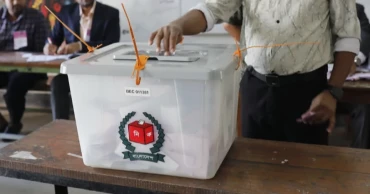
EC withholds results of 3 constituencies
The Election Commission has decided to withhold the results of three constituencies as court cases are pending against the declared winning candidates.
The constituencies are Sherpur-2, Chattogram-2 and Chattogram-4.
The EC issued three separate letters in this regard on Thursday.
The EC said the results are being withheld as cases are pending before the court against the winning candidates in these constituencies.
The election results will remain suspended until the disposal of the cases, it said.
The winning candidates are Aslam Chowdhury (Chattogram-4), Sarwar Alamgir(Chattogram -2) and Mohammad Fahim Chowdhury(Sherpur-2).
8 months ago
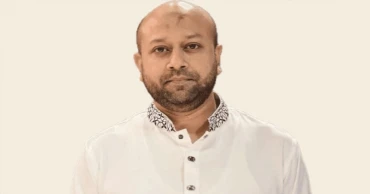
Barrister Fuad congratulates his opponent on his victory
Barishal-3 (Babuganj–Muladi) candidate Barrister Fuad has congratulated his opponent, Zainul Abedin, on his electoral victory, expressing gratitude to the voters and party leaders who supported him throughout the campaign.
In a Facebook post on Friday morning, he thanked the 61,192 respected voters who stood by him in support of justice, freedom, and a new political arrangement.
He also expressed special gratitude to the leaders and activists of the 11-party alliance, including Jamaat and NCP, for their tireless efforts in working for his electoral symbol.
Voting in Bangladesh’s national election concluded on Thursday in a largely peaceful atmosphere, raising hopes of restoring genuine democracy and securing a strong mandate for national reforms.
Polling began at 7:30am and continued until 4:30pm without interruption at 42,659 polling stations across 299 of the country’s 300 constituencies, amid the deployment of nearly one million security personnel and another one million polling staff.
Alongside the parliamentary election, voters also participated in a referendum to express their views through ‘Yes’ or ‘No’ votes on proposals for several constitutional amendments.
8 months ago

US congratulates Bangladesh on successful election, BNP on ‘historic victory’
The United States has congratulated the people of Bangladesh for holding a successful national election.
In a Facebook post, the US embassy in Dhaka extended greetings to Bangladesh Nationalist Party (BNP) and its leader Tarique Rahman on ‘historic victory’.
“The United States looks forward to working with you to realize shared goals of prosperity and security for both our countries,” it added.
8 months ago
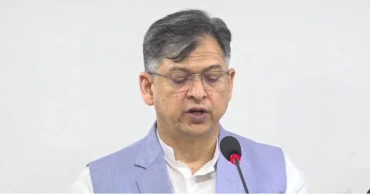
Deeply accountable to my constituents, says Salahuddin
BNP Standing Committee member Salahuddin Ahmed has said he feels a profound sense of responsibility and accountability to the people of his constituency who have elected him as their representative in the 13th Jatiya Sangshad.
Reacting to the announcement of the unofficial results, he told the media that in Cox’s Bazar-1 (Chakaria and Pekua), voters had earlier elected his wife with a significant margin during his absence, which further deepened his sense of responsibility towards the people of the area.
“People of this area were long deprived of development. I spent my childhood and school years here, and I have always dreamed of doing something for this region,” he said.
Expressing gratitude to the people of Bangladesh, he said, “When I was in enforced disappearance, people prayed for me and journalists wrote about me. By the grace of Allah, your prayers were answered and I returned with dignity to a fascism-free Bangladesh.”
He said he had made many commitments and would strive to deliver even more than he had promised.
Referring to the party’s overall victory, Salahuddin said the victory had been anticipated.
“We will not hold any victory processions. We have many responsibilities ahead. We do not want to create any tension through celebratory rallies,” he added.
According to the unofficial results, Salahuddin Ahmed secured 222,019 votes. His nearest rival, Jamaat candidate Abdullah Al Faruk, received 129,728 votes, while Islami Andolan contender Sarwar Alam Kutubi obtained 4,528 votes.
8 months ago

BNP’s Asaduzzaman unofficially wins Jhenaidah-1 by huge margin
BNP-backed candidate and former Attorney General Md Asaduzzaman was unofficially declared elected from the Jhenaidah-1 constituency in the 13th national election.
According to unofficial results, Asaduzzaman secured 171,598 votes, while his nearest rival Jamaat-nominated candidate Matiur Rahman received 55,577 votes.
Rathindranath Roy, Deputy Director of the Local Government Department (DDLG) at the Jhenaidah District Commissioner’s Office, said this information was collected at the field level. The result will be officially announced after the signed result sheets arrive.
Voting in Bangladesh’s national election concluded on Thursday in a largely peaceful atmosphere, with high hopes of restoring genuine democracy and securing a strong mandate for national reforms.
The polling in Bangladesh began at 7:30am and continued until 4:30pm without interruption at 42,659 polling stations in 299 out of 300 constituencies, amid the deployment of nearly one million security personnel and another one million polling staff.
Alongside the parliamentary election, voters also participated in a referendum to express their views through ‘Yes’ or ‘No’ votes on proposals for several constitutional amendments.
8 months ago