Moyeen Khan BNP
Bangladesh’s 2008 election was orchestrated: Moyeen Khan
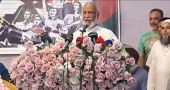
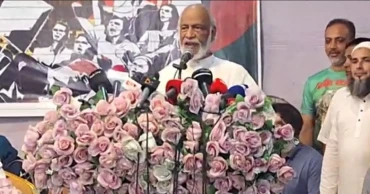
BNP senior leader Dr Abdul Moyeen Khan on Saturday said the 2008 national election in Bangladesh was neither free nor fair, nor impartial, claiming that it was an orchestrated and controlled one.
“I am compelled to say that the 2008 election was not free, fair, or impartial. It was a planned, rigged and controlled election,” he said while addressing a discussion.
Dr Moyeen, a BNP Standing Committee member, said the 1/11 government in 2008 had an unethical plan to depoliticise Bangladesh. “Although that plan eventually failed, an election was held with the help of certain quarters and it was portrayed internationally as free and fair, but in reality, it was not.”
He said different types of propaganda were there at the time as there were millions of fake voters and that BNP was falsely blamed for it.
“I have to reveal the historical truth. Many citizens were registered either in their village home or at their workplace in the city at that time. Due to the system, some were listed twice, but no one voted twice. They voted either at home or in the city, depending on where they were on the election day,” the BNP leader explained.
February election deadline must not be crossed, says BNP’s Dudu
A group of former Dhaka College students organised the programme to mark the anniversary of the July–August mass uprising and the fall of fascism, paying tributes to those who were martyred or injured.
Dr Moyeen said the false history created by the Awami League, resulting in the 1/11 political changeover, must be exposed.
He said the 1/11 government prepared a new voter list and conducted a national election. “But that vote was a completely controlled and lopsided one.”
The BNP leader alleged that the entire election was a planned one, with the allocation of the 300 parliamentary seats decided days before polling, allowing the Awami League to form the government. “As a result, Bangladesh was destroyed politically, morally, economically, culturally and religiously over the past 15 years,” the BNP leader observed.
Election resistance threat an ‘echo of autocracy’, says BNP’s Dr Zahid
He said the mass uprising in 2024 was the culmination of a 15-year struggle by BNP and other democratic forces amid oppression, when students and ordinary people finally rose up.
The BNP leader said the then Awami League government acted desperately, killing people of all ages -- from children and youths to workers and the elderly -- even firing from helicopters to cling to power.
He said when the interim government was formed following the fall of the Sheikh Hasina regime, BNP assured it of full cooperation to enable people to embrace democracy and form a government through a free and fair election.
Dr Moyeen said the interim government has indicated that the next national election is expected to be held before Ramadan in February. “We hope the Election Commission will now officially fix the specific date and election schedule.”
1 year ago
Moyeen Khan raises concerns over BCIM corridor’s strategic impacts, seeks China’s attention
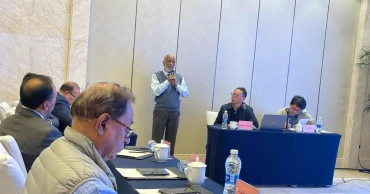
BNP Senior Leader Dr Abdul Moyeen Khan on Wednesday voiced concerns regarding the proposed route of the Bangladesh-China-India-Myanmar (BCIM) economic corridor under the Belt and Road Initiative (BRI) project, citing strategic implications and urged China to address the issue.
“As per the plan, one of the six economic corridors of the BRI will go from China to Myanmar, then into India. From India, it will enter Bangladesh and then return to India. This route, in fact, turns out in a way like a corridor for India,” he told a seminar organised by the Yunnan Minzu University.
The seminar, titled "Yunnan’s Participation in the Belt and Road Initiative (BRI) and Prospects for Cooperation with South Asian Countries," was held at the Wyndham Hotel in Kunming, Yunnan.
Dr Moyeen suggested that the ideal BCIM route would be for it to start in Kunming of China, and head to Myanmar. From Myanmar, it would, as planned for the Asian Highway, enter Bangladesh through Teknaf-Cox’s Bazar route and from then proceed onto West Bengal in India across Bangladesh, as envisaged originally.
"From a strategic point of view, this would offer a much more secure connectivity as far as Bangladesh is concerned. I sincerely request you to review this plan and bring it to the attention of those who have drawn out the current route,” he said.
Dr Moyeen highlighted that when an international road or rail connection under the BRI project goes from one country into India, then into Bangladesh, and then back into India, Bangladesh essentially becomes part of a connectivity corridor rather than becoming the part of an international route.
BNP pledges to deregulate business and economy if elected
He noted that such a concept could become a highly sensitive issue in terms of Bangladesh's two-political framework in the South Asia region.
"The very nature of connectivity makes us examine how the route is proposed…BRI is not just about trade and commerce, connectivity, and the society and culture. This route also has strategic implications, which are central to the sovereignty of a nation,” the BNP leader observed.
Dr Moyeen also said the original plan to establish the Asian Highway had lost momentum over the decades as people are now discussing the BRI.
As a densely populated small nation, Bangladesh must be cautious when formulating its strategic plans, he concluded.
Professor Duan Gang of Yunnan Minzu University presented the keynote paper, highlighting the advantages and features of Yunnan’s integration into the Belt and Road Initiative (BRI).
Among the countries crucial for China in this context, he said Bangladesh holds significant importance due to its strategic geographical location and demographic structure.
BNP vows to strengthen ties with China if elected, seeks strategic balance
Prof Duan said Bangladesh is part of the proposed Bangladesh-China-India-Myanmar (BCIM) economic corridor under the BRI project.
He explained that the corridor would connect China’s Yunnan province with Bangladesh, Myanmar, and Kolkata in India, boosting regional trade and cooperation.
Professor Duan said Chinese President Xi Jinping has tasked the Yunnan provincial government with playing a key role in establishing Yunnan as a hub of connectivity with regional countries, including Myanmar, Bangladesh, and India, through the implementation of the BRI.
He said BRI would foster closer economic and trade cooperation among the connected countries, boosting not only trade but also health cooperation, people-to-people exchanges, and cultural interactions.
Besides, Prof Duan said the BRI would enhance international education cooperation with the countries in the region, leveraging geographical advantages to promote further collaboration.
A 21-member Bangladesh friendship delegation, led by Moyeen Khan, attended the programme.
1 year ago
BNP vows to strengthen ties with China if elected, seeks strategic balance
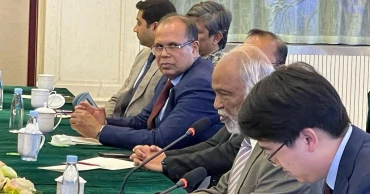
BNP senior leader Dr Abul Moyeen Khan on Tuesday unequivocally told Yunnan Province leaders that if his party comes to power, it would prioritise deepening strategic and diplomatic relations with China to ensure a balance of geopolitical power.
"It’s simple that we are in a geographical position where, on three sides, we are encircled by a big and powerful country. We need to balance and bring equilibrium to our geopolitical role and location through our close relationship with China," he told a meeting with Yunnan Province Vice Governor Xu Hao.
He said this diplomatic and strategic balancing is essential for the survival of Bangladesh. "I sincerely wish, as in the past, China will continue to offer its fullest support to Bangladesh and its people."
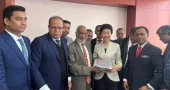
A 21-member Bangladesh friendship delegation, led by Dr Moyeen Khan, attended the meeting at the Foreign Affairs Office of the People's Government of Yunnan Province.
Senior officials from various departments of the provincial government were present.
Mirza Fakhrul hospitalised
On behalf of BNP Chairperson Khaleda Zia and Acting Chairman Tarique Rahman, Dr Moyeen extended heartfelt congratulations to the Communist Party of China and Yunnan provincial leaders.
He also noted that Khaleda Zia has been a consistent and longstanding friend of China for several decades.
Dr Moyeen said the BNP’s Acting Chairman has sent them to China with wishes to strengthen future collaboration and friendship between China and Bangladesh.
Following the mass uprising in Bangladesh last year, he said, political parties, including BNP, have been eagerly waiting for a national election.
“If our party, BNP, along with our allies, is elected by people and forms the government, our first steps will be to strengthen our friendship with the people of China. This is a commitment from BNP Acting Chairman Tarique Rahman," he said.
He said the people of Bangladesh have long regarded China as one of their trusted friends.
Dr Moyeen said Bangladesh is one-third the size of Yunnan, but its population is three times larger, highlighting the immense pressure on the government to ensure that people receive their rightful benefits and privileges.
Beware of attempts to create division: Mirza Abbas
He said Bangladesh is primarily an agriculture-based country, much like Yunnan province.
"Bangladesh is striving to develop industrially, especially in the Ready Made Garment (RMG) sector, as well as in other areas, though not as successfully as we have in the garment sector," he observed.
The BNP leader urged Chinese authorities to extend their cooperation in the agricultural and financial sectors of Bangladesh.
He mentioned that the Chinese Ambassador in Dhaka has already indicated support for a water management project along one of the country’s major rivers, the Teesta.
Dr Moyeen said the Chinese Ambassador has also indicated that China would support a $1 billion investment to implement this water management and irrigation project.
He said millions of poor people, particularly farmers, would greatly benefit if the project is implemented.
1 year ago
Moyeen Khan seeks China's support for RMG raw material production
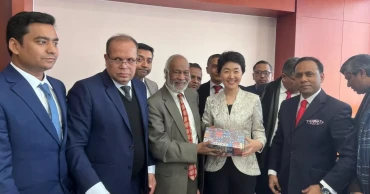
BNP Standing Committee member Dr Abdul Moyeen Khan on Wednesday urged China to assist Bangladesh in establishing facilities for producing raw materials for the garment sector to reduce the costs of RMG products.
“We seek your assistance in setting up the industry in Bangladesh so that we can produce raw materials for finished garment products. If we can manufacture these essential raw materials, we will be able to supply finished garments at a highly competitive price,” he said.
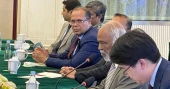
He made the remarks during a meeting with the Chinese Vice Minister of the International Department of the Communist Party of China (IDCPC), Sun Haiyan.
The Chinese leader met a unique Bangladeshi delegation comprising leaders from eight political parties, students, scholars and journalists at the IDCPC office in Beijing.
Dr Moyeen said Bangladesh requires China's support to produce raw materials for the garment sector within its own borders. “We want to learn from you how to manufacture garment raw materials, including yarn,” he said.
China could be one of Bangladesh’s best friends: Chinese Vice Minister
Besides, he proposed broader areas of cooperation once a new democratic government is formed in Bangladesh through a credible election.
He recalled that during Chinese President Xi Jinping’s visit to Bangladesh eight years ago, he had promised substantial economic support for the country.
“But, the previous government could only utilise 25-30 percent of the financial support promised by the Chinese President over the past eight years. We hope this financial assistance and cooperation will be revitalised in the coming months, which will greatly benefit the people of Bangladesh,” the BNP leader said.
Dr Moyeen urged China to assist Bangladesh in developing its AI industry. “I would also like to propose setting up at least one electric vehicle production factory in Bangladesh with your cooperation.”
He also called for strengthening strategic cooperation with China, considering Bangladesh’s geopolitical location.
The BNP leader expressed his heartfelt gratitude to China for its cooperation with Bangladesh, particularly in three major areas.
“The first is the China-Bangladesh Friendship Bridge, which was the first bridge constructed in Bangladesh over the River Buriganga with China's support. Now, there are many bridges and large infrastructures, but that bridge was the first major infrastructure built in Bangladesh with your help,” he told the meeting.
The second, he mentioned, was China’s support for Bangladesh’s garment sector. “Ziaur Rahman introduced the garment sector in Bangladesh with the concept and idea from China. After China, despite being a small country, Bangladesh is now the second-largest garment supplier in the world.”
“Lastly, Ziaur Rahman also initiated a strategic relationship with China. After the liberation war, when our armed forces were virtually destroyed, China fully supported the reconstruction of our military,” he said.
French Ambassador meets BNP leaders
The Bangladesh delegation, led by BNP Standing Committee member Dr Abdul Moyeen Khan, attended the meeting.
Earlier on Tuesday, the 21-member 'unique' delegation, consisting of leaders from eight political parties, including the BNP, travelled to China for an 11-day visit at the invitation of the Communist Party of China (CPC).
Dr Moyeen Khan said this visit will renew the ties between CPC and Bangladesh’s people and democratic political parties.
“We hope the relationship between the people and the governments of the two nations will be further strengthened in the days to come,” he said.
The BNP leader said relationship between the people of China and Bangladesh is historic. “We hope these ties will continue not just for another decade, but for thousands of years. This is my sincere wish.”
He mentioned that BNP founder Ziaur Rahman formally established Bangladesh’s diplomatic ties with China 50 years ago. “As a result, a new era of collaboration began between the two countries.”
BNP Legal Affairs Secretary Kayser Kamal, General Secretary of Jatiyatabadi Krishak Dal Shohidul Islam, General Secretary of Jubo Dal Nurul Islam Nayon, General Secretary of Swechchhasebak Dal Razib Ahsan and General Secretary of Chhatra Dal Nasir Uddin, Revolutionary Workers Party General Secretary Saiful Huq, Executive Coordinator of Ganosamhati Andolon Abul Hasan Md Shahidul Islam Rubel, National People's Party Chairman AZM Fariduzzaman, Nationalist Democratic Movement Chairman Bobby Hajjaj, General Secretary of Gono Odhikar Parishad Muhammad Rashed Khan, Joint Secretary General of Bangladesh Khelafat Majlis Maulana Ataullah Amin and Jatiya Dal Chairman Syed Ehsanul Huda, Dr Moyeen Khan’s wife, Advocate Roksana Khondker, Bangladesh Institute of International and Strategic Studies (BIISS) researcher Md Nahian Sajjad Khan, and Dhaka University’s International Relations department Prof Lailufar Yasmin, among others, the delegation members, participated in the meeting.
1 year ago