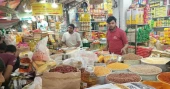
Ramadan Market

Stocks adequate to keep Ramadan market stable: Commerce Minister
Commerce, Industry and Textile and Jute Minister Khandaker Abdul Muktadir on Thursday said the government has adequate food stocks to keep the market stable during the upcoming month of Ramadan.
He said one of the key responsibilities of the Ministry of Commerce is to keep prices of essential commodities stable, and this duty becomes more important during Ramadan.
“Although there was no time to take special steps after assuming office, the existing stock situation is positive and sufficient to maintain price stability,” he added.
The minister made the remarks while replying to journalists after exchanging greetings with officials of different government departments and party leaders at Osmani International Airport.
Responding to a question on development plans for Sylhet, he said he had highlighted these plans during his long election campaign and in the election manifesto.
He said the he wants to work on issues directly linked to improving the living standards of people in Sylhet.
He said priority will be given to job creation, expansion of IT-related professions and the establishment of an AI centre in the region.
The minister said Bangladesh must build capacity to compete globally. Over the next five years, the government will use every day effectively to move the country forward in the global arena with sincerity.
Replying to a question on job creation at the Sylhet IT park, he said investment is essential to create employment.
He said special policy support is needed for expatriate and local investors in Sylhet, adding that work is underway and visible progress will be seen soon.
Among others, Sylhet-3 MP MA Malek, Divisional Commissioner Khan Md Reza-un-Nabi, Range DIG Md Mushfekur Rahman, Metropolitan Police Commissioner Abdul Quddus Chowdhury, Deputy Commissioner Md Sarwar Alam, the acting president of Sylhet Metropolitan BNP, and other party leaders were present at the time.
7 months ago

Enough stocks to keep markets stable during Ramadan, says Minister Muktadir
Commerce Minister Khandakar Abdul Muktadir on Friday said the government has adequate stocks of essential commodities to keep market prices stable during the holy month of Ramadan.
“The main responsibility of the Ministry of Commerce is to ensure price stability of essential food items. This responsibility becomes even more important during Ramadan,” he told reporters in Sylhet.
The minister said when the current government assumed office, there was little scope to take special measures ahead of Ramadan.
“However, the positive aspect is that the amount of food stock we currently have is sufficient to maintain price stability in the market,” he added.
Minister Muktadir speaking to journalists at Sylhet Osmani International Airport after exchanging greetings with officials of different government departments and party leaders.
Responding to a question on development plans for Sylhet, the minister said he had highlighted these issues throughout his election campaign and manifesto.
“We want to implement initiatives that are directly linked to improving the quality of life of the people of Sylhet,” he said, adding that priority would be given to employment generation, expansion of IT-related professions and the establishment of an AI centre.
The minister also said the government would work sincerely over the next five years, utilising every single day to move Bangladesh forward in the global arena.
'Not all collections in the road transport sector is extortion': Roads, Railways and Shipping Minister
Replying to a question about job creation at the Sylhet IT Park, he said investment is essential to generate employment.
“To attract investment, we need to improve communication systems, reduce red tape and ensure a supportive environment, including political stability,” Muktadir said.
He added that special policy support is needed for expatriate and local investors in Sylhet. “We are working on these issues and their implementation will be visible very soon."
Among others present were Sylhet MP MA Malik, Divisional Commissioner Khan Md Reza-un-Nabi, Range DIG Md Mushfekur Rahman, Metropolitan Police Commissioner Abdul Quddus Chowdhury, Deputy Commissioner Md Sarwar Alam, Sylhet Metropolitan BNP Acting President Rezaul Hasan Koyes Lodi and Sylhet District BNP President Abdul Qaiyum Chowdhury, along with leaders of the Bangladesh Nationalist Party and its associate bodies.
7 months ago
Grocery prices stable, but local fruits see sharp hike
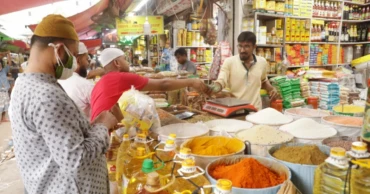
Grocery prices remain relatively stable on Tuesday, the third day of Ramadan, though local fruit prices saw a significant increase compared to last year.
A visit to the markets in Malibagh, Shantinagar, Segunbagicha and Fakirapool revealed that a kilogram of chickpeas is selling for Tk 110-130.
Shopkeepers said that the price ranged from Tk 120-140 per kg last year.
Beson is being sold between Tk 120-180 per kg, while double chickpeas cost Tk 150, Kabuli chickpeas Tk 250, sugar Tk 120, eggs Tk 130 per dozen, and puffed rice at Tk 80 per kg.
Shantinagar grocery store owner Monir said that compared to last year, Ramadan prices have remained steady, with some items even witnessing a decrease. The prices of spice-related items also remain at a reasonable level, he said.
Dhaka's streets abuzz with Iftar delicacies on Ramadan’s first day
Subah, a shopper at the market, observed that except for soybean oil, there are no significant shortages this year, and most items are within an affordable range.
The prices of psyllium husk, cardamom, cinnamon, coriander, turmeric powder, chilli powder, raisins, and nuts remain unchanged from the previous year.
Local Fruit Prices Surge
While grocery prices remain stable, local fruit prices have skyrocketed this Ramadan. Market visits indicate that papaya is selling for Tk 120-160 per kg, whereas last year, it was priced at Tk 80-120 per kg.
Depending on size, wood apple (bel) is being sold for Tk 120-250, with some exceeding Tk 300. As wood apple sherbet is a popular Ramadan drink, many consumers are struggling to afford it.
Guava is priced at Tk 100-150 per kg, jujube at Tk 150-180, pineapple at Tk 60-80 per piece, muskmelon at Tk 150-180 per piece, and watermelon at Tk 60-80 per kg.
Shamsul Haque, a fruit vendor at Segunbagicha market, explained that many fruits have arrived in the market earlier than their usual season due to Ramadan.
Vegetable prices soar in Dhaka as Ramadan begins
"Watermelon is not yet in season, but farmers are harvesting early to meet the demand. On the other hand, jujube season is ending, and papaya yield has been low this year, leading to the price hike," he said.
1 year ago
Ramadan Market: Mixed price trends in Dhaka though demand surges
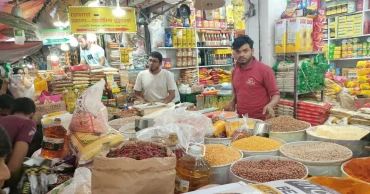
The prices of rice, fresh fruits, lemon, chicken, meat and fish have surged in Dhaka ahead of the holy month of Ramadan, while those of chickpeas, pulses, dates, puffed rice (muri), onion, garlic and various vegetables have declined.
On Thursday, kitchen markets across the capital witnessed a heavy influx of shoppers, reflecting the usual pre-Ramadan demand surge. Many consumers expressed frustration over the rising prices of essential commodities, particularly fish and meat.
Ramadan 2025: Five tips for mental and emotional well-being while fasting
A visit to key kitchen markets in Dhaka, including Karwan Bazar, Mohakhali, Hatirpool, Shantinagar, Malibagh, Rampura and Banasree, revealed price variations depending on location.
Consumers noted that while some Ramadan essentials have remained stable, the prices of daily consumption items have increased despite government measures such as tax and VAT reductions.
The price of fine-quality miniket rice has risen by Tk3 to 4 per kg this week, while coarse rice has increased by Tk2 to 3 per kg. Premium-quality miniket rice is being sold at Tk86 to 90 per kg at the retail level, while coarse rice is available for Tk58 to 65 per kg.
Chickpea prices have declined by Tk10 to 15 per kg, now selling at Tk100 to 110 per kg, depending on quality. Different types of pulses, including lentils, peas and Mung beans, are priced between Tk95 and 150 per kg.
The price of edible oil remains stable, though traders report a short supply of bottled soybean oil. Loose palm oil is selling at Tk160 per kg, while bottled soybean oil is priced at Tk170 per litre.
The prices of popular Ramadan beverages and dairy items have increased. Tang (powdered drink) and Ruh Afza (flavoured syrup) have risen by Tk60 to 100 per kg/litre compared to last year. Tang is now priced at Tk780 per kg, Ruh Afza at Tk575 per litre, and powdered milk at Tk860 per kg and lemons (four pieces) priced at Tk60 to Tk120.
Fresh fruit prices have also seen an uptrend, rising by Tk30 to 80 per kg. Oranges are selling at Tk330 to 380 per kg, Malta at Tk280 to 300 per kg, green apples at Tk420 per kg, and China Fuji apples at Tk330 to 380 per kg. Pomegranates (dalim) range from Tk450 to 560 per kg, white pears (naspati) from Tk330 to 360 per kg, green pears at Tk430 to 500 per kg, and red and black grapes at Tk550 to 600 per kg.
Bangladesh Bank sets new time for funds transfer and cheque clearing during Ramadan
Dates are being sold at Karwanbazar for Tk400 to 1600 per kg, depending on quality and brand. However, prices have dropped by Tk60 to 200 per kg ahead of Ramadan.
Traders claim that the government is levying Tk136 in taxes on every Tk100 worth of imported fruit, preventing them from reducing prices. As a result, domestic fruit prices have also increased. Thai papaya is selling at Tk150 per kg, guava at Tk90 to 120 per kg, bananas at Tk80 to 120 per dozen, and green coconuts (daab) at Tk100 to 160 per piece.
Bangladeshi traders import 38 types of fruit from 22 countries worldwide. Of these, 95% are apples, malta, oranges, grapes, and pineapples. The remaining 5% include pears, Kinnow, Kadbel, avocados, Rambutan and kiwis.
According to the National Board of Revenue (NBR), customs duties were increased in two phases for FY2024-25.
The first phase raised duties to 118.80%, while the second round increased them further to 136.20%. This means importers now pay customs duties on every Tk 100 worth of fruit.
Chicken prices have risen slightly ahead of Ramadan. Sonali and broiler chicken are now selling at Tk300 and Tk220 per kg, up from Tk290 and Tk190 per kg, respectively. Mutton prices have increased by Tk100 per kg, now selling at Tk1200 per kg in Karwanbazar.
Meanwhile, beef and other meats remain stable, selling at Tk730 to 780 per kg, depending on quality.
DSE announces new trading hours for Ramadan
The demand for river fish has increased, with prices ranging from Tk400 to 1200 per kg, depending on size.
Glulam Rahman, president of the Consumers Association of Bangladesh (CAB), attributed the price hikes to inadequate market monitoring.
“The price of some items has increased despite official data showing high import volumes of essential goods. Authorities must ensure that price hikes are justified. If irregularities are found, dishonest traders should be held accountable to relieve consumers,” said the CAB president.
1 year ago