Fascist’s Effigy
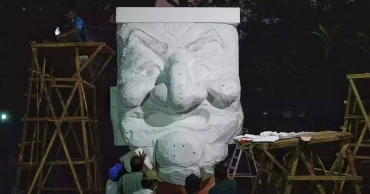
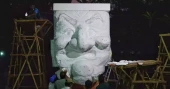
Fascist’s effigy being rebuilt at DU’s Charukola after arson incident
Artists at Dhaka University’s Faculty of Fine Arts (Charukola) are working tirelessly to reconstruct the ‘fascist effigy’ that was set on fire just days ahead of the Pahela Baishakh celebrations marking the Bengali New Year 1432.
The effigy, which was the central attraction of this year's Ananda Shobhajatra (festive procession), was burned in a late-night act of vandalism.
But the artists have taken on the challenge of recreating the piece overnight at the advice of Dhaka University authorities, using makeshift materials such as corrugated sheets to meet the urgent timeline.
'Fascist’s Effigy' burned at DU: Farooki blames Hasina’s ‘allies’, vows stronger resistance
During a visit to the Charukola premises, it was found that the artists were working with intense dedication despite the pressure.
They shared that the original motif had taken nearly a month to design and build — making it a near-impossible task to replicate within hours. Still, they remain determined to ensure that the spirit of the festival is not diminished.
“The original artwork required immense effort and artistic devotion,” said one of the artists involved in the reconstruction. “Those who set it ablaze have not only insulted our creation but also the spirit of art itself. We demand exemplary punishment for the perpetrators.”
University authorities confirmed that artists had resumed work from the morning and added that the matter had been left entirely in their hands. "We trust the artists and their commitment to the cultural heritage this festival represents," a spokesperson said.
This year’s Shobhajatra features several symbolic motifs aimed at voicing protest against authoritarianism. Alongside the reconstructed ‘face of fascism’, other artistic elements include representations of hilsa fish, tigers, palanquins, birds, and even a model of the popular ‘Mughdho’s water bottle’, blending satire with tradition.
The attack on the motif has sparked outrage and debate across social and cultural platforms, but the artists' swift and defiant response has reignited hope and pride among supporters of free expression.
As the first light of Pahela Baishakh dawns, the reconstructed effigy will stand not only as a symbol of resistance to tyranny but also as a testament to the unwavering spirit of Bangladesh’s artistic community.
1 year ago
'Fascist’s Effigy' burned at DU: Farooki blames Hasina’s ‘allies’, vows stronger resistance
An effigy symbolising Sheikh Hasina’s fascism was set ablaze on Saturday at the Fine Arts Institute of Dhaka University, prompting Cultural Adviser Mostofa Sarwar Farooki to condemn the act, accuse Awami League allies and call for quick legal action.
The 1432 Bengali New Year's theme "New Year's Harmony, End of Fascism" was inspired by the July-August mass uprising, and the traditional procession which was named 'Borshoboron Anondo Shobhajatra' (formerly 'Mongol Shobhajatra') on Friday by Dhaka University, was all set to feature a 20-foot-high motif called the "Face of Fascism".
Crafted from bamboo and cane, the depiction portrayed a woman with a toothy grin, four horns on her head, a large nose, and two fearful eyes. The striking image led many to believe it resembled ousted Prime Minister Sheikh Hasina.
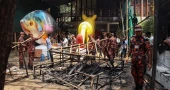
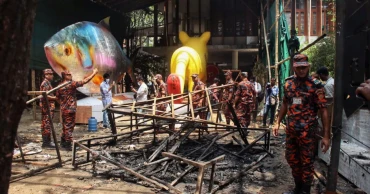
On Saturday early morning, a fire broke out at the Fine Arts Faculty where the motifs were being made: the monstrous fascist face motif was completely burnt in the fire, while the dove of peace motif was also partially burnt.
In a Facebook post made Saturday morning, Farooki condemned the incident and warned that those involved - regardless of political label - must face legal consequences.
‘Ananda Shobhajatra’ motifs burnt at DU Fine Arts Faculty
“Hasina’s collaborators torched the face of fascism last night at Charukola,” Farooki wrote. “Whether they belong to the Soft Awami League or the Awami B Team, everyone responsible must be brought under the law - urgently.”
The effigy was reportedly being prepared as part of this year's traditional procession organised by progressive cultural activists and students. The act of burning it was seen as an attempt to disrupt the symbolic protest, but Farooki stated that it had only strengthened the resolve of those involved.
“Those trying to stop this year’s procession will not just be held accountable under the law - we also want to assure them that this year’s procession is more powerful and meaningful,” he said.
1 year ago