BJMC

From backbone to decline; Bangladesh’s jute exports plunge
Once hailed as the golden fiber and the backbone of Bangladesh’s post-independence economy, jute now contributes less than 2% to the country’s total export earnings, a sharp fall from nearly 90% in the 1970s.
Despite its vast potential, Bangladesh’s jute sector continues to struggle under poor planning, outdated technology and a lack of effective policy support.
According to Export Promotion Bureau (EPB) data, export earnings from jute and jute goods have been steadily declining in recent years.
The sector earned USD 911.51 million in FY2022–23, dropping to USD 855.23 million in FY2023–24, and further down to USD 820.16 million in FY2024–25, sparking concerns over the future of what was once the country’s flagship export industry.
Years of Neglect and Policy Contradictions
Experts blame the sector’s downturn on years of neglect and inconsistent government decisions.
“The biggest problem with jute is the absence of any sustained, effective initiative,” said agronomist and University of Western Australia PhD researcher Dr Moinul Hasan Khan. “Over the decades, we’ve seen one jute mill after another shutdown. Farmers never received fair prices for raw jute, and failure to protect both mills and growers has steadily eroded our export income.”
Read more: Rizwana for expanding jute-based industry for environmental protection
In 2018, the Awami League government revamped the National Jute Policy to revive the sector and enhance its global competitiveness. Yet, only two years later, the same government shut 26 state-owned jute mills down, rendering around 25,000 workers jobless overnight.
“How can a country dreaming of export growth through jute shut down all its state-owned mills? It’s one of the most self-contradictory policy decisions imaginable,” said Dr Khan.
Data from the Bangladesh Jute Mills Corporation (BJMC) show that between 1972 and 1981, the number of state-owned jute mills increased to 82. The sector, however, soon began to crumble under financial losses, mismanagement and outdated machinery.
“Working in a jute mill once meant stability and pride,” recalled Nurul Akand, former Supply Manager of the iconic Adamjee Jute Mills. “Mill workers used to earn more than employees in other factories, with better bonuses and allowances. But one by one, those benefits disappeared.”
He said although the government later leased out closed mills to private operators, production never returned to its former levels.
Habib Hossain, a former officer at Monowar Jute Mills, said most public mills relied on outdated, Pakistan-era machinery. “No training was provided to workers to produce modern jute products. Eventually, citing losses, the government decided to close the factories instead of modernizing them.”
Read more: Govt working on Tk 100-crore fund to revive jute bags: Adviser Bashir
Currently, Bangladesh has over 200 private jute mills, which account for nearly all jute exports. However, private mill owners say they too are facing mounting challenges.
“The biggest challenge now is sourcing enough raw jute during the season,” said Tapas Pramanik, Chairman of the Bangladesh Jute Spinners Association (BJSA). “Because of hoarders, mills often can’t get adequate raw jute, which stalls production.”
Record Harvest, Farmers Under Pressure
In southern Bangladesh, particularly Faridpur district, the country’s largest jute-producing region, the area under jute cultivation reached 86,500 hectares this year, producing raw jute worth about Tk 2,000 crore, according to the Department of Agricultural Extension (DAE).
Yet farmers say they have reaped little benefit. Many had to sell their crops early at low prices, while hoarders later resold the same jute to mills at nearly double the rate.
“We borrow money for seeds, fertilizers, and labor. When loans fall due, we’re forced to sell quickly, often at minimal profit,” said Hamiduzzaman, a farmer from Salta upazila in Faridpur.
Read more: Govt orders probe into irregularities in Tk 518cr Jute mill project
The situation is similar in the northern districts. Farmers in Gaibandha, known for high-quality jute, said they sold raw jute at Tk 2,500–2,800 per maund during harvest season, while current market prices have soared to Tk 4,500–5,000 per maund.
“Now jute prices are high, but we have none left. Hoarders control the market and profit from our losses,” said Runu Mia, a farmer from Gaibandha.
Mill owners and traders alike point to hoarding and unregulated raw jute exports as the sector’s biggest threats.
“Hoarders are exporting raw jute abroad, depriving local mills of the raw material they need,” said Shamsul Haque Howlader, a jute trader from Nalchity upazila in Jhalakathi. “The foreign exchange earned from raw jute exports is only a fraction of what we could earn by exporting value-added jute goods.”
Business leaders warn that if hoarding and unregulated raw jute exports are not curbed soon, Bangladesh’s jute industry could face an even deeper crisis.
Both farmers and mill owners are urging the government to prioritize technological modernisation, research, and incentives for the sector. They argue that lack of proper retting (soaking) facilities and limited access to processing technology continue to hurt both productivity and quality.
Read more: Nepal keen to import raw jute from Bangladesh: Nepalese Ambassador
Farmers say they still rely on primitive methods, burning wood and straw to ret jute due to water shortages, while mill owners struggle with inefficient production systems.
To revive the sector’s lost glory, industry insiders have called for increased subsidies, tax relief and technological upgradation programs for both farmers and mills.
Talking about revitalising the jute industry, Jute and Textile Adviser Sk Bashir Uddin said the government wants to move forward by learning from past mistakes in the sector.
“Many unrealistic and colourful dreams were promoted about the jute industry without considering ground realities, which prevented solutions from addressing the root problems. In the past, inefficiency, incompetence, vested interests and mismanagement pushed the jute industry towards destruction,” he said.
Noting that plastic has gradually replaced jute in many areas, the adviser stressed the need for expanding the market for jute products. “To popularise jute bags, a revolving fund has been created under the climate fund involving more than 1,600 entrepreneurs.”
Regarding the closed jute mills, the Adviser said the government is in the process of gradually reviving the factories through privatisation.
Read more: Fire damages valuables of jute sack warehouses in Gazipur
He also mentioned that the government is considering a long-term plan for the jute industry.
As Bangladesh pushes towards export diversification, analysts say reviving the jute sector, once the pride of the nation, could provide a sustainable and eco-friendly path to industrial growth, but only if the government takes consistent, forward-looking action.
9 months ago

Environment-friendly ‘Sonali Bag’ headed to dustbin of history
Environment-friendly Sonali Bag, made of jute, has not been commercially viable even after five years of its pilot production due to fund shortage and continuing promotion of harmful polythene bags. Project insiders and innovators of the product are frustrated after failing to attain commercial viability even as an environmentally friendly alternative to polythene. The project is waiting to die now due to lack of allocation to run the factory, project insiders said. A pilot project was taken up in 2018 to market bags made from jute. However, the bag could not be brought to the market commercially in his fifth year. Inventor Mubarak Ahmed says another Tk 350-400 crore would be needed to market the golden bag.
Read: Hasina seeks Russian investment in jute sector
Only limited production of bags has been possible The officials of Bangladesh Jute Mills Corporation could not say when the project of commercial production of golden bag, an alternative of polybag will be implemented. In the absence of reliable alternatives, the market has floated banned polythene. The use of polythene is increasing in vegetable markets, grocery stores, shopping malls, and chain shops. Occasional raids have been carried out to control these environmentally harmful products, but the use of polythene has not reduced due to lack of alternatives. Polythene was banned in Bangladesh in 2002. Environmentalists say the failure to enforce the law is not the reason for the release of polythene. Not only Bangladesh, but the whole world is also worried about polythene. Millions of tons of polybags are being used every day, polluting the environment.
Read: Saudi willing to invest in closed jute mills Mubarak Ahmed Khan, Scientific Adviser of Bangladesh Jute Mills Corporation (BJMC), was the inventor of eco-friendly bags from jute named Sonali Bag in 2016.
It is a cellulose-based biodegradable bioplastic, an alternative to plastic bags. This bag is made by collecting cellulose from jute. It looks like ordinary polythene, but it is perishable. Before coming to the market commercially, ‘Sonali Bag’ had received a positive response at home and abroad. A pilot project was taken up in 2016 to market the bag. However, the bag could not be brought to the market commercially in six years.
Read Production in BJMC’s 2 leased out jute mills begins State owned Latif Bawani Jute Mill on the west bank of Shitalakshya River in Demra, Dhaka houses a factory for making Sonali Bags. On April 7, 2019, Tk 10 crore was allocated from Bangladesh Climate Trust Fund for the production of this bag. Necessary equipment and chemicals were purchased with that money. The bag is sold from the BJMC office at Motijheel only. In this context Bangladesh observed Jute Day-2022 on Sunday (March 6) with the theme of ‘Golden country of golden fire, environment friendly Bangladesh’.
Read BTMC’s jute mills incurred loss of Tk 3,168 cr in FY 21: Jute Minister
4 years ago
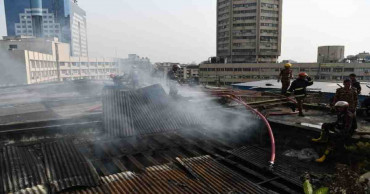
Fire at BJMC building under control
The fire on the seventh floor of Bangladesh Jute Mills Corporation (BJMC) office at Motijheel in Dhaka has been brought under control.
5 years ago

All BJMC jute mill workers to get arrears within Nov: Minister
The minister confirmed it at a press conference at the secretariat over paying the dues of the retired workers and others who lost their jobs.
“To pay the arrears of workers of eight jute mills, we’ve got Tk 1,790.52 crore from t
5 years ago

Workers of laid-off mills being deceived: BNP
BNP on Monday alleged that the government is deceiving the workers of 25 laid-off state-owned jute mills by not paying their dues.
6 years ago

Temporary teachers, staff of 5 Khulna BJMC schools in limbo
Temporary teachers and employees of schools under jute mills are staring at a bleak future after the government decided to shut state-owned jute mills in Khulna region.
6 years ago
.jpg)
Ganasanghati Andolan demands release of arrested jute mills leaders
The Ganasanghati Andolan on Tuesday demanded release of two workers' leaders of state-owned Bangladesh Jute Mills Corporation (BJMC).
6 years ago
.jpg)
Jute mill workers to get wages for June by next week: Minister
Textiles and Jute Minister Golam Dastagir Gazi on Friday said the workers of 25 closed state-run jute mills will receive their wages for the month of June through their personal bank accounts by next week.
6 years ago
.jpg)
Govt announces shutdown of production at 25 state-run jute mills
The government has decided to shut down production of 25 state-run jute mills under Bangladesh Jute Mill Corporation (BJMC) by providing cent percent dues of some 25,000 workers of the mills.
6 years ago
.jpg)
Jute mills workers won’t accept closure of BJMC: Zonayed Saki
Chief Coordinator of Ganasanghati Andolan Zonayed Saki on Wednesday said that the workers of state-owned Bangladesh Jute Mills Corporation (BJMC) will not accept its closure as it is an arrangement to "loot the state wealth and smuggling them abroad".
6 years ago