Humanitarian corridor
Not involved in humanitarian corridor issue; Teesta depends on Bangladesh: China
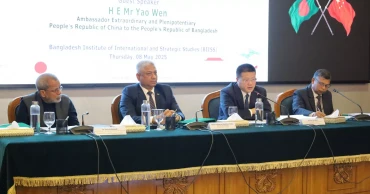
Chinese Ambassador to Bangladesh Yao Wen on Thursday said China is not involved in the “so-called humanitarian corridor” issue, stressing that China always respects sovereignty and territorial integrity of any country.
“For the corridor issue - so called humanitarian corridor, I should say China is not involved. As far as my understanding is concerned, it is an initiative by the United Nations agencies to provide humanitarian supplies to Rakhine State for the people affected by the conflict, China is not involved in this matter,” he said while responding to a question after delivering a country lecture.
The Ambassador said they are not interfering in any internal affairs of any country and hoped Bangladesh and Myanmar can properly solve the issue over the Rohingya through peaceful dialogue, and promote the process of repatriation.
Responding to a question on the updates of Teesta River Comprehensive Management and Restoration Project (TRCMRP), the Chinese envoy referred to the joint media statement issued after the bilateral meeting between Chief Adviser Prof Muhammad Yunus and Chinese President Xi Jinping where it was mentioned that Bangladesh welcomed Chinese companies to participate in the project.
Concerned over Delhi-Islamabad tensions, China opposes all forms of terrorism
“I should say China remains ready. We are willing to offer our help. Now it is up to Bangladesh to make a decision whether Bangladesh wants to move forward,” said Ambassador Yao.
Referring to whether it can be done through bilaterally, trilaterally or international consortium, it is truly Bangladesh’s decision how it will proceed with this project.
“China will respect the decision made by Bangladesh. I wish this project can be started as soon as possible. That’s what I want to say,” said Ambassador Yao.
Earlier, delivering his country lecture, the envoy said China champions a multi-polar world where sovereign equality is paramount. “Every nation, regardless of size, strength or wealth, deserves full respect for its sovereignty and dignity.”
He said no country shall interfere in others' internal affairs, and all states have the fundamental right to independently choose their social systems and paths of development, said Ambassador Yao.
“China and Bangladesh have always respected each other. As an independent sovereign state, Bangladesh must be free from external interference,” he said, adding that the Bangladeshi people have the right to determine their own path of development.
With a strong signal, Dhaka-Beijing set to elevate trade ties to new level: Ambassador Yao
The envoy said China has consistently and firmly supported Bangladesh in upholding its independence, sovereignty, and national dignity, as well as in pursuing a modernization path suited to its national conditions.
In turn, he said, Bangladesh has steadfastly upheld the one-China principle, rejected the so-called “Taiwan independence,” and adhered to the principle of non-interference in others’ internal affairs.
The envoy said China-Bangladesh relations have withstood the test of international turmoil and evolving political situations in Bangladesh, and has since gained strong momentum.
“The secret ingredient is equality and mutual respect. These principles will continue to be enshrined in our future relations,” he added.
Bangladesh Institute of International and Strategic Studies (BIISS) organised the country lecture on ‘Five Decades of Bangladesh-China Relations: Towards a New Height’ at the BIISS auditorium.
BIISS Director General Major General Iftekhar Anis delivered the welcome remarks while its Chairman AFM Gousal Azam Sarker chaired the session. Executive Director of the Centre for Alternatives, Bangladesh Imtiaz Ahmed made a presentation.
1 year ago
‘Humanitarian corridor’ issue still quite far off: Shafiqul Alam
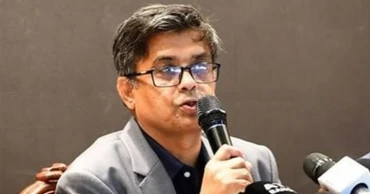
Chief Adviser’s Press Secretary Shafiqul Alam has said a final decision regarding the ‘humanitarian corridor’ to Rakhine State of Myanmar through Cox's Bazar will be taken in consultation with all stakeholders, including political parties, if there is any United Nations-led effort.
“We think this (humanitarian corridor) is still quite far off….it needs to be an UN-led effort,” he said while responding to a question from the media during his visit to Chattogram on Friday.
While interacting with the journalists in the port city of Chattogram, Alam also said the whole thing is usually done by talking to two countries – Bangladesh and Mynamr – first and other actors in Rakhine.
“When the United Nations takes any initiative, they talk to all relevant parties to reach a final decision,” he said, adding that any decision will be taken based on broader consensus.
Regarding the humanitarian corridor for Myanmar's Rakhine State, BNP acting Chairman Tarique Rahman on Thursday said only an elected parliament can make such a sensitive decision.
“The freedom-loving people of the country believe that the decision on whether or not to grant a corridor must come from the people themselves—specifically, through their directly elected National Parliament,” he said while virtually addressing a rally.
The Press Secretary also criticised the Awami League saying the previous regime did not even dare to call Rohingyas as the Rohingyas were called as 'Forcibly Displaced Myanmar Nationals' (FDMN).
“When you will fear to call them Rohingyas, then you do not believe in their rights,” Alam said.
Amid growing discussions on ‘humanitarian corridor’ to Rakhine State of Myanmar through Cox's Bazar, the interim government on Tuesday (April 29) categorically said they have not discussed the so-called ‘humanitarian corridor’ with the United Nations (UN) or any other entity.
"We want to make it categorically clear that the government has not discussed the so-called "humanitarian corridor" with the UN or any other entity," Chief Adviser's Press Secretary Alam told UNB while responding to a question.
Political parties to compromise for state reforms, hopes Ali Riaz
He said the government position is that should there be a UN-led humanitarian support to the state of Rakhine, Bangladesh would be willing to provide logistics support.
According to UNDP, the Rakhine state is facing an acute humanitarian situation.
"Bangladesh has a stellar record of helping countries in times of distress, as exemplified by our aid to Myanmar following the recent devastating earthquake," Alam said.
Besides, the Press Secretary said, they are concerned that the persistence of suffering may lead to further inflows of people from Rakhine into Bangladesh, which they cannot afford.
"We also believe that the UN-supported humanitarian aid would help stabilise Rakhine and create conditions for the return of the refugees back to Myanmar," he said.
Given the present conditions, Alam said, the only viable route for delivery of aid to Rakhine is through Bangladesh.
Bangladesh is agreeable in principle to provide logistics support to the transportation of aid through this route, he mentioned.
Alam, however, said there has not been a decision on the provision of aid to Rakhine.
"We are in touch with the parties concerned in this regard. In due course, we will consult relevant stakeholders in Bangladesh," said the Press Secretary.
Regarding the reports of involvement of a major power, he said, these are "pure and unadulterated" propaganda.
"We have seen a constant barrage of malicious disinformation hurled against Bangladesh in recent months, which is still continuing," said the Press Secretary, adding that this sort of propaganda is no different.
What are humanitarian corridors?
The United Nations considers ‘humanitarian corridors’ to be one of several possible forms of a temporary pause of armed conflict, according to the DW.
‘Humanitarian corridors’ or safe passages are essentially agreements between parties to the armed conflict to allow for safe passage for a limited time in a specific geographic area, according to the International Committee of the Red Cross (ICRC).
They can allow civilians to leave, humanitarian assistance to come in or allow for the evacuation of the wounded, sick or dead, ICRC said in a definition.
Due to their limitations in scope, humanitarian corridors are not an ideal solution. Crucially, civilians, whether there is a safe passage agreement or not must be protected from the effects of hostilities, must be allowed to evacuate from a besieged area, and humanitarian organizations must be able to work whenever and wherever necessary to provide protection and assistance to people affected by armed conflict.
Those engaged in the fighting must ensure that IHL rules on the conduct of hostilities are respected in order to protect civilians, and that humanitarian assistance can reach those in need..
They are demilitarised zones, in a specific area and for a specific time — and both sides of an armed conflict agree to them.
What are they for?
Via these corridors, either food or medical aid can be brought to areas of conflict, or civilians can be evacuated, according to DW.
The corridors are necessary when cities are under siege and the population is cut off from basic food supplies, electricity and water.
In cases where a humanitarian catastrophe unfolds because the international law of war is being violated — for example through large-scale bombing of civilian targets — humanitarian corridors can provide crucial relief.
1 year ago