Israel wildfire
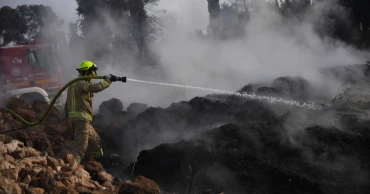
Multiple countries send aircraft to help Israel battle widespread wildfire
Several nations have dispatched firefighting planes to Israel as the country struggles to contain a large wildfire that has been burning for a second day, shutting down the main highway between Tel Aviv and Jerusalem and forcing drivers to flee their vehicles.
The blaze erupted midday Wednesday in the forested hills outside Jerusalem, driven by hot, dry weather and strong winds. It quickly spread through pine forests, prompting the evacuation of multiple communities and casting a smoky haze over the city. The wildfire has led to the cancellation of many Independence Day events as emergency forces shifted focus to firefighting efforts.
According to Israel’s fire and rescue service spokesperson Tal Volvovitch, roughly 5,000 acres (20 square kilometers) have been scorched—making it the most severe wildfire Israel has faced in a decade. Remarkably, no homes have been reported damaged so far.
Authorities warned the public to avoid parks and forests and urged caution with open flames, particularly as Independence Day traditions often include outdoor barbecues.
Israel declares state of emergency as wildfire rages near Jerusalem
Twelve people were hospitalized for smoke inhalation, and 10 more received treatment at the scene. Additionally, 20 firefighters sustained minor injuries, Volvovitch said.
To assist in firefighting efforts, aircraft from Italy, Spain, Croatia, France, Ukraine, and Romania were deployed. Other nations including Cyprus and North Macedonia also sent water-dropping planes. As of Thursday morning, 10 firefighting aircraft were operating, with eight more expected throughout the day.
Evacuation orders for around a dozen communities in the Jerusalem hills were lifted on Thursday. Three Catholic religious communities, evacuated the previous day, were allowed to return. While agricultural land—including vineyards and olive groves—suffered significant damage, historic churches were spared, said Farid Jubran of the Latin Patriarchate.
The main Jerusalem-Tel Aviv highway reopened after being closed on Wednesday when flames neared the roadway. On Thursday, charred landscapes and pink fire retardant covered scorched trees near the highway, and smoke still lingered in the air.
While wildfires are common in Israel’s summer months, such intense blazes this early in the year are rare. Much of Israel’s forests are artificially planted, and recent climate conditions have created ideal conditions for fire spread—minimal winter rain, rising temperatures, and erratic winds.
Anat Gold, who oversees the central region for the Jewish National Fund (KKL), which manages forests and promotes environmental projects, said the fire was largely under control. However, shifting winds made containment efforts difficult, with flare-ups occurring in previously controlled areas.
Gold attributed the fire’s intensity to ongoing drought conditions and the broader effects of climate change. “When you have consecutive years of low rainfall, the risk of fire increases dramatically,” she said.
The current blaze is reminiscent of the 2010 Mount Carmel fire in northern Israel, which lasted four days, killed 44 people, and destroyed over 12,000 acres of forest.
1 year ago