Kashmir terror attack

Ceasefire a meaningful beginning, but 'retaliation' mindset risks it: Prof Shahab Khan
Highlighting the importance of permanent solutions, Executive Director of the Bangladesh Center for Indo-Pacific Affairs Professor Shahab Enam Khan has said although the situation between the two South Asian nations has "stabilised" for now, there remains a risk of renewed escalation if either India or Pakistan makes a "strategic miscalculation".
"The ceasefire marks a meaningful beginning, but a prevailing "retaliation" mentality could jeopardise it, possibly leading to further military confrontations," Khan, who also serves as a professor at the Department of International Relations of Jahangirnagar University, told UNB on Sunday.
The foreign affairs expert said this risk is a "significant concern" for the international community, especially major powers like Beijing and Washington, as well as regional neighbours such as Tehran and others in the Middle East and South Asia, who are closely monitoring developments.
India and Pakistan agreed to a ceasefire on Saturday after “US-led talks” to end the most serious military confrontation between the nuclear-armed rivals in decades but accused each other of violating the deal just hours later.
The ceasefire had been expected to bring a swift end to weeks of escalating clashes, including missile and drone strikes, triggered by the mass shooting of tourists last month that India blames on Pakistan, which denies the charge.
But multiple explosions were heard in two large cities of Indian-controlled Kashmir hours after the countries agreed to the deal.
Indian Foreign Secretary Vikram Misri said late Saturday that “there had been repeated violations of the understanding arrived between the two countries” and accused Pakistan of breaching the agreement.
Focus on Permanent Solutions
To promote lasting peace, Prof Khan said, it is politically wise to avoid retaliatory rhetoric and focus on permanent solutions.
He said this strategy should incorporate the growing international consensus on resolving the tensions surrounding Kashmir and terrorism.
Dhaka appreciated Indian Prime Minister Narendra Modi and Pakistan Prime Minister Shehbaz Sharif for agreeing to a ceasefire with immediate effect and to engage in talks.
"I most sincerely commend Prime Minister Narendra Modi of India and Prime Minister Shehbaz Sharif of Pakistan for agreeing to a ceasefire with immediate effect and to engage in talks," said Chief Adviser Professor Muhammad Yunus in a message on Saturday night.
Prof Yunus expressed his deep appreciation to US President Donald Trump and US Secretary of State Rubio for their effective mediation.
India and Pakistan accuse each other of violating ceasefire hours after reaching deal
"Bangladesh will continue to support our two neighbours to resolve differences through diplomacy," Prof Yunus said.
Delhi could consider sharing information and evidence related to the Pehelgaon attacks, while Pakistan should disclose evidence indicating that military actions on its territory violated international law and principles of war, Prof Khan said.
Role of International Community
He said the international community can play a vital role in facilitating investigative support and implementing confidence-building measures to alleviate tensions and mistrust.
"Therefore, India and Pakistan must maintain open and honest dialogue at various levels, including among political parties," Prof Khan said.
The ongoing communication between both militaries and discussions at the national security adviser level are aiding the de-escalation process and bridging gaps in political communication.
"However, a critical issue both countries must address is misinformation and disinformation," Prof Khan said, adding that without a political commitment to counter misinformation warfare, public perception will continue to pose political challenges.
Nonetheless, he thinks, history demonstrates that periods of tension often serve as opportunities for improved relations, as seen with European states or the Asean group.
India and Pakistan agree to ceasefire in US-mediated talks
"This recent episode could potentially pave the way for greater cooperation between the two developing countries, with India assisting Pakistan in combating terrorism and Pakistan helping India expand its economy," Prof Khan said.
The revitalisation of a reformed Saarc has never felt more necessary than in the past week of heightened tensions, he said, adding that the earlier they embrace regional cooperation, the better it will be for South Asia and its neighboring countries.
Efforts by Trump Administration
"After a long night of talks mediated by the United States, I am pleased to announce that India and Pakistan have agreed to a FULL AND IMMEDIATE CEASEFIRE. Congratulations to both Countries on using Common Sense and Great Intelligence. Thank you for your attention to this matter!” US President Donald Trump said through his verified social media handle on Saturday night.
Responding to a question, Prof Khan told UNB that the recent escalation of tensions has increased geopolitical risks in the region, posing threats to peace, stability and economic growth.
"It is commendable that the Trump Administration played a key role in alleviating these tensions and reducing military pressures," he said.
India-Pakistan clash sees use of Chinese missiles, French jets, Israeli drones and more
Diplomatic efforts from Beijing and Tehran have also contributed to diffusing the situation, Prof Khan observed.
Meanwhile, he said, Delhi has made a positive gesture by indicating a willingness not to complicate matters unless Islamabad continues to pose military threats.
1 year ago

‘Missiles in the Sky’: Panic grips Indian border cities as war clouds gather
Millions of people in cities along India’s border and in Indian-administered Kashmir are living in fear as blackouts and explosions shake their communities.
New Delhi, India — Aqib Parray, a resident of Jammu in Indian-administered Kashmir, was standing at a local shop near his home when the power suddenly went out late on Thursday, May 8. Moments later, loud explosions echoed in the air.
Parry recalled the panic that swept through the streets as people rushed to their homes. “From my rooftop, I saw missiles streaking across the sky,” he said, describing the scene. “Then the internet went out. We’ve never seen anything like this in Jammu.”
For two generations of Indians and Pakistanis, the sight of missiles in the sky and the threat of war—coupled with blackouts and the looming danger of missiles, even far from the frontlines—was unprecedented. In 1999, the two countries fought over the contested Kargil region, but the conflict was contained.
Now, as tensions escalate between India and Pakistan, millions of people in both countries are witnessing a situation they have never experienced before. This includes the 750,000 residents of Jammu, along with millions more in other cities that were struck on Thursday evening, according to the Indian government.
The Indian Ministry of Defence reported that eight missiles were fired from drones originating from Pakistan towards Jammu and surrounding areas, including Satwari, Samba, Udhampur, and even targets in Pathankot, Punjab. India claims all missiles were intercepted, and no casualties were reported.
However, Pakistan’s Information Minister Attaullah Tarar denied any attacks on Indian-administered Kashmir or across the international border.
India and Pakistan trade fire and accusations as fears of a wider military confrontation rise
Despite official statements, the growing anxiety is palpable in cities near the frontier, particularly in Indian-administered Kashmir, following the death of 26 civilians in Pahalgam and two days after India launched missile strikes on several Pakistani cities. The threat of war looms heavy, especially in communities close to the border.
‘Sleepless Nights’
In Indian Punjab, authorities imposed blackouts in multiple districts, including Chandigarh, Jalandhar, Pathankot, and Mohali, after dusk. Sabarpreet Singh, a 46-year-old businessman from Amritsar, said he is struggling to cope with the situation. “Things are changing so fast. I haven’t been able to sleep. I’m thinking of leaving the city with my family—my wife and children are terrified when the sirens go off,” he said.
On the evening of Wednesday, a similar blackout was enforced in parts of Gujarat’s Kutch region and in border areas of Rajasthan, where the India-Pakistan frontier cuts through the Thar Desert.
The situation is even more dire along the Line of Control, the de facto border dividing disputed Kashmir between India and Pakistan. Both sides have exchanged heavy artillery, resulting in civilian casualties. India has evacuated thousands of residents, who now sleep in shelters at night.
“There were attempts to target military sites in Jammu, including the defense airport,” a local intelligence officer told Al Jazeera, requesting anonymity. “While we have confidence in our defense systems, the security situation is worsening. We are closely monitoring the situation.”
Praveen Donthi, a senior analyst at the International Crisis Group, explained that India's current unease is understandable. “After India struck deep inside Pakistan and Pakistani-administered Kashmir on May 7, killing at least 31 people—whom India labeled terrorists, but Pakistan called civilians—Pakistan is under immense pressure to retaliate,” he said. “The government and civil society in Pakistan were unwilling to de-escalate without a response.”
‘Senseless Belligerence’
On Thursday, New Delhi accused Pakistan of attempting to target military sites in several cities, including Srinagar and Amritsar, using drones and missiles. While Indian officials claimed to have “neutralized” these attacks, India retaliated by targeting Pakistan’s air defense systems in multiple locations, including Lahore, Pakistan’s second-largest city.
Pakistan’s military, however, stated that its air defense system brought down 25 Indian drones overnight, including in Lahore and Karachi. Pakistani officials confirmed at least one civilian death and five injuries.
Pakistan says it intercepted 25 Indian drones; India claims it neutralised attacks
Indian Foreign Secretary Vikram Misri reaffirmed that any future Pakistani attack would be met with a swift response from New Delhi. He insisted that India was merely acting in self-defense after the escalation initiated by Pakistan, which he identified as stemming from the Pahalgam attack.
Pakistan’s Ministry of Foreign Affairs denied any involvement in attacks on India or Indian-administered Kashmir and warned that any escalation based on false pretenses would be met with “full resolve and determination.”
Political scientist Sumantra Bose emphasized the urgent need for international intervention. “The situation requires immediate diplomatic action to prevent further escalation,” he said. “This conflict is senseless and has been poorly managed. It should never have escalated to this point.”
Bose warned that the situation was quickly spiraling out of control. “It is a continuous loop of retaliations from both sides. If this goes on, it could lead to an even greater conflict.”
US State Department spokesperson Tammy Bruce confirmed on Thursday that the US is actively engaged with both India and Pakistan at multiple levels. She acknowledged Pakistan’s call for an independent investigation into the Pahalgam attack, adding that the US supports efforts to hold the perpetrators accountable.
However, Indian Foreign Secretary Misri had already rejected calls for an independent investigation, citing a lack of confidence in Pakistan’s willingness to cooperate.
Praveen Donthi observed that the Trump administration, until May 7, appeared to be allowing the situation to play out without significant interference. He warned, “Unless the US and other global powers intervene more actively, the situation could spiral into a full-scale war.”
Tensions escalate as India, Pakistan exchange drone and missile strikes
Bose, for his part, argued that “it is already a state of war.” He added, “Things are quickly getting worse. The key decision-makers in both India and Pakistan must be compelled to stop this senseless belligerence and end the cycle of escalation before it’s too late.”
Source: With inputs from Al Jazeera
1 year ago
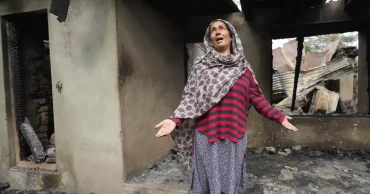
India and Pakistan trade fire and accusations as fears of a wider military confrontation rise
India fired attack drones into Pakistan on Thursday, killing at least two civilians, the Pakistani military said. India, meanwhile, accused its neighbor of attempting its own attack, as tensions soared between the nuclear-armed rivals.
India acknowledged that it targeted Pakistan’s air defense system, and Islamabad said it shot down several of the drones. India said it “neutralized” Pakistan’s attempts to hit military targets. It was not possible to verify all of the claims.
The exchanges came a day after Indian missiles struck several locations in Pakistan, killing 31 civilians, according to Pakistani officials. New Delhi said it was retaliating after gunmen killed more than two dozen people, mostly Hindu tourists, in India-controlled Kashmir last month. India accused Pakistan of being behind the assault. Islamabad denies that.
Both sides have also traded heavy fire across their frontier in disputed Kashmir, and Pakistan claimed it killed scores of Indian soldiers. There was no confirmation from India.
Late Thursday, in Indian-controlled Kashmir, residents of the city of Jammu reported explosions and sirens, followed by a blackout.
India’s Headquarters of the Integrated Defence Staff, a central coordinating arm for all Indian armed forces, said military stations in Jammu, Udhampur and Pathankot were targeted by Pakistan using missiles and drones. It said the attacks were repelled and no casualties were reported.
Shesh Paul Vaid, the region’s former director-general of police, told The Associated Press that the Jammu Airport likely was also under attack and that some of the 50 loud explosions he heard likely were because “our defense system is at work.”
Jammu and Udhampur are close to the Line of Control, the de facto border that divides the Kashmir region between India and Pakistan. Pathankot is in India's Punjab state.
Sirens were also heard in some parts of the region’s main city of Srinagar, residents said. It was followed by a blackout in the city and other parts of the region.
Pakistan's Ministry of Foreign Affairs in a statement rejected the Indian claims that Pakistan launched attacks on Pathankot, Jaisalmer and Srinagar, saying “these claims are entirely unfounded, politically motivated, and part of a reckless propaganda campaign aimed at maligning Pakistan".
Pakistan says it intercepted 25 Indian drones; India claims it neutralised attacks
It added that “such actions not only further endanger regional peace but also reveal a disturbing willingness to exploit misinformation for political and military ends”.
Pakistan's Prime Minister Shehbaz Sharif has vowed to avenge the deaths in India's missile strikes, raising fears that the two countries could be headed toward another all-out conflict. Leaders from both nations face mounting public pressure to show strength and seek revenge, and the heated rhetoric and competing claims could be a response to that pressure.
U.S. Secretary of State Marco Rubio spoke Thursday to the Pakistani prime minister and India's External Affairs Minister Subrahmanyam Jaishankar, urging both sides to de-escalate the situation, the U.S. State Department said.
The relationship between countries has been shaped by conflict and mutual suspicion, most notably in their dispute over Kashmir. They have fought two of their three wars over the Himalayan region, which is split between them and claimed by both in its entirety.
With tensions high, India evacuated thousands of people from villages near the highly militarized frontier in the region. Tens of thousands of people slept in shelters overnight, officials and residents said Thursday.
About 2,000 villagers also fled their homes in Pakistani-administered Kashmir.
Mohammad Iftikhar boarded a vehicle with his family on Thursday as heavy rain lashed the region. “I am helplessly leaving my home for the safety of my children and wife,” he said.
India fires drones at Pakistan
India fired several Israeli-made Harop drones at Pakistan overnight and into Thursday afternoon, according to Pakistani army spokesman Lt. Gen. Ahmad Sharif, who said 29 were shot down. Two civilians were killed and another wounded when debris from a downed drone fell in Sindh province.
Tensions escalate as India, Pakistan exchange drone and missile strikes
One drone damaged a military site near the city of Lahore and wounded four soldiers, and another fell in the garrison city of Rawalpindi, near the capital, according to Sharif. “The armed forces are neutralizing them as we speak,” he told state-run Pakistan Television.
In Lahore, local police official Mohammad Rizwan said a drone was downed near Walton Airport, an airfield in a residential area about 25 kilometers (16 miles) from the border with India that also contains military installations.
India’s Defense Ministry said its armed forces “targeted air defense radars and systems" in several places in Pakistan, including Lahore.
Blackout in Gurdaspur district
New Delhi, meanwhile, accused Pakistan of attempting “to engage a number of military targets” with missiles and drones along the Line of Control that divides Kashmir and elsewhere along their border. “The debris of these attacks is now being recovered from a number of locations,” it said.
At a news briefing, Pakistan’s Foreign Minister Ishaq Dar on Thursday rejected India’s claim that Islamabad carried out any attack in Indian Punjab. “These accusations are an attempt to incite anti-Pakistan sentiment among the Punjabi Sikh population in India,” he said.
Seated alongside Dar, the military spokesperson, Sharif said Pakistan shot down 29 Indian drones after they violated its airspace.
Pakistani Information Minister Attaullah Tarar told parliament that so far Pakistan has not responded to India’s missiles attacks, but there will be one. Later Thursday, Indian authorities ordered a night-time blackout in Punjab’s Gurdaspur district, which borders Pakistan.
The Harop drone, produced by Israel’s IAI, is one of several in India’s inventory, according to the International Institute for Strategic Studies' Military Balance report.
Pakistan claims it destroyed 12 Indian drones
According to IAI, the Harop combines the capabilities of a drone and a missile and can operate at long ranges.
The two sides have also exchanged heavy fire over the past day.
Tarar said that the country’s armed forces have killed 40 to 50 Indian soldiers in the exchanges along the Line of Control. India has not commented on that claim. Earlier, the army said one Indian soldier was killed by shelling Wednesday.
Sikh Temple in Kashmir
Tarar denied Indian accusations that Pakistan had fired missiles toward the Indian city of Amritsar, saying in fact an Indian drone fell in the city. Neither claim could be confirmed.
India’s Foreign Ministry has said that 16 civilians were killed Wednesday during exchanges of fire across the de facto border.
Pakistani officials said six people have been killed near the highly militarized frontier in exchanges of fire over the past day.
Indian Foreign Secretary Vikram Misri denied that New Delhi has targeted civilians and a key dam, as Pakistan has alleged. He, in turn, accused Pakistani forces of targeting civilians, including at a Sikh Temple in Kashmir, where he said three Sikhs were killed.
Flights remained suspended at over two dozen airports across northern and western regions in India, according to travel advisories by multiple airlines. Pakistan resumed flights nationwide after a suspension at four airports, according to the Civil Aviation Authority.
1 year ago
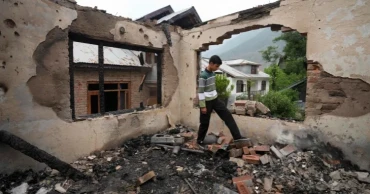
Pakistan says it intercepted 25 Indian drones; India claims it neutralised attacks
Pakistan's military has claimed that it has intercepted 25 Israeli-made Herop drones allegedly launched by India.
In a statement, the Inter-Services Public Relations (ISPR), the army’s media wing, said, “So far, 25 Israeli-made Herop drones have been shot down by the Pakistani military,” citing the use of technical equipment and weapons.
“Debris from Israeli-made Herop drones is being recovered from various areas of Pakistan,” the statement added.
Pakistan shoots down Indian drone in the city of Lahore, officials say
“Pakistan forces are giving a befitting reply to the enemy and are destroying all its intentions,” it concluded.
Meanwhile, a BBC report says India has stated it thwarted Pakistani attempts to target military sites with “drones and missiles” in the northern and western regions during the intervening night of Wednesday and Thursday.
Sources: Al Jazeera and BBC
1 year ago