climb trees
Early human ancestors used their hands to both climb trees and make tools, new study shows
Our hands can tell a great deal about a person’s lifestyle—and the same holds true for our early human ancestors.
Activities like climbing, gripping, or pounding apply pressure to different parts of the fingers, and over time, bones respond to these stresses by thickening in the areas under the most strain.
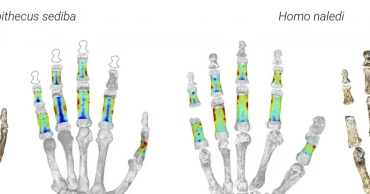
To understand how ancient humans used their hands, researchers used 3D scanning technology to measure and assess the thickness of finger bones.
Their study focused on fossilized hand remains from two early human ancestor species discovered in southern Africa: Australopithecus sediba, who lived roughly 2 million years ago, and Homo naledi, who lived about 300,000 years ago.
Ancient footprints rewrite timeline of land-dwelling animals
Both ancient human species showed signs of simultaneously using their hands to move around – such as by climbing trees – as well as to grasp and manipulate objects, a requirement to being able to make tools.
“They were likely walking on two feet and using their hands to manipulate objects or tools, but also spent time climbing and hanging,” perhaps on trees or cliffs, said study co-author and paleoanthropologist Samar Syeda of the American Museum of Natural History.
The findings show there wasn’t a simple “evolution in hand function where you start off with more ‘ape-like’ and end up more ‘human-like,’” said Smithsonian paleoanthropologist Rick Potts, who was not involved in the study.
Complete fossil hands are relatively rare, but the specimens used in the study gave an opportunity to understand the relative forces on each finger, said Chatham University paleontologist Erin Marie Williams-Hatala, who was not involved in the study.
“Hands are one of the primary ways we engage with world around us,” she said.
10 months ago