Faiz Ahmad Taiyeb
New policy to end 15 years of telecom irregularities: Taiyeb
The interim government is working on a new telecom policy aimed at reforming the sector, ending 15 years of what it termed “fascism,” and ensuring a generational transformation in service delivery, said Faiz Ahmad Taiyeb, Special Assistant to the Chief Adviser on Posts, Telecommunications and ICT.
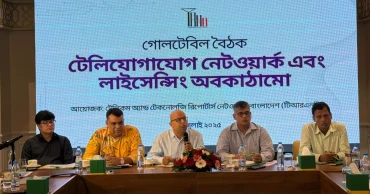
Speaking at a roundtable titled “Telecom Network and Licensing Policy Reform”, organised by the Telecom and Technology Reporters Network, Bangladesh (TRNB) at a hotel in Dhaka on Saturday, Taiyeb said the policy is being shaped to shift from mere connectivity to service-oriented networks.
“The new generation demands a new kind of transformation. That’s why we are preparing a policy focusing on next-generation services. We are clearing out the clutter in the sector—even if it hurts vested interests,” Taiyeb said.
“Logical suggestions will be considered, and the government's positive initiatives should be welcomed,” he added.
Referring to operator profits, he said, “Operators are earning Tk 400 crore in dividends and still express dissatisfaction. It’s time they look out for national interests.”
Taiyeb made it clear that licences will no longer be limited arbitrarily.
Instead, he said, the number will depend on performance and obligations.
Licences issued merely for toll collection in the past will be discontinued, he added, noting that research would determine the optimal number of licences and foreign company representatives must work in the country’s broader interest.
Committed to helping Bangladesh maintain inclusive growth path: WB VP
On improving services, he warned, “Mobile operators must enhance service quality or risk losing customers.”
He also highlighted efforts to free up low-band frequencies and reform the existing telecom ecosystem.
BTRC Chairman Major General (retd) Md Emdad Ul Bari said telecom is a real-time service and any changes must be sustainable.
“With less than 50% of the population using the internet, licence cancellation is not on the table. The policy includes a migration plan, and stakeholder collaboration is essential,” he said.
Posts and Telecommunications Division Secretary Zahurul Islam said the new policy would attract both domestic and foreign investment.
ISPA President Aminul Hakim called for eliminating tax disparity, stating, “ISPs meet 65–70% of the 7.5 terabit demand yet pay 15% tax, while mobile operators with 35% market share pay none.”
AMTOB Secretary General Mohammad Zulfikar, presenting the keynote, said telecom operators are central to the digital economy. “Despite 65 million social media users, 90 million remain unconnected. Rising operating costs, along with investment caps in the proposed policy, are alarming for the sector,” he warned.
The discussion was chaired by TRNB President Samir Kumar Dey, with a welcome speech by General Secretary Masuduzzaman Robin.
Grameenphone CEO and AMTOB President Yasir Azman, Banglalink CEO Johan Buse, Teletalk MD Nurul Mabud, corporate affairs heads from major operators, World Bank consultant Mahtab Uddin Ahmed, and Fiber@Home CIO Suman Ahmed Sabir also spoke at the event.
1 year ago

Starlink begins operations in Bangladesh; lowest package costs Tk 4200
Starlink, a Non-Geostationary Orbit (NGSO) satellite internet provider owned by Elon Musk’s SpaceX, has officially started its operations in Bangladesh.
The announcement was made on Tuesday (20 May) in a Facebook post by Faiz Ahmad Taiyeb, Special Assistant to the Chief Adviser.
“On Monday (19 May) afternoon, they informed me over a phone call and confirmed the matter this morning on their X handle,” he said.
“Initially, Starlink is launching with two packages – Starlink Residence and Residence Lite. The monthly cost is Tk 6,000 for one and Tk 4,200 for the other. A one-time cost of Tk 47,000 will be required for setup equipment,” he added.
Faiz Ahmad also said there will be no speed or data limits. Individuals will be able to use unlimited data at speeds of up to 300 Mbps. Customers in Bangladesh can start placing orders from today.
“With this, Sir’s (CA's) expectation of launching within 90 days has been fulfilled,” he said.
He went on to say, “Although expensive, this creates a sustainable alternative for premium customers to access high-quality and high-speed internet services.”
“In addition, companies will have opportunities to expand their business into areas where fibre or high-speed internet services are yet to reach. NGOs, freelancers, and entrepreneurs will benefit from uninterrupted, high-speed internet throughout the year,” said the Special Assistant to the Chief Adviser.
BTRC issues licenses to Starlink to operate in Bangladesh
The Chief Adviser on Tuesday congratulated all involved as Starlink officially started its operations in Bangladesh, says his Deputy Press Secretary Abul Kalam Azad Majumder.
Prof Yunus on February 14 held an extensive video discussion with Elon Musk, the founder of SpaceX, and owner of Tesla and X, to explore future collaboration and to make further progress to introduce Starlink satellite internet service in Bangladesh.
On April 28, Chief Adviser Prof Yunus officially approved the license for Starlink to begin operations in Bangladesh, marking a significant step towards improving connectivity, especially in remote and underserved areas.
On April 7, Starlink applied to the BTRC for a licence to operate in the country under the regulatory framework titled ‘Guidelines for Non-Geostationary Orbit (NGSO) Satellite Services Operators in Bangladesh’.
CA Prof Yunus approves Starlink’s license to operate in Bangladesh
On March 25, Prof Yunus directed the relevant authorities to ensure the commercial launch of Starlink’s satellite broadband internet service in Bangladesh within 90 days.
In accordance with this guideline, Starlink submitted a formal application along with the applicable fees and required documents.
A decision to issue the license was taken in principle during a meeting of the commission on April 21.
Starlink becomes a new addition to Bangladesh’s internet landscape, marking the country as the second in South Asia—after Sri Lanka—to host services from the global satellite internet provider.
1 year ago