fiscal year 2025–26
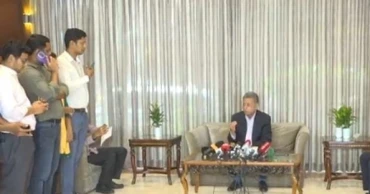
BNP’s Amir Khosru dubs budget unrealistic, disconnected from revenue reality
BNP senior leader Amir Khosru Mahmud Chowdhury on Monday said the proposed budget for the fiscal year 2025–26 would not be very easy to implement as its size is disproportionately large -- much like the traditional budgets of the previous regime—and lacks link with revenue collection.
“The budget should be based on revenue income. The size of the budget should have been smaller. There is no qualitative change in the budget this time, only a slight change in the numbers. So, it will not be very easy for the government to implement this budget,” he said.
Khosru, a BNP Standing Committee member, made the remarks while giving his initial reaction to the proposed budget at a city hotel.
In response to a question on whether the proposed budget is traditional, he said, “I don’t want to use that word. But it has not been able to deviate much from the continuity of the previous government…I think there are fundamental flaws.”
The BNP leader said the budget should focus on increasing revenue to ensure sufficient money flow for the private sector, enhance investment, and reduce both foreign debt and internal borrowing, along with interest rates.
No immediate power price hike, assures Finance Adviser
He said their expectations from the 2025-26 budget are limited since it has been placed by an interim government. “The interim government has various limitations as it is not an elected one.”
Khosru criticised the previous Awami League government for expanding the budget without a corresponding increase in revenue. “The way the previous government increased the size of the budget had no correlation with revenue collection,” he said.
He said when the entire revenue is spent on operating expenses, the government must borrow—either domestically or internationally—to implement development projects.
“The problem is that excessive borrowing, both domestically and externally, increases the debt burden. The people are the ones who have to repay it year after year. Development efforts are hampered due to rising interest obligations,” the BNP leader said.
He also observed that heavy domestic borrowing impacts the entire financial system, pushing up bank interest rates and crowding out private borrowers.
“It also raises the level of internal debt. When the government borrows heavily from within the country, loans for individuals and businesses shrink. As a result, investment is hampered, employment is not generated, and people’s income does not increase. Since the private sector cannot access credit, they are unable to expand existing investments,” Khosru said.
Considering these issues, the size of the budget should have been linked to revenue income. I believe that was not done. The entire revenue will be spent on operating expenses. If we continue to borrow from both domestic and foreign sources, it will inevitably impact the economy. This is crucial—this is the main point,” he said.
Referring to the budgets presented by the previous Awami League government, the BNP leader noted that only minor changes have been made. “There has been a slight variation in the numbers, as has been the case in previous budgets. The core principle remains the same—we are continuing along the same path.”
Khosru said their party will come up with a formal reaction to the budget through a press conference at 11am on Wednesday at the BNP Chairperson’s Gulshan office.
Earlier in the day, Finance Adviser Salehuddin Ahmed unveiled a Tk 790,000 crore national budget for the 2025–26 fiscal year, which begins in July.
Govt moves to cut prices of cancer, other medicines
This is the first time Salehuddin, a former central bank governor, has presented the national budget, as well as the first budget presented by the interim government led by Prof Muhammad Yunus.
1 year ago

No immediate power price hike, assures Finance Adviser
Finance Adviser Salehuddin Ahmed on Monday said the government has decided not to raise electricity prices for the time being to give people relief considering the prevailing high inflation.
“It is very important to ensure adequate supply of energy and at the same time keep it as affordable as possible to improve the quality of life of citizens and keep the economy running. In principle, we have decided not to increase the price of electricity for the time being in the context of the prevailing high inflation,” he said while presenting the national budget for the fiscal year 2025–26.
At present, Salehuddin said, the amount of subsidies given in the power sector is about 1 percent of GDP, which is very high.
To reduce this gradually, he said, a plan has been taken to reduce the overall cost of power generation by 10 percent.
Bangladesh unlikely to get electricity from Rooppur nuke plant before 2026
The adviser said if this plan can be implemented, it is estimated that the cost of electricity subsidy of more than Tk 11,000 crore will be saved.
“We are reviewing the power purchase agreements and have taken the initiative to conduct energy audits to reduce the cost of power generation,” he said.
Salehuddin said a plan has been made to supply 648 million cubic feet of gas from domestic sources within this year and to extract an additional 1500 million cubic feet gas from local wells by 2028.
Bangladesh to receive 40MW electricity from Nepal for 5 months
“Keeping these targets in mind, emphasis has been laid on increasing the capacity of the local gas exploration company BAPEX and necessary funds have been allocated for this,” he said.
1 year ago