Nagorik Coalition
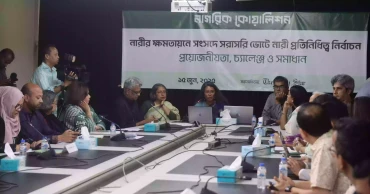
‘Nagorik Coalition’ seeks direct election of women from 100 seats
Nagorik coalition on Sunday called for the direct election of women from at least 100 parliamentary constituencies in the upcoming national election, aiming to ensure greater political empowerment and representation of women.
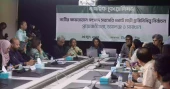
The demand was raised at a press conference titled “Direct Election of Women in Parliament: Necessity, Challenges and Solutions” held at The Daily Star Centre in the capital.
Speakers at the event stressed that alongside national elections, women's representation must also increase in local government bodies.
They underscored the need for greater economic empowerment of women to support this transition.
BNP Organising Secretary Shama Obaid expressed her personal support for the direct election of women but emphasised that the process must be conducted properly.
Promote bamboo as alternative to timber in furniture making: Rizwana
“We use women’s votes in elections, push them to the front lines during movements where they risk being shot. Half of our population is female, yet we fall short when it comes to ensuring their rights,” she said.
Shama added that genuine political will from all parties is essential to enhance female leadership.
She also said that the BNP supports increasing the number of reserved seats to 100 but stressed that women in reserved seats should not feel inferior or sidelined.
Speaking at the event, Shirin Sharmin Haque, head of the Women’s Reform Commission, said expanding the number of seats in Parliament has become a necessity of the time.
She pointed out that to reduce hostility towards women in politics, non-conventional proposals have been made, and their implementation is now more crucial than ever.
“We must not hold women back under any circumstances,” she asserted.
Dr Tasnim Jara, senior joint member secretary of the National Citizen Party (NCP), said she is hopeful that all political parties will reach a consensus to ensure that at least 25 per cent of lawmakers are directly elected women.
“Women must be given a chance to enter Parliament through direct voting. Female candidates face many challenges, and we must find ways to address them,” she said.
She also questioned the frequent scrutiny over the qualifications of female candidates while the same is not asked of their male counterparts, despite women playing vital roles in various sectors, especially in rural areas.
Besides, they called for the introduction of direct election mechanisms to bring more women into Parliament and ensure their rightful place in national decision-making.
10 months ago

Nagorik Coalition terms Yunus-Tareque meeting a ‘hopeful development’
Nagorik Coalition, a platform advocating for democratic reforms in the state structure, has termed the upcoming meeting between Chief Adviser Yunus and BNP’s Acting Chairman Tarique Rahman a “hopeful development” on Wednesday.
In a press release, the platform said that a crisis is deepening due to the firm stance of the BNP and several other political parties against the proposed roadmap for April elections and their demand for polls to be held in December.
“This political deadlock is expected to escalate further after the Eid holidays,” it warned.
It added that there are clear signs of conspiracies, both domestic and international, being orchestrated to destabilise Bangladesh.
All eyes now on Prof Yunus-Tarique talks amid strained BNP-govt ties
Against this backdrop, the Nagorik Coalition described the upcoming June 13 meeting in London between Yunus and Tarique as “a very hopeful development amid the current political impasse.”
The platform said it hopes their proposed ‘7/2’ constitutional reform agenda to feature prominently in the discussion, the reforms aim to prevent constitutional authoritarianism and ensure neutrality in appointments, along with establishing institutional checks and balances in power.
Key elements of the proposal include, adopting the July Charter as a foundation for political consensus, allocating seats in the upper house through proportional representation, ensuring impartiality in constitutional appointments, reinstating the caretaker government system, and electing women’s reserved seats through direct voting.
The platform further stated that neither December nor April is a practical timeframe for holding the next national election.
“Reaching consensus, enacting legal reforms, and preparing for elections within December would be highly challenging,” it said, “while holding elections in April would discourage elderly and ill voters due to extreme heat.”
It further mentioned that nationwide election-related activities and campaigning during the scorching Ramadan period would be difficult for political parties and government officials alike.
Additionally, the schedule would clash with the country’s key public examinations—SSC and HSC—posing serious obstacles to a fair electoral process.
Despite these constraints, the government has yet to explain why it proposed April as the election timeline, the coalition said.
Even if election dates are set for the first half of April, there has been no announcement on when or how the key reform and election-related steps will be implemented, it added.
It warned that any delay in executing these phases could ultimately push back the proposed April election as well.
10 months ago