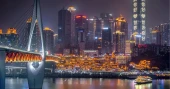
Chinese Megacity Chongqing
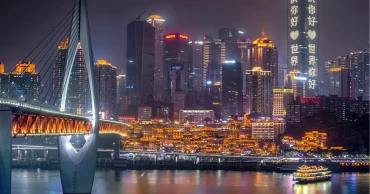
Chongqing, The 3D City: Chinese Megacity Looking Like AI-Generated
Often mistaken for scenes from a sci-fi simulation, Chongqing, a Chinese Megacity, stirs curiosity with its dramatic cityscapes. Rarely found on typical tourist routes, this sprawling urban area rises in layers, sparking comparisons to a real-world cyberpunk dream. Its towering structures, elevated highways, and surreal angles give it an almost AI-generated look. Let’s take a closer look at this enigmatic city, uncovering the layers of its futuristic vision.
A Rich Urban Profile in Global Tourists’ Blind Spot
Tucked in southeast China near the upper reaches of the Yangtze River, Chongqing emerges as a staggering urban force. With a population of over 32 million, it holds the title of the world’s largest city by population. Its footprint spans more than 31,800 square miles, comparable in size to an entire European country like Austria.
Yet, despite its immense scale and significance, Chongqing remains a hidden gem on the global tourist map. Few international visitors set foot in this colossal city, even though its geography is breathtaking by all means. Towering mountains, steep valleys, and buildings perched along cliffs define its dramatic terrain.
As a major economic and transport hub of China, Chongqing defies conventional urban planning. Roads twist through vertical landscapes. Highways loop over rooftops. Entire metro lines cut directly through residential towers. In recent years, these surreal visuals have captivated social media, leaving many to wonder whether this is an AI-generated city.
Read more: Wales’s Stream in the Sky: World’s Tallest Navigable Aqueduct Pontcysyllte
History from Ancient Roots to Rapid Rise
Chongqing’s roots run deep, with a history that spans more than 3,000 years. For much of that time, it remained a modest riverside settlement. But its transformation over the past four decades has been nothing short of extraordinary.
Just 40 years ago, Chongqing was still a village in many parts. What now rises as a sprawling megacity has been built almost entirely within the last 30 years. Its rapid vertical expansion is a modern marvel.
During the Second World War, the city served as a key base, and traces of that era still linger. Scattered beneath the surface are old wartime bunkers, once shelters from bombing raids. Today, many of them have been creatively repurposed into lively hotpot restaurants and atmospheric underground bars.
Multi-layer City Architecture
Often described as a city built in three dimensions, Chongqing earns that reputation with striking justification. Its layered urban layout can be disorienting, even for the most seasoned travelers. Visitors regularly emerge from stairwells only to find themselves on rooftops or staring down into deep valleys. Nothing here feels level. Gravity itself seems negotiable.
Read more: Smiling Quokka Turned Rottnest Island into a Global Tourist Hotspot
Set against the striking meeting point of the Yangtze and Jialing Rivers, the city clings to a landscape of jagged cliffs and steep mountainsides. Homes rest on bridges. Neighbourhoods stack one atop another. Metro lines cut through skyscrapers as if tunnelling through rock. It’s a vertical maze, engineered with remarkable ambition.
The skyline speaks volumes. Chongqing is home to 298 skyscrapers soaring over 100 metres and 26 that breach the 200-metre mark. That places it among the world’s top cities for high-rises and sixth within mainland China.
For tourists, this surreal, sky-layered cityscape feels like something out of science fiction. But for many residents, especially those in the lower reaches, living in the shadows is a daily reality. In some corners of Chongqing, sunlight doesn’t pour in. It peeks through momentarily before vanishing behind concrete giants.
Read more: UNESCO World Heritage Sites in Bangladesh
1 year ago