National Consensus Commission-Bangladesh
Reform Talks: Bangladesh’s political parties agree on EC’s appointment process
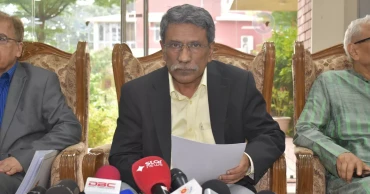
Political parties on Wednesday reached a consensus to incorporate a provision in the Constitution for forming a selection committee to nominate the Chief Election Commissioner and other election commissioners during the reconstitution of the Election Commission.
The agreement came during the 18th day of the second-round dialogue between the National Consensus Commission and the political parties at the Foreign Service Academy in the capital on Wednesday.
“Political parties and alliances have reached a consensus to include a provision in the constitution to form a specific committee for nominations to the Election Commission. The Jatiya Sangsad Speaker will lead this selection committee,” said NCC Vice Chair Prof Ali Riaz while briefing reporters after the day’s session.
He said there has been agreement to amend several sub-sections of Article-118 of the Constitution.
According to the agreed proposal, there will be an election commission consisting of the Chief Election Commissioner and election commissioners (number to be determined by law). A five-member selection committee headed by the Speaker will be formed for nominations to the Election Commission. Other members of the selection committee are the Prime Minister, the Opposition Leader, Deputy Speaker (from the opposition party) and a judge of the Appellate Division to be nominated by the Chief Justice.
The selection committee shall start searching names for the EC’s reconstitution 90 days before the expiry of the current commission. The qualification and disqualification for CEC and other commissioners as well as the searching procedure will be determined by a law.
NCC begins reform talks with political parties
Based on a consensus, the committee shall recommend one name each for the posts of the CEC and commissioners to the President who will then make the formal appointments for a five-year term. The office of Speaker shall provide secretariat assistance to the committee.
On Wednesday, the appointment process of some important constitutional and statutory institutions – Election Commission (EC), Public Service Commission (PSC), Comptroller and Auditor General (CAG), Anti-Corruption Commission (ACC), and the Office of the Ombudsman—were discussed. “Today (Wednesday), the discussion over the Election Commission completed,” said Prof Riaz.
“Different political parties have shown significant flexibility from their earlier positions to reach this consensus today. This will pave the way for establishing an independent and effective Election Commission,” he said, extending sincere thanks to all the political parties for their responsible stance.
Describing Wednesday’s discussions as highly fruitful, the NCC vice chair expressed optimism that the National Charter could be finalised by the end of this July.
“We will continue our efforts and are optimistic that we will soon reach a complete national charter (reform charter) based on political consensus,” said Prof Riaz.
1 year ago

Reform dialogue: Consensus reached on curbing abuse of emergency promulgation
Political parties on Sunday reached a consensus over a proposal to change the emergency promulgation provision of the Constitution in a bid to prevent its misuse, according to a participant.
The agreement came on the 12th day of the second-round reform dialogue of the National Consensus Commission with the political parties at the Foreign Service Academy in Dhaka.
“A consensus has been reached on the emergency promulgation issue today,” Saiful Huq, general secretary of Revolutionary Workers Party of Bangladesh (RWPB) told UNB after emerging from the discussion.
The Article 141(A) of the Constitution currently states that If the President is satisfied that a grave emergency exists in which the security or economic life of Bangladesh, or any part thereof, is threatened by war or external aggression or internal disturbance, he may issue a Proclamation of Emergency [for one hundred twenty days]. But provided that such Proclamation shall require for its validity the prior counter signature of the Prime Minister.
Consensus Commission holds meeting with EC
According to the new proposal, the Proclamation of Emergency can be issued for 90 days and ‘internal disturbance’ will be replaced by the threats towards independence, sovereignty and integration of the State.
But such Proclamation shall require for its validity the prior approval of the Cabinet.
The leader of the opposition or in his/her absence, the deputy leader of the opposition shall be invited to the Cabinet meeting to be held to endorse the decision to declare the emergency, said the proposal.
The state of emergency can be extended for 30 days after the first 90 days, said Abul Hasan Rubel, executive coordinator of Ganasamhati Andolon, who also attended the meeting.
During the emergency, two rights of any citizen shall not be undermined. These are – right to life: and right to protection from persecution, cruel, inhumane or defamatory behaviour or punishment.
1 year ago
Riaz urges political parties to show flexibility to ease July Charter talks
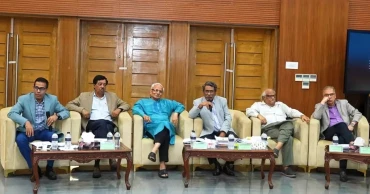
Vice-chair of the National Consensus Commission Professor Ali Riaz on Sunday urged political parties to demonstrate greater flexibility and compromise to help ease the finalisation of the July Charter.
“This dialogue has given political parties an opportunity to come closer. We have observed this progress,” Riaz said while inaugurating Sunday’s session between political parties and the Commission at the Foreign Service Academy in the capital.
He added, “From the standpoint you have started, some level of concession will be necessary. In considering these concessions, speak to your own policymakers.”
Ali Riaz said certain key issues remain unresolved from the past days of discussion. “Among these are the formation of an upper house of parliament, women's representation, and the establishment of a National Constitutional Council,” he said.
Over the weekend, he said, several political parties reached out to the Commission — and the Commission to them — expressing a willingness to consult their leadership on issues like the upper house.
5 secretaries, Grade-1 official sent into forced retirement
“The Commission also believes they need to hold internal meetings. For this reason, we have decided to defer discussions on these issues and reconvene two days later,” Ali Riaz added.
On Sunday, the Commission planned to focus discussions on the Prime Minister’s tenure, the core principles of the Constitution, and the delimitation of electoral constituencies.
Calling for empathy and realism from the political parties, Ali Riaz said, “Consider the context. We are here today because of a difficult situation — 16 years of conflict, the sacrifice of nearly a thousand lives, countless cases of enforced disappearance. Many remain missing to this day. These are your activists, your sons. We are only able to sit here today because of them.”
“In this light, we must reflect on where agreement is possible and how far we can go. It’s important to consider the space for compromise. I request you to move closer to that space, only then will the July Charter become easier to finalise,” he said.
Others present at the meeting included Abdul Muyeed Chowdhury, head of the Public Administration Reform Commission; Safar Raj Hossain, chief of the Police Reform Commission; Badiul Alam Majumdar, chief of the Electoral Reform Commission; Justice Emdadul Haque, head of the Judicial Reform Commission; and Iftekharuzzaman, chief of the Anti-Corruption Commission Reform Committee.
1 year ago
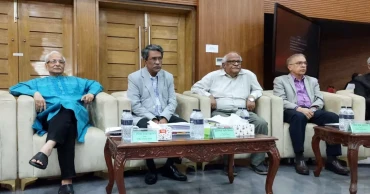
Consensus Commission’s Sunday session kicks off
After a two-day break, the second phase of discussions between political parties and the National Consensus Commission resumed on Sunday morning.
Representatives from various political parties, including the BNP and Jamaat-e-Islami, took part in the dialogue which began at 11:20am at the Foreign Service Academy in Dhaka with Professor Dr Ali Riaz, the Commission’s Vice President, in the chair.
According to the organisers, the session aims to conclude discussions left unfinished in earlier rounds.
Budget utilisation in social protection sees steady growth: Report
Alongside Ali Riaz and other members of the Consensus Commission are present at the talks.
They include Abdul Muyeed Chowdhury, head of the Public Administration Reform Commission; Safar Raj Hossain, chief of the Police Reform Commission; Badiul Alam Majumdar, head of the Electoral Reform Commission; Justice Emdadul Haque, chief of the Judiciary Reform Commission; and Iftekharuzzaman, head of the Anti-Corruption Commission Reform body.
Despite the ongoing sessions, political parties have yet to reach a common ground on key issues such as the distribution of seats in a proposed Upper House of Parliament and the formation of a National Constitutional Council (NCC).
1 year ago