Bangladesh-Automobile Sector
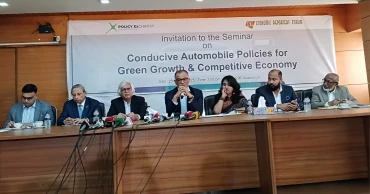
Bangladesh's automobile sector faces headwinds amidst economic shifts and policy gaps: Speakers at a seminar
Speakers at a seminar on Tuesday highlighted that Bangladesh’s automobile sector is navigating a complex landscape marked by declining vehicle registrations, high import costs, and significant public transport deficiencies.
They emphasised balancing foreign exchange pressure with growing private and trade demand necessitates an efficient mix of reconditioned and new automobiles, supported by a coherent national policy framework that prioritises safety, environmental sustainability, and economic efficiency.
The speakers made the remarks at a seminar on ‘Conductive Automobile Policies for Green Growth & Competitive Economy’, held at the auditorium of Economic Reporters’ Forum (ERF) in Paltan, Dhaka on Wednesday. The ERF and think tank ‘Policy Exchange Bangladesh’ jointly organised the seminar.
M. Masrur Reaz, chairman and CEO of Policy Exchange in a presentation on the automobile sector, highlighted critical challenges and offered policy considerations for fostering a vibrant and sustainable automotive industry.
Commerce Adviser Sheikh Bashir Uddin was present in the seminar as the chief guest.
President of Bangladesh Reconditioned Vehicles Importers and Dealers Association (BARVIDA) Abdul Haque, President of Bangladesh Chamber of Industries (BCI) Anwar-Ul-Alam Chowdhury (Parvez), Chairman of Uttara Motors Motiur Rahman, former president of Dhaka Chamber of Commerce and Industries (DCCI) Rizwan Rahman, among other spoke in the seminar as panel discussant.
Adviser Sheikh Bashir emphasised policy diversifications in transport sector so that the nation come out from the state-run criminal activities that happened in last 16 years.
“Unnecessary big infrastructures have been made; some of projects are half done, but the state has to bear huge spending burden of these projects. To save the state from such ambitious plan, these projects should demolish spending the state money,” commerce adviser said this from his own (not a government policy) opinion.
Giving an example, he said that there are US$27 billion freight fare trading happening centering Bangladesh, but Bangladeshi businesses are contributing only $1 billion in this sector, despite immense opportunities.
Like this, automobile sector also import dependent, there is no stable policy to grow own environment friendly and low energy consumed automobiles industry here, said Adviser Sheikh Bashir.
Masrur Reaz underscored in the presentation that the automobile sectors profound impact on national priorities, including standard of living, public and labor mobility, macroeconomic stability (particularly foreign exchange reserves), trade logistics, and environmental protection.
However, recent trends paint a challenging image, such as:
Declining Registrations and Rising Costs:
Private passenger car registrations have seen a sharp decline, plummeting by 37 percent from a peak of 16,695 units in 2022 to just 10,499 in 2024. Overall vehicle registrations hit a decade low in 2024, reflecting a 15 percent drop from the previous year and a staggering 47 percent decrease since 2022.
This downturn is attributed to high dollar prices, a persistent forex crisis, macroeconomic instability, increased import duties, and political uncertainties.
Backed by IMF, remittances, Bangladesh’s Forex reserves hit $27.3 billion
Motor vehicle import payments also fell by 29 percent from FY21 to FY24, further indicating the impact of forex constraints and weakened consumer demand. Despite this, reconditioned vehicle imports saw an 8.6 percent increase in year-on-year in FY2023-24, largely due to a 30-35 percent surge in car prices driven by currency depreciation.
The government's revenue from imports, however, saw a slight increase to Tk 4,114.61 crore in FY24.
The Shift to Private Transport and its Implications:
The report noted a significant shift towards private transportation, especially motorcycles, driven by economic growth and the perceived poor quality and inconvenience of public transport. While public transport growth previously followed a style inverted U-curve (increasing with income then declining post-2018), private transport shows a continuous linear increase with income, indicating a sustained consumer preference for personal mobility.
This surge in private vehicle demand, however, has macroeconomic and environmental implications. The transport sector contributed 14 percent of Bangladesh’s fuel combustion greenhouse gas emissions in 2020 (84 million tons), with road transport accounting for 75 percent of these emissions.
Furthermore, PM2.5 air pollution remains a major health risk, with Dhaka's average significantly exceeding WHO guidelines. Road transport contributes to a considerable portion of PM2.5-related diseases and premature deaths.
Challenges in Policy and Infrastructure:
Several broad issues impede the automobile sector's growth. Bangladesh lacks a comprehensive national ‘Motor Vehicle Policy’. The sector is heavily import-oriented, with over 70 percent of vehicles being reconditioned cars from Japan, and local manufacturing largely limited to CKD component assembly.
The country imposes one of the highest tax burdens on imports, with high supplementary duties creating distortions and discouraging efficiency. Tariff differentials between Completely Knocked Down (CKD) and Completely Built Units (CBU) are notably high (32 percent for small cars, 70 percent for large cars), favoring minimal local value addition. Policy inconsistencies and frequent changes also deter long-term foreign investment.
Moreover, weak regulatory control, coupled with inadequate urban and economic planning, contributes to congestion and fails to effectively manage private car growth.
Recommendations for a Sustainable Future:
The Policy Exchange Bangladesh report advocates for key policy considerations to address these challenges. It suggests that import criteria should prioritize vehicle standards (e.g., emissions, road safety) over age, noting that Bangladesh's five-year import limit for used vehicles is among the strictest globally.
Relaxing this limit to, for instance, 10 years, could significantly reduce import payments and improve affordability.
The report highlights the technical and economic merits of Japanese reconditioned vehicles, emphasising their long lifespan, high resale value, durability, fuel efficiency, and environmental friendliness. Increasing depreciation facilities for reconditioned vehicles from 35 percent to 50 percent in the upcoming budget is also proposed to offset high import costs due to Taka devaluation.
Ultimately, balancing foreign exchange pressure with growing private and trade demand necessitates an efficient mix of reconditioned and new automobiles, supported by a coherent national policy framework that prioritizes safety, environmental sustainability, and economic efficiency.
11 months ago